Agentic Posture Management: Getting Started
A practical path from discovering agents on your endpoints to identity, policy, and audit, sized for a 30-day pilot.

Key takeaways
- Treat agentic posture as a continuous view of the agents, tools, and identities running in your environment, and extend it beyond a one-time model audit.
- Start with discovery on the endpoint, because you can't scope or score agents you don't know exist.
- Give each agent its own identity, with short-lived credentials and scoped tools, and assign an accountable human owner.
- Sort tool actions into read, write, and execute. Set allow, block, or human approval for each, and turn on audit from day one.
- Pilot on your riskiest workflow before you build a complete inventory.
- Keep cloud security posture management (CSPM) and data security posture management (DSPM) for the infrastructure you host.
If you're a security or IT leader, you've probably seen AI agents arrive before the program to govern them. Developers installed "Model Context Protocol" (MCP) servers, and teams added "skills" and "hooks" to their coding tools. Browser extensions also began acting on people's behalf. Most posture tools weren't designed to see any of that.
You can start small, though. Agentic posture management begins with a live inventory of the agents running on your endpoints. Identity, policy, and audit come after it, and each gets easier once you can see the agents you're governing.
What agentic posture management covers
We define agentic posture management as continuous discovery, assessment, and remediation of risk from agents and their tools. This is our own working definition, not an industry standard. A working definition still helps, because it gives your team one shared scope to argue with and refine.
It follows the form of AI security posture management (AI-SPM), which we describe as continuous discovery, assessment, and remediation of AI risk across what an organization builds and runs. That approach has limits, because AI-SPM misses much of how AI is actually used. The agentic version narrows the focus to agents, MCP servers, skills, hooks, and extensions, and to the identities and permissions behind them.
Your vantage point determines which risks you find. A model-only approach evaluates the safety of a given model. A usage-first approach examines how people and agents use AI day to day, which is the premise of usage-first AI security posture management. A common pattern we see is that the usage question comes up after an incident, so it's a sound place to build.
We see this as a complement to CSPM and DSPM. Those tools still cover the infrastructure and data stores you build and host. Agentic posture sits beside them and covers agent use on the devices where work happens.
The approach has one limit. Agents that run outside managed endpoints, such as server-side agent platforms, software-as-a-service (SaaS) embedded copilots, and unmanaged devices, fall outside an endpoint-based inventory.
A developer who connects an MCP server to a coding assistant is a good first example. No cloud misconfiguration exists and no dataset moved, yet the assistant can now call tools that touch internal systems. Classic posture tools often won't flag it, but a usage-first view will. That makes your scope one sentence: usage and agent posture alongside CSPM, DSPM, and model posture.
Start with a live inventory of agents on your endpoints
Discovery comes first because the later controls depend on it. You can't assign an owner, score a risk, or write a policy for an agent that isn't on any list. In our experience, the first inventory surprises teams, because agents arrive through personal installs and small experiments instead of procurement.
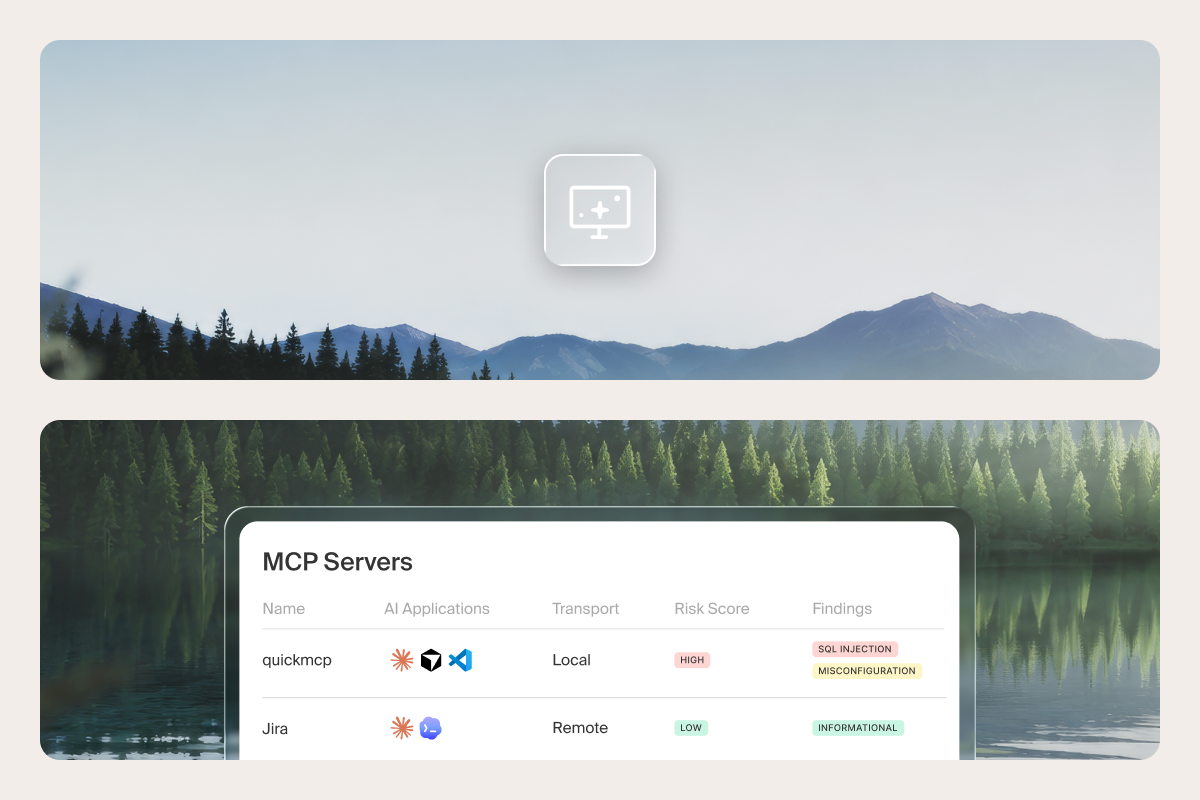
We'd start the inventory with agents, MCP servers, skills, and browser extensions, and then add hooks, integrated development environment (IDE) extensions, and code packages. Our Agentic Endpoint Posture capability keeps a live inventory of every AI asset on the device. It runs in Island Desktop and builds on "Device Query."
Our own threat research supports scoring each item, in addition to listing it. In that research, we analyzed 33,563 public MCP servers and 475,865 tools. About 1 in 8 of those nearly 34,000 servers exposed a tool that can execute code or take an irreversible action on the first call. Many servers in your inventory won't be dangerous. A risk score shows you which ones are, and a flat list can't.
Say an engineer installs a community MCP server to speed up ticket triage. If discovery shows the server can run shell commands, you have a concrete reason to review it. If it only reads public documentation, you can leave it alone. Once discovery has run across a pilot group, pick a risk-score threshold above which an item gets removed or reviewed.
Treat each agent as an identity
Once you can see agents, you need to know which identity each one acts under. Many agents run on a developer's own token or a long-lived application programming interface (API) key, so their actions look like the human's actions in your logs. That makes investigations slow and least privilege hard to apply.
We think agents belong in your posture program as identities, each with scoped tools, short-lived credentials, and an audit record of its actions. This lines up with the risks in the Open Worldwide Application Security Project (OWASP) Top 10 for agentic applications. As we read it, the list includes tool misuse and identity and privilege abuse. The two risks are close cousins, because an agent with broad standing access can misuse tools at a scale a person rarely would.
The Agentic Identity capability issues "just-in-time" credentials, so an agent gets access for one task and loses it afterward. A credential alone isn't enough, so we pair least privilege with "least agency," which is how you govern the action, not just the key. Least agency limits the actions an agent may take and the systems it may reach. The approach also adds human approval for risky steps and one audit trail.
A support agent that reads a customer record and drafts a reply shows how this works. It doesn't need write access to the billing system, and it doesn't need that record tomorrow. We'd replace its standing keys with scoped, just-in-time credentials and assign an accountable human owner, so a specific person answers when something goes wrong.
Enforce policy at the point of action
Identity tells you which agent is acting, and policy sets the actions it may take right now. We'd make that decision at the moment of the action instead of at install time. An approved tool can still be used in a risky way, and a blocked-tool list goes stale as new tools appear.
We built AI Runtime Protection around that idea, with controls for tools, MCP servers, and skills by scenario, user, group, and device posture. Prompt-level filtering covers only the instructions an agent receives, and the damage happens when the agent acts, which is why governing what agents do matters more than filtering prompts.
Start by sorting tool actions into read, write, and execute. You can usually allow reads against low-sensitivity data. Writes to shared systems often deserve a closer look, and you can send anything that executes code or can't be undone to human approval. Code-executing and irreversible tools are the category we flagged earlier.
Consider a developer whose assistant wants to run a deployment command. You can allow it on a managed device with a healthy posture, require approval on an unmanaged device, and block it for a contractor group. Turn on audit at the same time, because a policy you can't prove was enforced is hard to defend later.
A 30-day plan for getting started
The sequencing below is our own synthesis of the steps above, not a published benchmark. It reflects the order we'd follow, and you should adjust it to your environment.
In week one, assign owners. Usage posture tends to fall between end-user computing, data security, and identity, so it often has no owner by default. Put one person from each group in the room and agree on the owner of each decision.
In weeks one and two, run discovery on a pilot group and score the agents you find. In week three, move your highest-risk agents onto scoped, short-lived credentials. In week four, turn on policy and audit for the riskiest workflow. We'd pick the agent that touches your most sensitive data or can take the most irreversible action. Start there instead of waiting for a complete inventory.
By day 30, you won't have finished, but you'll have an inventory, an accountable owner for each agent in scope, one governed workflow, and an audit trail. That gives your leadership a concrete result and gives you a basis for deciding where to expand next. Island Enterprise AI fits these pieces together, with AI Protect for visibility, control, and data protection across AI entry points. That gives you a clear first step: one risky workflow, one owner, and discovery on the devices it touches.
FAQs
What is agentic posture management?
It's the continuous discovery, assessment, and remediation of risk from agents and their tools, including MCP servers, skills, hooks, and extensions. It also covers the identities and permissions behind them. If you're new to the idea, a usage-first view of AI security posture management is the place to start.
How is it different from CSPM and DSPM?
CSPM and DSPM cover the cloud infrastructure and data stores you build and host, and you'll still need them. Agentic posture covers agent use on the devices where work happens, so you can add it beside your existing tools.
What should an agent inventory include?
Begin with agents, MCP servers, skills, and browser extensions, and then add hooks, IDE extensions, and code packages. On the device, Agentic Endpoint Posture inventories those items. Score each item so you can set a threshold for removal or review, since a flat list won't show which items matter.
Who should own an agentic posture program?
Pick one person from end-user computing, data security, and identity in week one, and agree on the owner of each decision. Then assign an accountable human owner to every agent in scope.
Do we need to replace our existing credentials and identity and access management (IAM) setup?
You don't necessarily have to replace them. The goal is to move agents off standing keys and a developer's own token. Move your highest-risk agents to scoped, just-in-time credentials first, using something like Agentic Identity. Then limit the actions the agent may take, so that you govern the action, not just the key.
Which tool actions need human approval?
Anything that executes code or can't be undone is a good candidate for approval, and writes to shared systems deserve review. With AI Runtime Protection, you can apply those decisions by scenario, user, group, and device posture and log each one from the start.
Do we need a complete inventory before we turn on policy?
No. We'd pilot on the one workflow where an agent touches your most sensitive data or can take the most irreversible action. Run discovery on the devices it touches, put policy and audit around it, and expand from there.

Island is defining the future of work for people and AI agents. Its enterprise agentic control plane helps organizations enable, govern, and audit agentic workforces alongside people. Island boosts productivity across devices, browsers, applications, networks, and data while protecting sensitive information, simplifying access, and helping enterprises scale AI safely.