Agentic attack frameworks go after the apps nobody is watching
The FBI sent out a bulletin urging companies to take sites offline because of AI attacks. What now?

On November 13, 2026, the FBI published a FLASH advisory on ARTEX, an open-source penetration testing framework that threat actors have turned into an intrusion tool. ARTEX runs on large language models (LLMs) and splits an operation across specialized agents that handle reconnaissance, exploitation, privilege escalation, and data collection with little human direction. The FBI reports some intrusions moving from first targeting to privileged access in under three hours.
The advisory also shows where those agents aim. ARTEX does its best work against peripheral systems - partner and supplier portals, employee apps, sales-support tools, legacy services, third-party integrations, and apps built inside individual business units. Many of these sit on the internet because nobody moved them, and an agent can enumerate them faster than a security team can inventory them.
Most of what ARTEX exploits lives in application code and cloud configuration. SQL injection, XML external entity (XXE) flaws, unsigned Security Assertion Markup Language (SAML) assertions, Kerberoasting, and secrets left in JavaScript bundles all need fixes in the application, the directory, or the cloud account, and Island does not patch them. Four of the FBI's recommendations do land on Island, starting with the one at the center of the advisory.
Take internal apps off the internet
The FBI's first recommendations are to inventory every internet-facing application, restrict administration and publishing interfaces to dedicated paths, and move enterprise apps behind Zero Trust access to remove their external exposure.
Island Private Access (IPA) handles that last step. Lightweight connectors deployed inside the private network make an outbound connection to Island's cloud, so the application never accepts an inbound connection from the internet. Island decides access per session and per application, based on user identity and device posture. Island Private Access 360 (IPA 360) applies the same policy to native clients, Secure Shell (SSH), Remote Desktop Protocol (RDP), and other ports and protocols through Island Desktop.
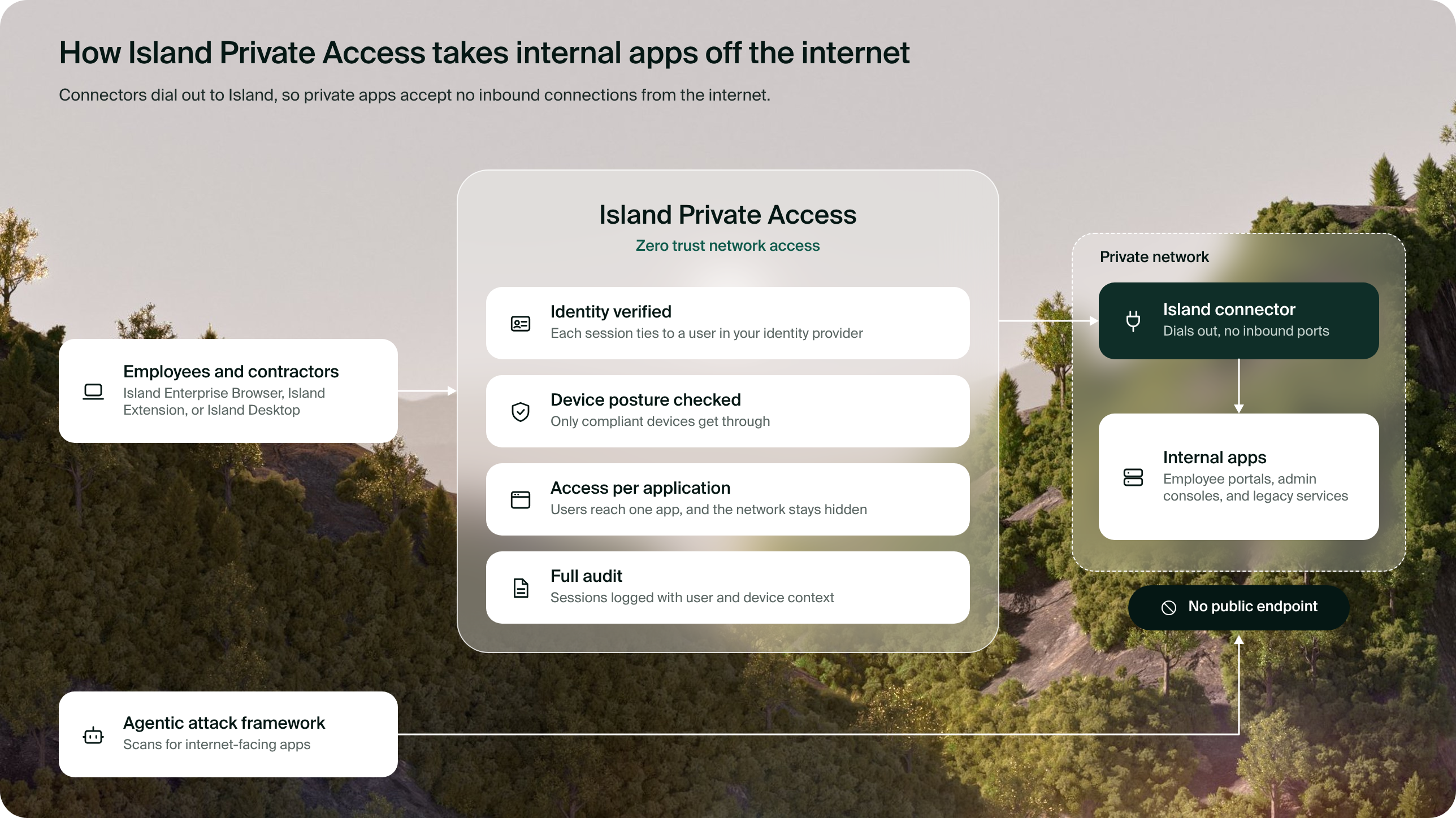
An employee portal reachable only through Island Private Access has no public endpoint, so a directory fuzzing sweep finds nothing to answer it. The advisory also lists stolen virtual private network (VPN) configurations among ARTEX's initial access methods, and per-application access in place of broad VPN access closes that path as well.
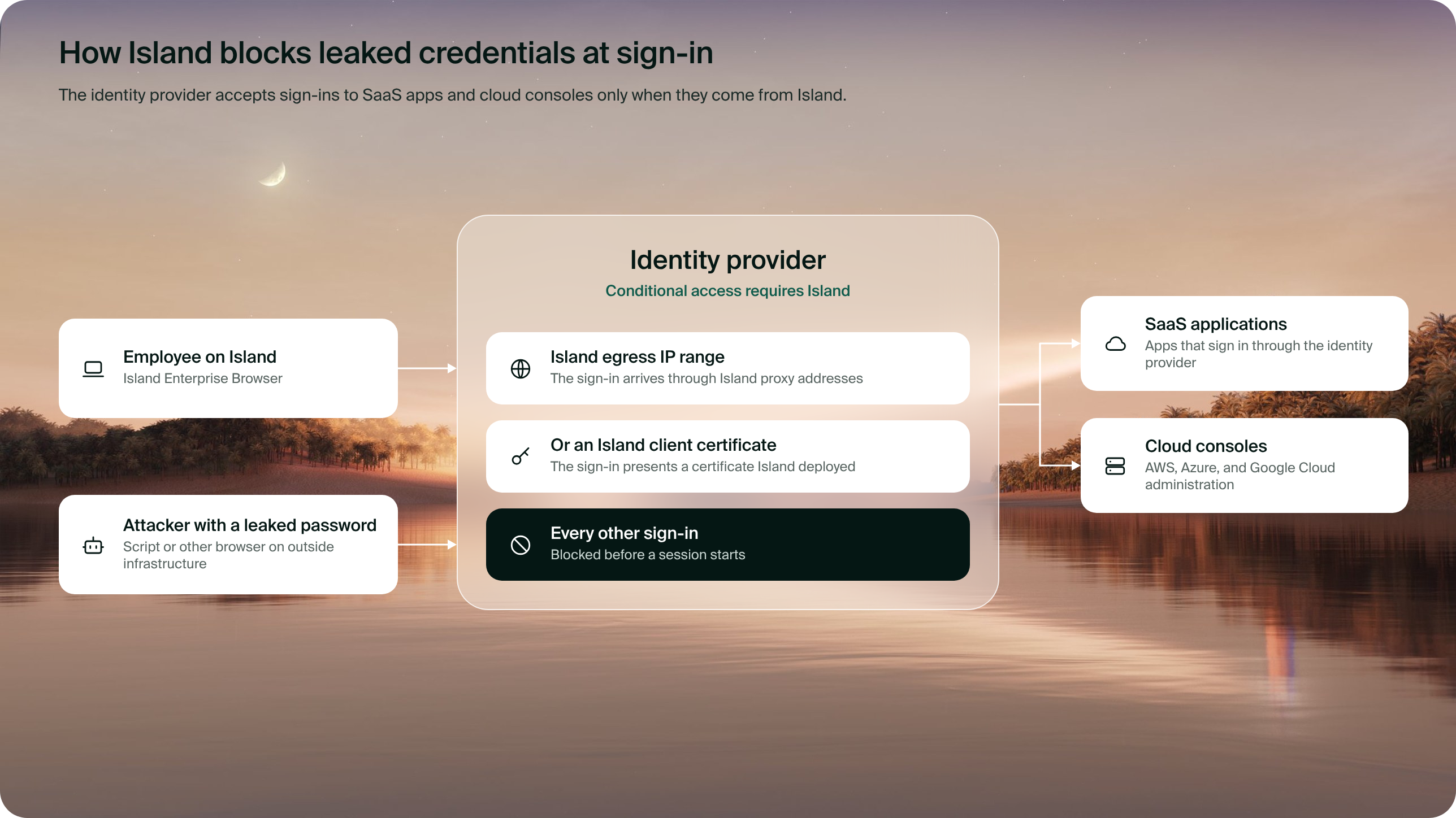
Cloud consoles and software as a service (SaaS) applications cannot sit behind a connector, because the provider hosts them. For those, the identity provider can require that every sign-in comes from Island, and it verifies each one by Island's egress IP range or a client certificate. The advisory lists leaked credentials and weak administrative passwords among ARTEX's ways in, and a password replayed from attacker infrastructure fails that check. The control covers people who sign in through the identity provider. Service principals and API keys never open a browser, so this control does not reach them.
Apps that customers or the public must reach stay public, and their defenses belong to the application. The case is strongest for the long list of apps whose only audience is internal.
Give partners access to apps instead of trust paths
In the campaigns the FBI documents, ARTEX pivoted through compromised vendor credentials and trusted business-to-business federation. A partner identity with standing network or tenant trust gives an agent a route from a weaker supplier into the enterprise.
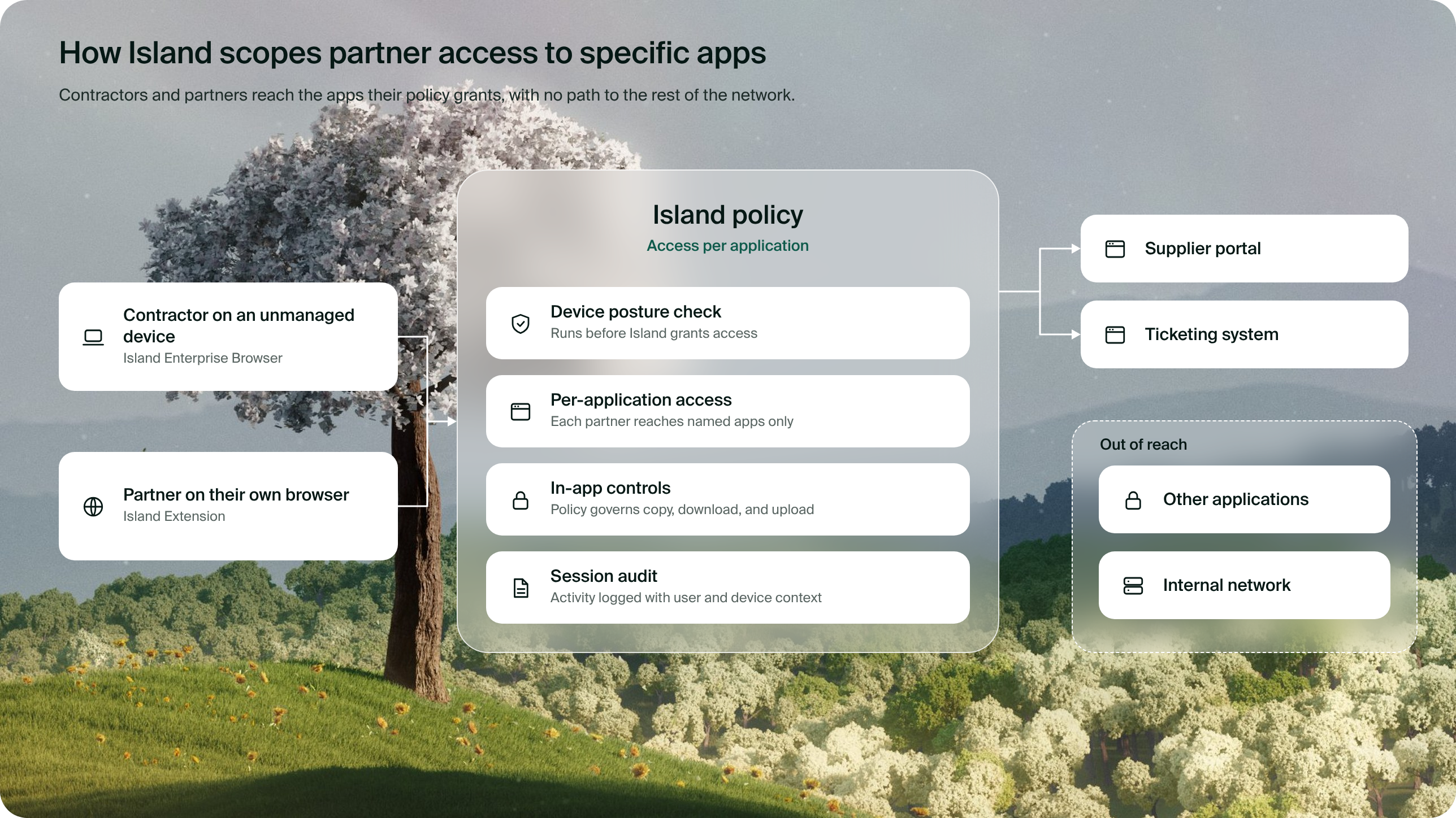
Island gives contractors and partners access to specific applications through the Island Enterprise Browser or Island Extension. Island checks device posture before it grants access, and policy governs what each person can do inside each app. A compromised partner account reaches only the apps its policy grants, under the same controls and audit as every other user. Trust between cloud tenants is a separate problem, and the fix belongs in cloud identity and access management (IAM).
Find the non-human identities ARTEX abused
Much of the activity in the advisory runs through credentials that belong to software: shared access signature tokens, service principals, storage account keys, OAuth apps with newly added credentials, and an administrator token forged from a key nobody rotated. The FBI asks defenders to monitor credential additions, privilege assignments, and app-only activity, and to apply least privilege to multi-tenant app permissions.
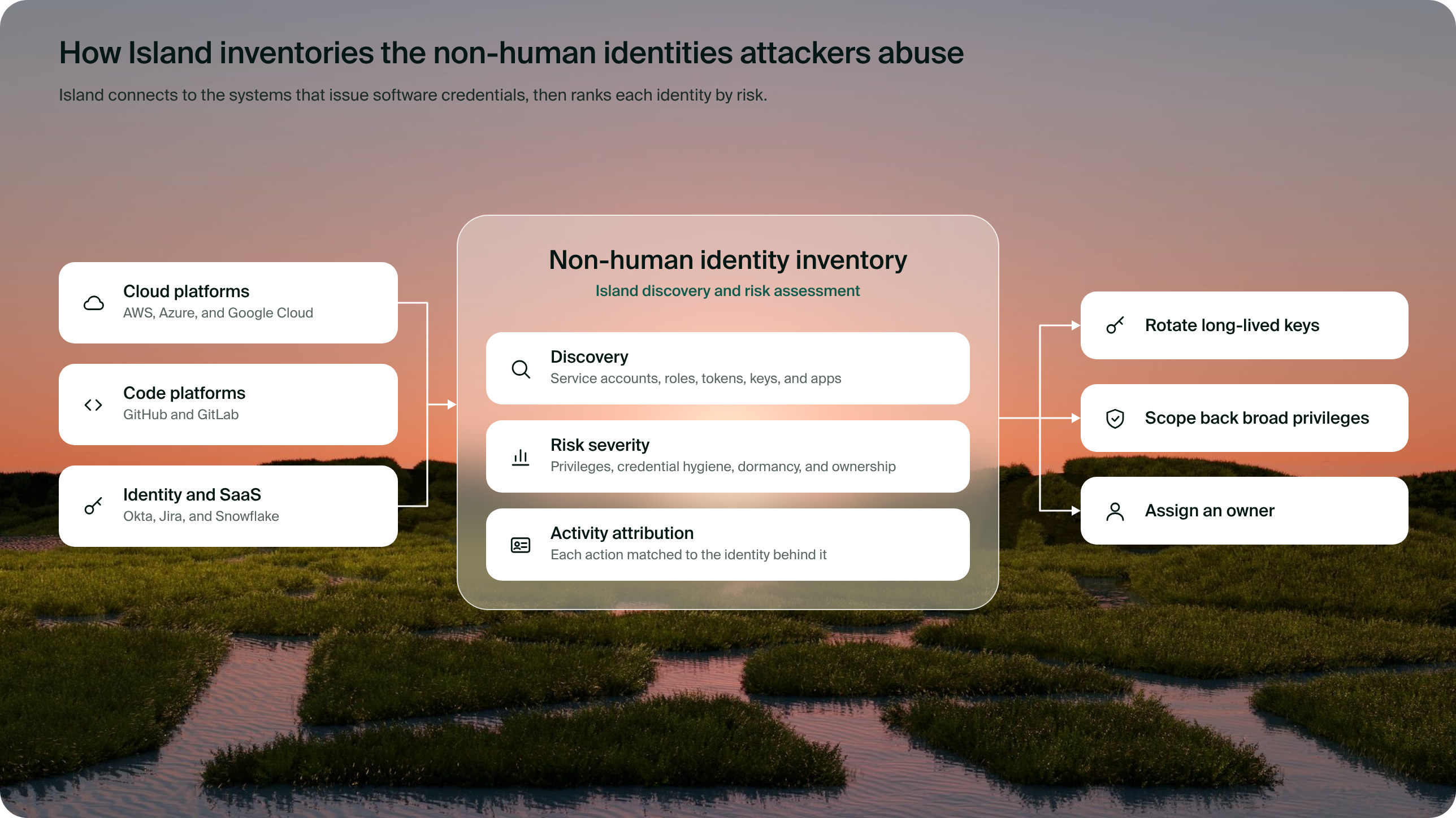
Island's non-human identity (NHI) capability inventories service accounts, roles, API tokens, keys, and apps across AWS, Azure, Google Cloud, Okta, GitHub, GitLab, Jira, and Snowflake. Each identity gets a severity based on its privileges, credential hygiene, dormancy, and ownership, and its activity ties back to the identity that performed it. The forged administrator token in the advisory came from a key nobody rotated. The inventory puts keys like that, long lived, broadly privileged, and unowned, at the top of the list to rotate or scope back.
Watch for agentic tooling on managed endpoints
The advisory lists outbound calls to LLM provider APIs, and unfamiliar LLM proxies or resellers in egress logs, as indicators to investigate alongside other suspicious activity. Most ARTEX instances run on attacker infrastructure. The indicators matter when a framework runs on a compromised workstation, or when someone starts an unscoped test on their own laptop.
Agentic Endpoint Posture inventories the AI applications, AI harnesses, Model Context Protocol (MCP) servers, code packages, and integrated development environment (IDE) extensions on a managed device. Island Network inspects traffic from desktop and command-line agents that call a model, through its secure web gateway (SWG), and its data loss prevention (DLP) policy can block structured data leaving a managed endpoint for an unauthorized destination. Security teams see which agents run on each device and who owns them.
That coverage ends at the managed endpoint. The server and cloud storage exfiltration the advisory describes needs controls in those environments.
After ARTEX
The original developer pulled the ARTEX repository in October, and the framework kept spreading through forks, mirrors, and a commercial version. The next framework will chain techniques at the same speed, which leaves defenders little time to respond once an intrusion starts. That puts the weight on work done before an intrusion starts, such as moving internal apps off the internet and retiring credentials nobody owns.
The FBI marked the advisory, FLASH-20261113-001, Traffic Light Protocol (TLP) CLEAR and published it at ic3.gov.
Frequently asked questions
What is ARTEX?
ARTEX is an open-source autonomous penetration testing framework written in Go. It connects to external LLM providers and turns an attacker's plain-language goals into commands for specialized agents to run. The FBI says threat actors have used it since at least August 2026 against financial services, government, defense, healthcare, and other sectors.
What does the FBI recommend organizations do about ARTEX?
The advisory groups its recommendations under four headings: reduce the external attack surface, harden identity and access, strengthen application protections, and preserve evidence and respond. It starts with an inventory of every internet-facing application, peripheral systems included, and asks organizations to move enterprise apps behind Zero Trust access where feasible. On identity, it calls for least privilege on multi-tenant app permissions and for monitoring credential additions, privilege assignments, and app-only activity.
How does Island Private Access take an internal app off the internet?
Island Private Access connectors run inside the private network and open an outbound connection to Island's cloud. The app never accepts an inbound connection from the internet. A scan finds no public endpoint. Island decides access for each session and each application based on user identity and device posture, and Island Private Access 360 applies the same policy to native clients, SSH, RDP, and other ports and protocols through Island Desktop.
Can an attacker sign in to SaaS apps and cloud consoles with a stolen password?
Not if the identity provider requires every sign-in to come from Island. The identity provider verifies each sign-in by Island's egress IP range or by a client certificate that only Island holds, so a correct password replayed from attacker infrastructure fails the check. The advisory lists leaked credentials and weak administrative passwords among ARTEX's ways in.
What are non-human identities, and how does Island find the risky ones?
Non-human identities are the credentials software uses, such as service accounts, IAM roles, API keys, tokens, and OAuth apps. Much of the activity in the advisory ran through them. Island pulls its inventory from the systems that issue these identities, including cloud consoles, source repositories, and SaaS platforms, and compares the access each one holds with the access it uses. Long-lived keys, broadly privileged roles, dormant identities, and identities with no owner rise to the top of the list to rotate, disable, or scope back.

Michael is Field CTO at Island, bringing over 30 years of data networking, operations, and cybersecurity domain expertise. He formerly served as Head of Technical Marketing and Chief Cybersecurity Evangelist at SentinelOne where he was responsible for messaging and strategic development of their XDR product roadmap as well as the identity security portfolio. Prior to SentinelOne, he held the title of Chief Technical Strategist for McAfee. Michael was the co-founder and CTO of NitroSecurity – later acquired by McAfee – where he was responsible for developing and implementing their overall SIEM technology vision and roadmap and has held senior technical management positions at Cabletron and Avaya.