.svg)
Agentic AI Security Needs One Policy for People and Agents

Key Takeaways
- Agentic AI security governs what AI agents can access and do when they act on behalf of people, across browsers, apps, data, and tools.
- Most agentic AI risk surfaces at the moment of action: a hijacked goal, a misused tool, or an agent using more privilege than its sponsor.
- A separate security stack for agents repeats familiar point-solution sprawl, while one policy and one audit trail for people and agents is easier to enforce.
- The practical starting point is to discover running agents, tie each to a human sponsor, and let existing data and access rules follow them.
Agentic AI security is about governing delegated work, not just protecting a model
An agent gets approved to help with the quarterly close, and the request sounds harmless enough. A week later, it has a login, a handful of connected tools, and a to-do list nobody reviews line by line.
Agentic AI security is the practice of protecting and governing AI agents that plan and take multi-step actions with real access to enterprise systems. It covers identity, permissions, tool use, data handling, and oversight, so an agent's work stays inside the boundaries set for the people it serves.
A model answers a question, while an agent acts on the answer, so the unit of risk moves from the response to the action. Here's what agents typically bring to the table that a chatbot doesn't:
- They hold credentials to real applications and accounts.
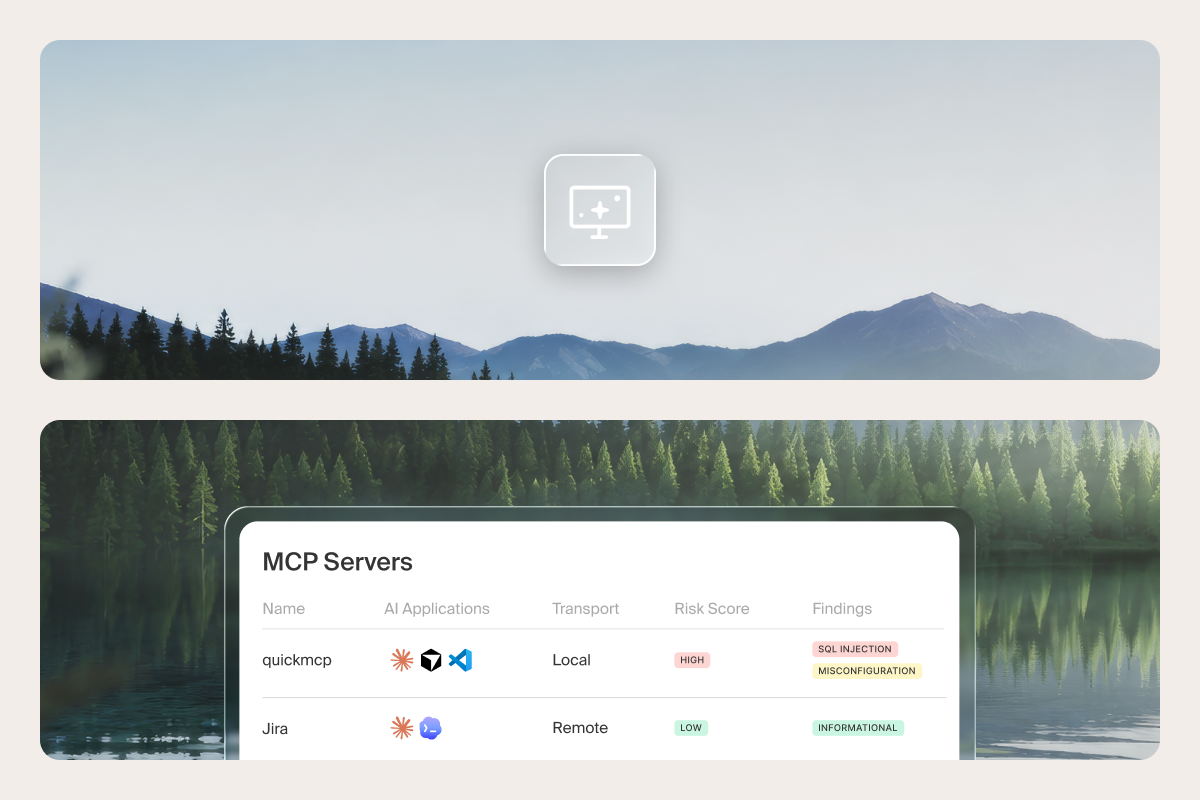
- They call tools and APIs, including Model Context Protocol (MCP) servers.
- They keep memory across steps and sessions.
- They chain actions together without a human reviewing each one.
Those capabilities reshape the risk list, and the OWASP Top 10 for Agentic Applications, released December 9, 2025, reflects it. Of its ten categories, the first three map most directly to delegated work:
- Agent Goal Hijack (ASI01), where instructions hidden in a page, email, or file redirect what the agent is trying to do.
- Tool Misuse & Exploitation (ASI02), where an agent uses a legitimate tool in a harmful or unintended way.
- Identity & Privilege Abuse (ASI03), where an agent operates with more access than its task or its person should allow.
The same list covers memory and context poisoning (ASI06), where planted content quietly shapes an agent's later steps. Prompt injection, which OWASP ties to goal hijacking, is also measurable, and NIST's Center for AI Standards and Innovation (CAISI) has measured it.
In NIST's agent hijacking evaluations, new red-team attacks raised attack success from 11% to 81% in one benchmark environment. It's a test result rather than a real-world rate, yet it shows how quickly defenses tuned to known attacks can fall behind.
Look closely and each of these risks comes down to the same question. What is this agent allowed to do on someone's behalf, and who decided?
Most agent security programs are rebuilding the stack one tool at a time
At most organizations, the agent security shortlist keeps getting longer as each new risk gets its own answer. It often starts with an agent identity tool and grows into an AI gateway, a prompt filter, a runtime guardrail, and its own log.
Each purchase answers a real question, which is why the pattern feels so natural. It's the same logic behind the existing security stack, built one sensible decision at a time, and those decisions were right for their era.
What the agentic era has surfaced is a mismatch between where policy lives and where agents work. Agents don't live in a separate world; they act through the same browser sessions, SaaS tenants, desktops, and data the workforce already uses. When agent policy lives in one console and people policy lives in another, the rules start to drift.
An analyst can't export the customer list to a personal drive. The agent she launched from her laptop can, because no one thought to write the same rule twice.
Audit splits too, so reconstructing who did what means stitching an identity log, an agent gateway log, and a browser or DLP log. The tools aren't wrong. They just don't know about each other.
Security leaders were already pushing back on this kind of sprawl before agents arrived. In a 2022 Gartner survey reported by CSO Online, 75% of organizations planned to consolidate security vendors, up from 29% in 2020. Agents add a new reason to revisit that goal, since each agent-specific tool typically adds a console, a policy model, and a log to reconcile.
The cost of that drift eventually shows up in the agentic projects themselves. Gartner predicts over 40% of agentic AI projects will be canceled by the end of 2027. Its reasons are escalating costs, unclear business value, or inadequate risk controls, and that last cause is the one security teams can influence most directly.
One policy for people and agents starts with treating every agent as a delegate
Your team can say what any employee is allowed to do right now, on this device, in this app. Ask the same question about an agent, and the honest answer is often a pause, because nobody has written down who it's acting for.
A single policy begins by writing that answer down for every agent. Agents work best as delegates rather than new users, so each one should be tied to a human or team sponsor whose policy it inherits.
The industry, including standards bodies, is still working out how agent delegation should function. In a draft concept paper on agent identity and authority, NIST's National Cybersecurity Center of Excellence (NCCoE) asks how to handle "on behalf of" delegation. Released as a draft in February 2026, the paper isn't final guidance, but it's asking the right question.
In practice, a single policy covering people and agents rests on four properties:
- Sponsored identity, so every agent maps to an accountable human or team.
- Inherited access, so an agent can't exceed its sponsor's current permissions on the current device.
- Shared data rules, so DLP, upload, paste, and download policies apply whether a person or an agent is driving.
- One audit trail, so person and agent actions land in the same record, linked to each other.
The less obvious point: policy should often get narrower when an agent is driving. The sponsor's access is the ceiling, and the task decides how much of it the agent actually needs.
A person who can approve invoices rarely needs an agent with the same power. What they need is an agent that prepares invoices and leaves the approval with a human. For any new agent, the most useful design question is this: what's the smallest slice of my access this task needs?
Just-in-time, short-lived credentials are what make inheritance practical at scale. Standing API keys typically recreate the service account problem many teams spent years cleaning up, with broad, permanent access and no clear owner.
Under one policy, the analyst's agent hits the same export rule she does. The blocked attempt lands in the same record as her own activity, tied to her as sponsor, so "who did this?" has one answer.
The workspace is where one policy can actually be enforced
A policy is only as good as the place it's enforced. Much of what agents do happens inside a browser tab, a desktop app, or a local tool call, where network inspection sees only a connection.
Where a control sits determines what it can see, and the options form a rough hierarchy. Controls built into an enterprise browser and desktop see the page, the session, the prompt, and the action natively.
Extensions bring much of that visibility to consumer and AI browsers, and they're valuable, especially as a complement. Extension-only approaches, though, inherit the limits of whatever browser they sit on. Network and proxy controls sit further out still, where they see traffic but usually not the intent inside a session.
AI browsers made the question urgent in December 2025, when Gartner advised CISOs to block them for now, according to The Register. The guidance allowed for approval only after an organization assesses the AI back end behind a browser, and as a short-term move, it's sensible.
Over time, though, blocking tends to push agents into the shadows rather than out of the business, so the durable answer is to govern them.
Island was designed for this gap, with governance embedded into the workspace itself, so it works as the environment rather than one more tool. Island Enterprise Browser, Island Enterprise AI, and Island Network Services share one policy engine and one audit trail for people and agents.
The Island Extension carries that policy into consumer and AI browsers, so teams who prefer them stay inside the same rules. Agentic Endpoint Posture discovers the agents, MCP servers, skills, and extensions already running on endpoints.
Agentic Identity, working with the Island MCP Gateway, issues just-in-time credentials to agents. AI Protect's inline classifiers watch for prompt injection and data leakage while the work is in motion.
Because these controls are built in, not bolted on, a person and the agent working for them meet the same rules in the same place. The real payoff is being able to say yes to AI more often, because each new agent lands inside rules you already trust.
Human oversight works best when it's reserved for actions with consequences
Approval prompts that fire on every step teach people one habit, which is to click "allow." By the hundredth prompt of the week, a human checkpoint has quietly become a rubber stamp.
Oversight is a real requirement, and for high-risk AI systems, Article 14 of the EU AI Act requires design that lets people effectively oversee them. Not every agent falls into that category, but the principle is a useful design bar for any agent with real access.
The better move is to tier approvals by the consequence of the action rather than by which agent is acting. The same agent can draft an email with no approval at all. Sending that email to an external domain with an attachment is a different action, and it deserves a checkpoint.
A single policy makes this workable because the rule keys on the action and the data, regardless of who or what is driving. Three kinds of action typically warrant a human checkpoint:
- Moving sensitive data outside the organization.
- Making irreversible changes, such as payments, deletions, and permission grants.
- Acting outside the sponsor's normal pattern of work.
Everything else can run at agent speed, which is why you wanted agents in the first place. Fewer prompts also means each one gets real attention from the person who sees it.
When each approval is recorded in the same log as the action it approved, post-incident review becomes a reading exercise instead of an excavation.
Start with the agents you didn't build
Agents are arriving from every direction, so where should you start? Most programs begin with the homegrown agents engineering is building, because those agents are visible and they have owners.
The bigger near-term exposure is usually the agents nobody formally deployed. SaaS copilots switched on by default, AI browser sidebars, coding agents, and MCP servers on laptops are typically already running with real credentials.
This pattern has a history, and a 2023 Salesforce survey found more than half of workplace generative AI users used it without formal employer approval. Agents raise the stakes of that habit, because they act on what they find instead of just answering.
A sequence that tends to work, and that builds on controls you already have, looks like this:
- Discover agents, MCP servers, and AI extensions across your browsers and endpoints.
- Assign each one a human or team sponsor.
- Apply the data and access rules you already enforce for people, so agents inherit them.
- Turn on a unified audit trail before you expand any agent's autonomy.
- Widen what agents can do as evidence accumulates.
The order matters because discovery and sponsorship come before new rules, and most of the rules you need probably exist already.
You're not building an agent security program from scratch. You're extending the one you already run to cover a new kind of worker.
Your people and your agents can share one rulebook
If you're rethinking how agents fit into your security model, we're happy to walk through what we've built. Request a demo.
FAQs
What is agentic AI security?
It's the governance of what AI agents can access and do for people, spanning identity, permissions, tool use, data handling, and oversight. The goal is to let agents work at full speed without operating outside the rules your people follow.
How is agentic AI security different from traditional AI security?
Traditional AI security focuses on a model's inputs and outputs. Agentic AI security also governs the actions an agent takes with real credentials across apps and data.
What are the biggest agentic AI security risks?
The risks that matter most are usually goal hijacking via prompt injection, misused tools, and agents with more privilege than their sponsor. Each one becomes more serious as an agent gains access to systems where actions are hard to undo.
Should AI agents have their own identities?
Yes, as long as each agent identity is tied to a human or team sponsor. That way its access can't exceed what the sponsor could do, and its actions stay attributable.
How do you secure AI agents without blocking AI adoption?
Govern agents where they work, under the same policy as your people. Approving a new agent then becomes a policy decision rather than a new security project.

Island is defining the future of work for people and AI agents. Its enterprise agentic control plane helps organizations enable, govern, and audit agentic workforces alongside people. Island boosts productivity across devices, browsers, applications, networks, and data while protecting sensitive information, simplifying access, and helping enterprises scale AI safely.

.png)
.svg)
.svg)

