How Fintech Companies Can Get Rid of VPN, VDI, and DLP
A single control plane lets financial institutions retire VDI, VPN clients, and standalone PAM, while extending the same enforcement to AI agents legacy tools weren’t built to control.

Core banking systems, trading platforms, risk management tools, CRM, and regulatory reporting all run in the browser — and AI copilots and agents now read data, call tools, and trigger workflows inside those same applications. The security stack around them was assembled with individual pieces: VPN and VDI for off-premises access, SSE and proxies for data controls, PAM for shared accounts, MDM for personal devices, DLP agents on the endpoint.
Each of those tools sees only its specific slice of the work; none of them see the whole interaction. None of those tools was built to see inside a session as it occurs or to observe what an agent is doing. Island’s position is that enforcement belongs where the work happens — in the application session, at the tool call, on the endpoint — under one policy that covers every human and every agent.
Here’s how financial services companies can concentrate their complex security and observability stack into a single layer, saving costs while simplifying your architecture.
Why traditional security solutions are blind to AI
Standard security tools all sit outside the place where financial services work actually happens.
Network-layer tools enforce against traffic. SSE platforms, proxies, and secure web gateways can see the domain a user reached and the application they opened. Seeing anything more requires SSL inspection, which adds latency and fails against certificate pinning. Even with inspection in place, actions inside the page like copying, pasting, and downloading sit below what these tools can reach.
Endpoint agents see processes and files. They do not see the rendered page, so a record displayed on screen and a record pasted into a personal webmail tab look identical from outside the browser.
VDI and RBI resolve the visibility problem by moving the session off the endpoint entirely, at the cost of infrastructure, IT operations, and responsiveness.
AI widens every one of these gaps. A network control can block a public AI platform, but it can’t stop a user from pasting account numbers into an approved one, and it can’t stop browser extensions from logging AI chat sessions to external servers. An agent pulling customer records from Salesforce into an unvetted tool crosses every one of these boundaries without setting off any alerts. If an indirect prompt injection in a web page causes an agent to exfiltrate customer account information, the network sees a file leave and the endpoint sees a process run but neither one sees the malicious instructions.
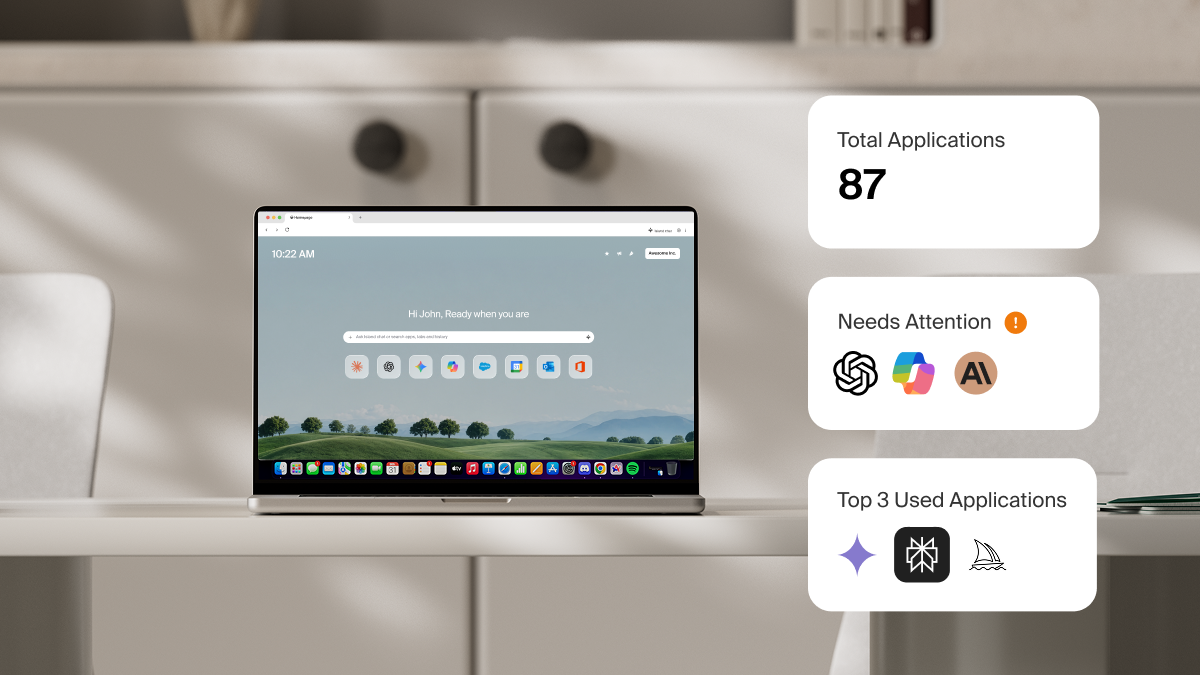
A control plane closes the gap by operating where the interaction happens. The enterprise browser sees the full session — the page, the user, the data, the action — and the platform extends that same visibility to the tool call, the MCP connection, and the endpoint, so the chain from prompt to action to file is captured as one governed event. Consolidating browser and agent security into a single platform lets you look at all the other pieces of your stack and consider which ones are no longer needed.
What an enterprise browser takes off the stack
VDI, for browser-based work. Most VDI seats in a financial institution exist to deliver web applications to people working off-premises — relationship managers, back-office analysts, contract staff. When the controls live in the browser, those users get the same access and the same policy enforcement on their own device, without the virtualization layer in between. VDI stays where it's genuinely needed, for thick-client applications that have no web equivalent.
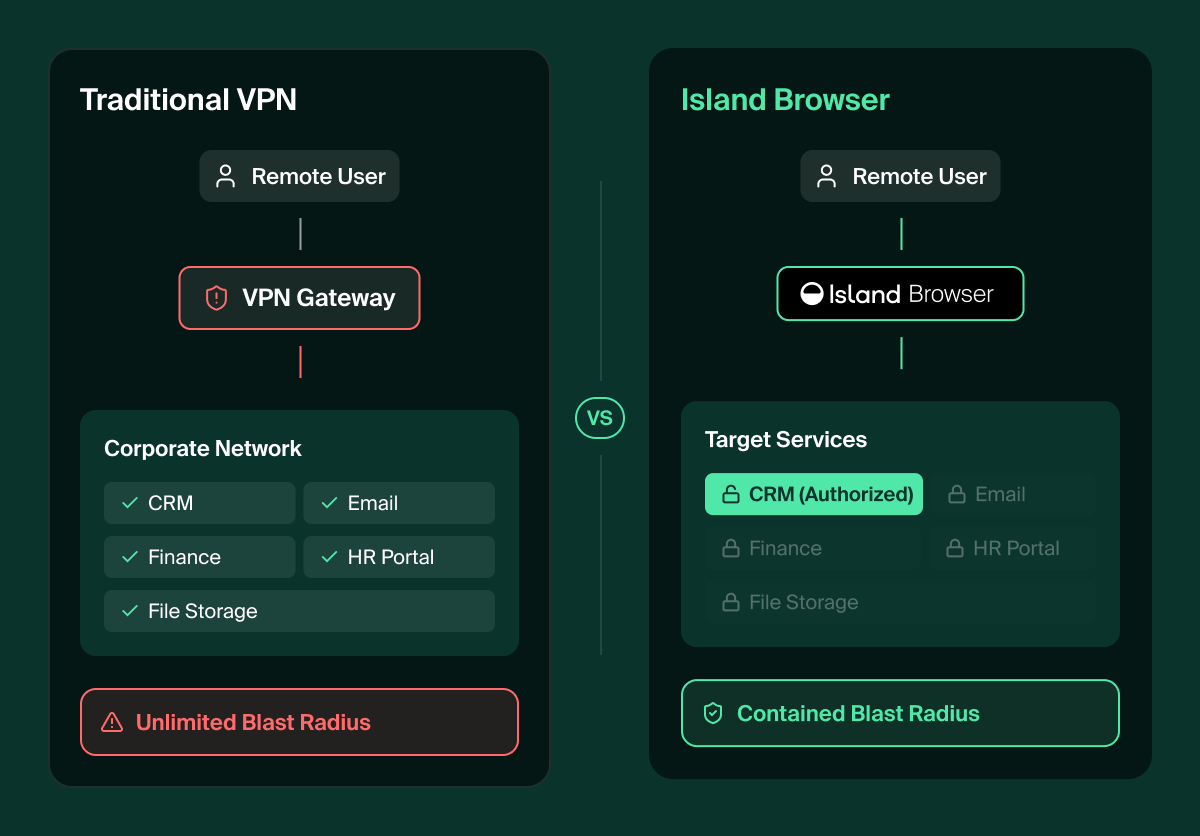
The VPN client, for private banking systems. Integrated ZTNA connects users to internal applications without a separate client and without exposing the broader network. This matters most for the populations where client deployment is slowest: contractors, BPOs, and third-party service providers who don't use your hardware and don't sit inside your management tooling.
PAM, for shared accounts. Shared trading accounts, customer service platforms, and administrative systems where individual credentials aren't practical all present the same problem — you can log the account, but not the person. An enterprise browser lets users authenticate without seeing the credential and attributes every action to the individual who took it.
The AI block list. Most financial institutions’ current AI control is a deny rule at the proxy and an acceptable-use policy, which pushes usage into shadow AI the security team can’t monitor. Because the control plane operates inside the session, institutions can approve AI tools instead of blocking them: PII and account data are redacted from prompts before they leave, every interaction is logged against the individual, and the same policy follows contractors and BYOD users without MDM or VDI.
Point-based AI security products, like prompt firewalls, standalone AI-DLP, and usage discovery tools, are becoming available. But when the enforcement layer governing global user work sessions also covers AI, you will never need to buy them.
Enterprise browsers for compliance
Compliance obligations in financial services — SOX, PCI DSS, GLBA, and third-party requirements in regimes like NYDFS Part 500 and DORA — don’t care about your application architecture. They simply require that you are able to demonstrate which individual accessed which data, when, under what controls, and what happened to that data afterward. AI adds a new compliance rule: the EU AI Act, enforced starting August 2026, requires all regulated institutions to produce records of how AI systems are used.
A control plane produces that evidence as a byproduct of enforcement, because the controls and the audit trail live in the same layer. In the browser session, sensitive fields are masked by default and each unmasking event is logged against the user who viewed it. Privileged sessions are recorded, giving you session-level evidence for SOX audits rather than an access list. Blocked downloads and blocked paste actions are logged as events, so a prevented incident leaves a record. Third-party and BPO activity is attributed to the named individual rather than the shared account they logged in with.
All this also applies to AI. Every prompt, response, and tool call is captured at the content level and tied to the user, the device, the agent, and the policy in force. Agent actions carry a verifiable identity rather than disappearing behind the service account that spawned them, and the records export for SOC 2, ISO 27001, and internal review.
A network tool can tell you the policy was configured. A control plane identifies the human or agent responsible for an action and what they did inside which application, even on a device you don’t own.
Get the full framework
The control plane starts with the browser, and The Financial Services Browser Buyer’s Guide gives CISOs, CIOs, and financial services IT leaders a framework for comparing an enterprise browser against VDI, SSE, and RBI across cost, complexity, and user experience — what each one delivers for financial services specifically, and which ones you can begin to peel away once enforcement moves into the session.
The guide also works through ten financial services use cases in detail, from AI enablement and BPO onboarding to M&A cutover and business continuity during an incident, along with the four-step deployment sequence and the questions to ask any vendor before you shortlist: whether ZTNA is integrated or dependent on a third product, whether mobile support matches desktop, and whether the vendor can point to customers of comparable size and regulatory exposure.

FAQs
What is a control plane for enterprise applications and AI?
A control plane is a single enforcement layer that governs how every identity — human or agent — accesses applications and data: one policy framework, one audit trail, applied wherever the work happens. In Island’s platform, the enterprise browser is the centerpiece, extended by enforcement at the endpoint, the network, and every AI tool call, so the same controls cover a relationship manager in a CRM and an agent calling an MCP server.
Seven of the world's ten largest financial institutions use Island. What makes the Island platform particularly suited for banking and finance?
Financial services firms face unique pressures: rapid innovation creating complex interconnected systems, stringent regulatory oversight, sophisticated cyber threats targeting sensitive data, and fierce competition for talent requiring excellent employee experiences. The enterprise browser addresses all these challenges simultaneously—enabling secure innovation, satisfying compliance auditors, defending against advanced threats, and providing users with a smooth, productive workspace that improves retention and satisfaction.
Does Island ensure visibility for our compliance teams?
Yes. The Island browser provides comprehensive user analytics, monitoring all work activity in high fidelity while keeping personal browsing private, with a privacy indicator that lets users know how and when they're monitored, plus analytics that integrate with your SIEM for enterprise-wide visibility. For privileged users accessing critical financial systems, Island captures full session details including user identity, device information, and specific actions taken, all without requiring source code changes or complex integrations.
Can an enterprise browser replace VDI?
For browser-based work, yes. Most VDI seats in a financial institution exist to deliver web applications to people working off-premises. When enforcement lives in the browser, those users get the same access and the same policy controls on their own device, without the virtualization layer. VDI stays where it’s genuinely needed — thick-client applications with no web equivalent.
Can SSE and proxies see what a user does inside a SaaS application?
No. Network-layer tools enforce against traffic, so they can see the domain reached and the application opened. Seeing more requires SSL inspection, which adds latency and fails against certificate pinning. Even with inspection in place, actions inside the page — copying, pasting, downloading — sit below what these tools can reach. The same blindness applies to AI: a network tool can block an AI platform, but it can’t see what data enters an approved one.
How does Island govern AI agents in a financial institution?
The same way it governs people. Every prompt, tool call, and response is inspected inline, with DLP and PII redaction applied before data leaves. Agents receive just-in-time, time-boxed credentials scoped to the task rather than inheriting a user’s standing permissions, and every agent action is tied to a verifiable identity in the audit trail — so an examiner can see what an agent did and on whose behalf, not just that a service account was active.
Does Island natively produce audit evidence regulators will accept?
Yes. Unmasking events are logged against the individual who viewed the data, privileged sessions are recorded for SOX evidence, blocked downloads and paste actions are logged as events, and third-party activity is attributed to the named user rather than the shared account. AI interactions are captured at the content level and export for SOC 2, ISO 27001, and internal review. These are records of what happened, not confirmation that a policy was configured.

Island is defining the future of work for people and AI agents. Its enterprise agentic control plane helps organizations enable, govern, and audit agentic workforces alongside people. Island boosts productivity across devices, browsers, applications, networks, and data while protecting sensitive information, simplifying access, and helping enterprises scale AI safely.