.svg)
Island and Cisco Secure Access Enable Zero Trust Everywhere
Organizations today must deliver secure access to applications for a rapidly expanding set of users, including employees, contractors, and partners, working across both managed and unmanaged devices. Traditional approaches built around VPNs, VDI, and device-centric controls struggle to keep up with this reality, often introducing complexity and friction while leaving gaps in security. To truly support modern work, organizations need a zero trust model that can consistently verify identity and device posture, and securely connect any user, on any device, to the private applications and sensitive data they need.
Closing the Gap Between Access and Action
Traditional zero trust architectures are built around a simple principle: verify identity and device posture before granting access. While that remains essential, it is no longer sufficient on its own.
In today's environment, risk does not end when access is granted. It often begins there.
Island, the Enterprise Browser, and Cisco Secure Access combine browser-native controls with cloud-delivered Security Service Edge (SSE) to deliver a more complete zero trust model. One that does not stop at access, but extends all the way to user behavior.
Island embeds security directly into the browser itself, where users, applications, and data intersect. Island makes it possible to govern what users do with data on their local machine: how they copy it, paste it, share it, download it, or interact with it inside applications.
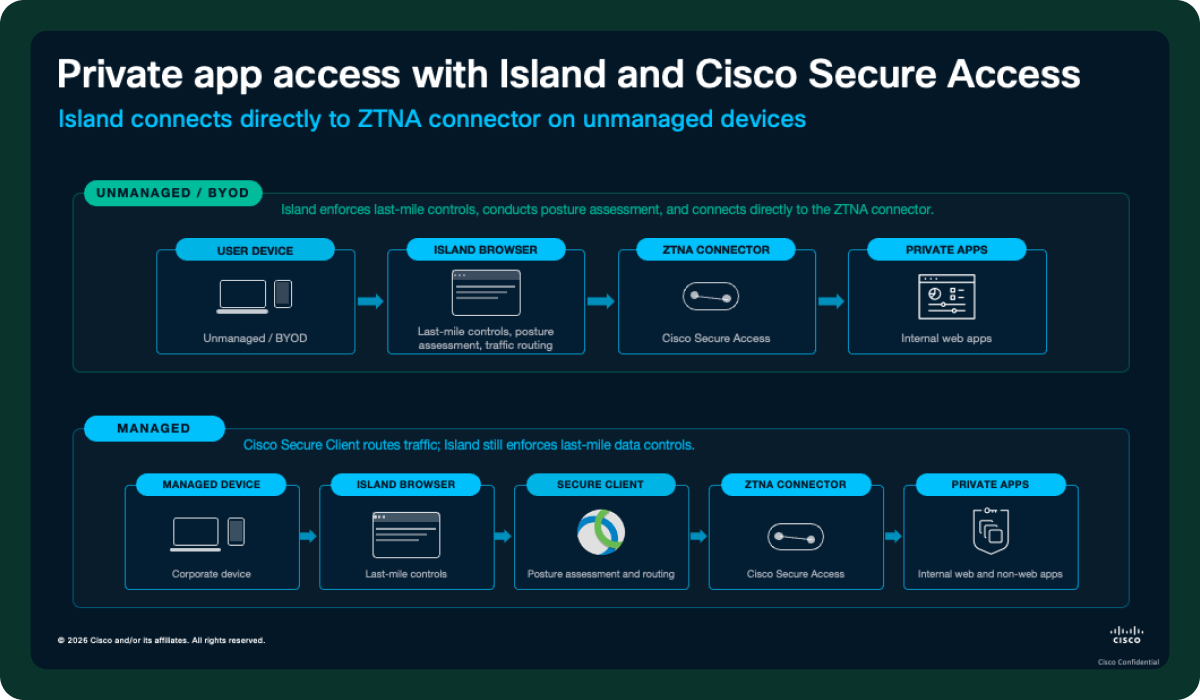
Cisco Secure Access provides the complementary network foundation with zero trust network access, ensuring that only authenticated users on trusted devices can access Island and connect to private applications. At the same time, it delivers cloud-based policy enforcement and visibility across application traffic.
Together, these capabilities create a continuous security model that spans from the moment a user logs in to the moment they interact with sensitive information.
A Practical Approach to BYOD and Third-Party Access
One of the most persistent challenges for IT and security teams is enabling secure access for unmanaged devices. Contractors, partners, and remote workers often need access to critical applications, but traditional approaches such as VPNs or virtual desktops introduce friction, cost, and complexity.
This is where the combined Island and Cisco solution stands out. Users can simply install Island, log in, and immediately gain secure access to the applications they need. Behind the scenes, device posture is evaluated in real time and shared with Cisco Secure Access, which determines whether access should be granted.
Because policies are enforced directly in the browser, organizations can apply enterprise-grade controls without requiring full device management or invasive agents. This makes it possible to extend secure access to virtually any user, on any device, without compromising security or introducing user friction.
Say “Yes” to Generative AI
The rise of generative AI has introduced a new dimension to enterprise security. Employees are increasingly interacting with AI tools directly in the browser, often without clear visibility or control from IT.
Island and Cisco Secure Access provide visibility and governance over these interactions. AI applications can be discovered in real time, access can be restricted or redirected to approved tools, and sensitive data can be prevented from being exposed in prompts or outputs.
This allows organizations to say yes to AI-driven productivity, enabling adoption rather than blocking it, while maintaining confidence that their data remains protected.
Moving Beyond VDI and Legacy Access Models
For years, virtual desktop infrastructure has been the default approach for securing high-risk access scenarios. While effective in some cases, VDI is expensive to operate, complex to manage, and often delivers a suboptimal user experience.
The Island and Cisco integration offers a modern alternative. By combining browser-native controls with zero trust access, organizations can deliver direct, secure access to applications without the need for virtualization. Users benefit from faster, more intuitive workflows, while IT teams gain a simpler and more scalable architecture.
A New Standard for Secure Work
The combination of Island, the Enterprise Browser, and Cisco Secure Access represents a shift in how security is delivered. It moves beyond controlling access to controlling interactions. It replaces fragmented solutions with a more coordinated approach. And it aligns security with the reality that the browser is the key business tool for today's workforce.
For IT and security leaders, this creates a clear path forward: a way to support modern work, enable AI, and protect sensitive data, without sacrificing user experience or operational efficiency.

Richard Greene joined Island after 30 years of leadership focused on the enterprise security industry. He has held positions from CEO, to leading global sales teams and alliance organizations for notable companies including Symantec and McAfee, as well as several successful start-ups. In this role, Richard is responsible for identifying and building partnerships that strategically help Island build and lead the Enterprise Browser category, and form "better together" value propositions for our mutual customers. Richard holds a BSc in Mechanical Engineering from Nottingham University, England.



.svg)
.svg)

