.svg)
Built to Stay Up: How Island Approaches Network Resiliency
As AI and automated workloads grow, so does the cost of network downtime. Here’s how the Island Enterprise Network is engineered to keep your business running when underlying infrastructure fails.
Most enterprise network conversations start with features. The ones worth having start with a different question: what happens when something goes wrong? Any network will work on a good day. The ones that matter are built for the bad ones.
Network patterns have changed. Traffic used to be a person clicking a link and waiting for a page to load. Today, most of it is AI assistants, automated tools, and background processes running constantly, often in parallel, with no humans at the keyboard. The volume is higher, the pace is faster, and the dependencies are tighter. A single degraded connection can stall a workflow, fail an automation, or break a customer experience. Resilience and business continuity aren't infrastructure concerns anymore. They're business ones.
The network is the critical path for all of it. A degraded connection isn't just a productivity inconvenience anymore. It's an interrupted workflow, a failed automation, a compliance gap. The tolerance for network instability is shrinking at exactly the moment network demand is growing.
Here's how the Island Enterprise Network is built.
Three hyperscalers as a foundation. Not one
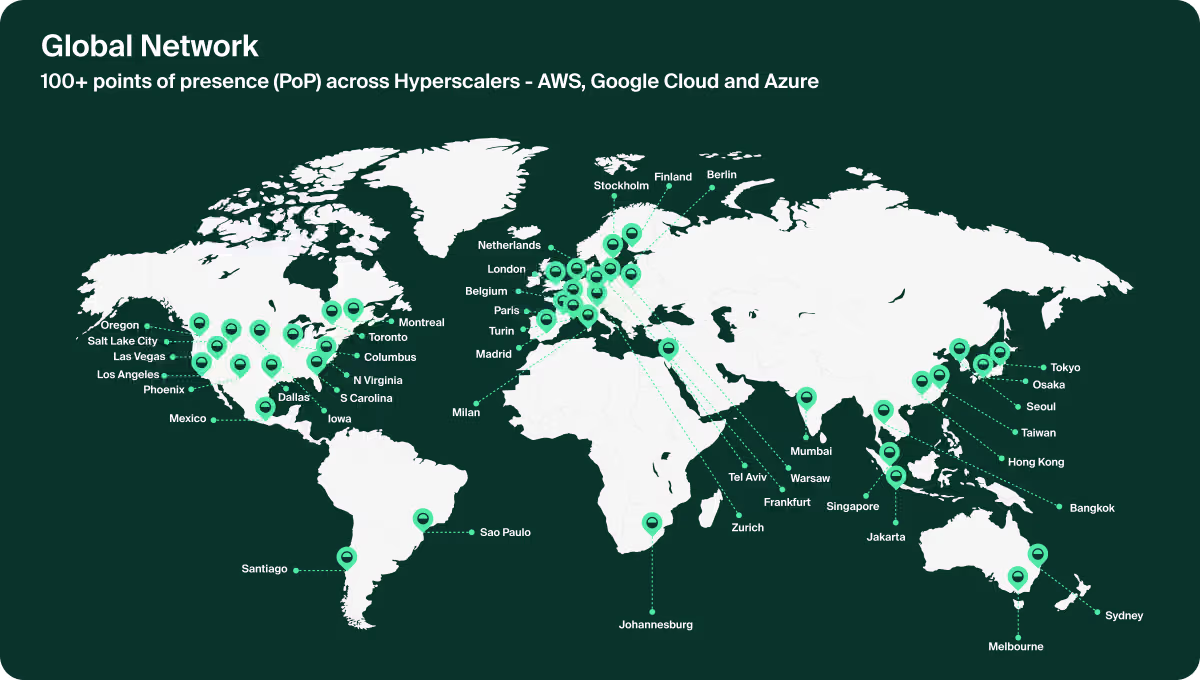
Island runs natively across AWS, Azure, and GCP infrastructures simultaneously. This design is an architectural safeguard against system-wide infrastructure failure.
When one provider has a regional event, a routing fault, or a control-plane failure, traffic keeps moving through the others. No incident bridge. No waiting on a status page. Your users keep working as usual. Many traditional SASE platforms were designed around a single cloud provider, or their own physical data centers. Multi-cloud support, where it exists today, was often added later rather than built in. Depending on a single provider creates a point of failure that enterprise operations can't absorb. Read more here about why Island Modern SASE is built on hyperscaler infrastructure.
Primary and secondary transport: eliminating the silent brownout
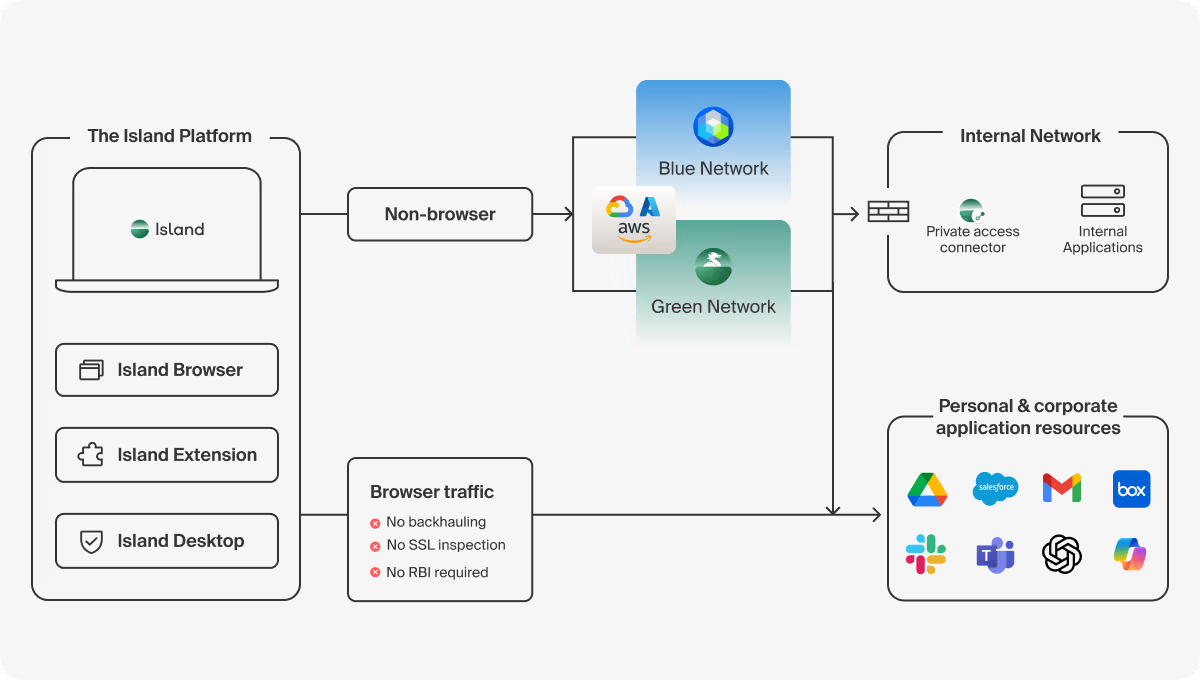
The hardest failures to deal with aren't full outages. They're the quiet ones. Packet loss, latency spikes, intermittent drops that make a connection unusable long before anything registers as a full outage. A single-stack network can degrade this way without anyone noticing, right up until sessions start dropping. Island runs two independent network stacks at the same time, both active, both carrying traffic. If one starts to degrade, traffic shifts to the other automatically. No reconnect prompt, no dropped calls, no broken sessions. The shift happens beneath the application layer, so the user never sees it.
- Primary and Secondary Pathing: The Island client does not run a primary backup model. It establishes and maintains two distinct, concurrent transport-layer paths to the hyperscaler infrastructure. Both paths actively pass telemetry and traffic, meaning there is zero setup delay or tunnel-negotiation overhead when a path shift is required.
- Instantaneous Flow Migration: Because both stacks are fully active, if transport path A encounters an anomaly, the client shifts active traffic flows to transport path B instantly without the user even noticing.
By leveraging the massive regional footprint of hyperscalers, we can land these parallel transport stacks across completely distinct edge ingestion nodes or even different provider backbones. This provides a guaranteed, working baseline to fall back to the millisecond a primary link starts to slip.
Why a single point of presence is a silent outage risk
Network resilience starts with what happens when a point of presence starts to struggle. Most traditional networks can recover from a full outage but they're slower to react when a PoP just starts to slip, when traffic slows down or a region gets congested. In those moments, users are stuck on a degraded path with no automatic way out. The result is a regional dark spot: a group of users effectively offline while the rest of the network looks fine.
Island's architecture eliminates rigid entry-point pinning on both boundaries of the transit path:
- Dynamic Client Routing: Island clients don't anchor to a single point of presence and stay pinned when it degrades, the way traditional SASE clients do. They continuously monitor multiple healthy entry points across the network and fail over in under a second, before applications stutter.
- Connector-Side Symmetry: Private application access follows the same model. It never depends on a single static tunnel, so if a PoP hosting one degrades, traffic routes through a healthy PoP instantly without dropping the session.
WireGuard transport: protocols for modern compute constraints
Island's transport layer is built on a WireGuard-class protocol, chosen to replace the overhead of IPsec and SSL-VPN architectures designed for static, perimeter-bound networks.
The difference shows up in three places that matter. Sessions are faster to establish and quicker to recover, so a video call stays alive when someone walks out of the office and onto cellular. The protocol is lighter on devices, so it doesn't drain CPU or battery. And a smaller codebase means a smaller attack surface, which makes it easier to audit and trust.
A production-hardened architecture
Running millions of sessions a day surfaces edge cases no architecture diagram can predict. Each one gets found, fixed, and built back into the design. Every node runs with full service symmetry, meaning all components are present everywhere. There's no tiered setup where some regions get a stripped-down policy engine or slower processing. Traffic entering the Island Enterprise Network gets the same security, routing, and resilience regardless of where in the world it enters.
Across three hyperscalers, two independent network stacks, multi-PoP failover, and modern protocols, Island delivers a production-hardened network built to hold when the rest of the internet breaks.
FAQs
How does Island coordinate multi-cloud routing without adding latency? Island runs across AWS, Azure, and GCP, and routes each connection through the closest healthy entry point, whichever provider it's on. Because the three hyperscalers are connected by high-speed private links, moving traffic between them adds very little latency while keeping full redundancy across providers.
What criteria triggers a client to switch between the primary and secondary transport stacks? The Island client monitors telemetry in real time across both transport stacks. Rather than waiting for a hard connection drop, the client monitors continuous health indicators, shifting traffic instantly if packet loss exceeds a tight operational threshold, if jitter spikes outside of nominal tolerances, or if round-trip time (RTT) degrades relative to the parallel path.
Why choose WireGuard over traditional enterprise IPsec for SASE transport? IPsec is a complex, heavy protocol that relies on lengthy state negotiations and is prone to tunnel deadlocks during network transitions. WireGuard uses state-of-the-art cryptography primitives and a stateless connection model. This yields a significantly smaller attack surface, faster cryptographic throughput, and the ability to maintain seamless application sessions even when a user shifts physical networks or encounters high packet loss.
Idan is a Product Group Manager at Island, responsible for the Network and ZTNA product domains. His work focuses on Island’s global infrastructure and secure connectivity strategy, enabling reliable, high-performance access for enterprises worldwide.



.svg)
.svg)

