.svg)
Why Island Modern SASE is Built on Hyperscaler Infrastructure
How decoupling the SASE enforcement plane from rigid physical PoPs solves the three biggest headaches in enterprise networking: transit jitter, application backhauling, and silent transport brownouts.

When a packet leaves a user's device, the physical path it takes to reach an application dictates the user experience. Latency, jitter, and reliability are determined on the wire, long before any security policy executes. So the fundamental question for any SASE architecture is simple: what network does your enforcement plane sit on, and who operates its routing layer?
Traditional SASE vendors build, peer, and maintain proprietary PoP footprints. Island made a different architectural choice. Our Modern SASE enforcement plane runs natively inside AWS, Azure, and GCP regions.
Premium networking, included
Traditional SASE relies heavily on the public internet to bridge the gap between disparate PoPs, or forces vendors to manage complex, leased private circuits. Island bypasses this operational overhead by running directly on the world's most sophisticated global private networks.
By integrating directly with transit mechanisms like AWS Global Accelerator, Azure Front Door, and Google Cloud Premium Tier, we ingest user traffic onto a provider-owned private fiber backbone at the nearest edge ingestion point. Traffic enters the hyperscaler's private backbone near the user and stays on it until it reaches the region closest to the destination.
Minimized Public Internet Exposure
Packets are onboarded to private fiber near the user, minimizing transit over unpredictable, congested public peering points and BGP-flapping transit providers.
Deterministic Pathing
Hyperscaler backbones use optimized, software-defined routing algorithms that respond to real-time path health, reducing jitter and tail latency.
No Middle-Mile Circuits to Provision
We inherit a multi-billion-dollar global fiber infrastructure out of the box. There are no private circuits to stitch together or statically provision.
Proximity to where SaaS actually lives
The core philosophy of the Island Perfect Packet model, our framework for ensuring every packet takes the shortest, most secure path to its destination, is to enforce security policy exactly where it makes the most architectural sense, without default backhauling.
The majority of enterprise SaaS applications, including Microsoft 365, Salesforce, ServiceNow, Workday, and Snowflake, already run natively inside AWS, Azure, or GCP. When Island's enforcement plane sits inside these hyperscaler regions, the packet path from user to SaaS stays short.
This matters for the Perfect Packet path. Island monitors and enforces at the point of interaction. When traffic does need to route through Island's network, enforcement sits inside the same hyperscaler region as the destination SaaS application, keeping the hop short. For most of the journey, traffic stays on hyperscaler backbones. When traffic does cross the public internet, that segment is minimized.
- The Micro-Hop: The transit from the user to Island and from Island to the SaaS application stays mostly within the hyperscaler’s private backbone. Island inspects and enforces at the point of interaction.
- Eliminating the Hairpin: Traditional SASE often routes a packet to a proprietary PoP three states away for inspection, only to egress it back out to the public internet to reach a cloud data center.
- Enforcement at the Destination Region: When traffic is steered through Island's network, policy runs inside the same hyperscaler region as the destination SaaS application. Inspection happens at the end of the path, next to where the application lives, not at a detour midway through it. Traffic is evaluated once, close to its destination, then continues the short remaining hop on private fiber.
.png)
Auto-remediation and elastic capacity
A network is only as strong as the infrastructure it runs on. When a proprietary SASE PoP experiences a hardware failure, power disruption, or a localized DDoS attack, the vendor must manually intervene or rely on fragile, high-level failover protocols that drop active stateful connections.
Hyperscaler infrastructure self-heals at the layer below us. Failed instances, degraded availability zones, and network anomalies get detected and routed around by the provider, without Island intervention. Our enforcement logic stays focused on policy and packet handling. The substrate keeps itself healthy and capacity scales horizontally on demand.
Eliminating the PoP Saturation Cliff
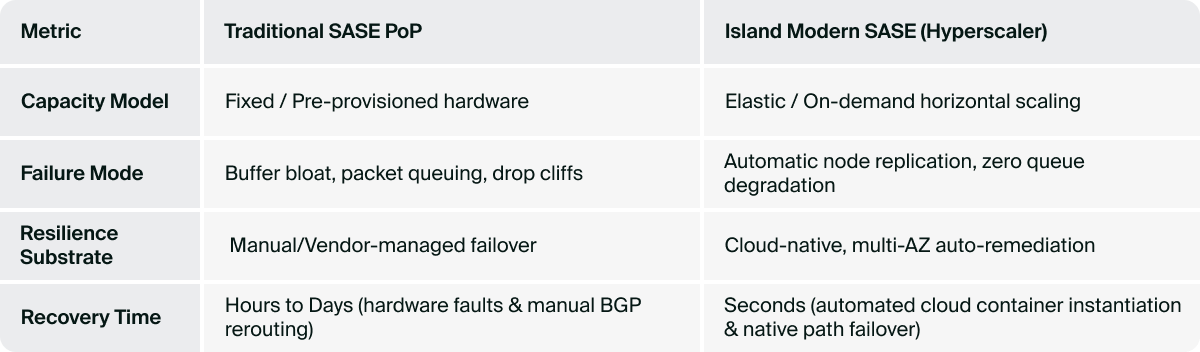
A traditional PoP is a box-bound resource. It has a finite amount of CPU, memory, and throughput. When a regional traffic spike occurs, these appliances hit a capacity ceiling, resulting in queued packets, dropped connections, and throttled throughput.
Island completely eliminates the PoP saturation failure mode. Because our enforcement plane is cloud-native, it scales horizontally and elastically on demand. Here is how the two models compare under load:
The Perfect Packet Realized
Ultimately, the network layer comes down to efficiency. With Island, a user’s traffic hits a premium private backbone almost immediately, undergoes policy inspection inside the exact cloud environment where their enterprise applications live, and completes its journey over private fiber. The infrastructure underneath automatically heals itself and scales to match real-time load.
The alternative makes a security vendor build and operate a global network, laying fiber, peering, and running data centers worldwide. Island runs the Perfect Packet on hyperscaler networks instead, which delivers predictable latency, high uptime, and capacity that scales with demand.
FAQs
Does running on hyperscalers mean Island depends on a single cloud provider or introduces a single point of failure? No. Island's enforcement plane runs across AWS, Azure, and GCP rather than any one provider. Enforcement node placement aligns to where your users and SaaS applications actually sit, so traffic is inspected close to its destination regardless of which cloud hosts it. If one region or provider degrades, the architecture is not pinned to it. This is the opposite of a fixed-PoP model, where a single hardware site going down takes its entire coverage area with it.
How does cloud-based inspection affect latency compared to traditional SASE PoPs? First, most traffic never goes through cloud-based inspection at all. Island enforces at the point of interaction, in the browser and on the device, so the majority of sessions stay direct. For the traffic that does route through Island's network, latency still drops in nearly all cases. Traditional SASE forces a backhaul model, routing packets to a distant proprietary PoP before sending them back out to the internet. Because Island's enforcement sits within the same major cloud regions as destination SaaS providers, the final leg is a low-latency intra-cloud or region-to-region hop over private fiber.
What about applications that aren't hosted on AWS, Azure, or GCP? Not every destination sits inside a hyperscaler region. For self-hosted, on-prem, or other-cloud applications, the path still benefits from hyperscaler ingestion near the user, then exits the backbone at the point closest to the destination. The hyperscaler segment carries traffic for as much of the path as possible. The remaining hop to a non-hyperscaler destination runs over standard transit. Less of the path on the public internet, even when the endpoint isn't on a major cloud.
How does Island handle a regional hyperscaler outage? Because enforcement runs across AWS, Azure, and GCP, and spans all Availability Zones within each region, the architecture is not tied to any single provider or region. When a region degrades, PoP placement is not pinned to it, and the hyperscaler's own control plane isolates and routes around faults at the infrastructure layer. This is different from a fixed-PoP model, where a single site going down takes its entire coverage area with it until the vendor intervenes.
Some vendors also run on AWS, Azure, or GCP. What is actually different? Hosting location is not the same as an enforcement model. A vendor can run on hyperscaler infrastructure and still backhaul every packet to a fixed inspection point before letting it continue. Island enforces at the point of interaction first, in the browser and on the device, and uses the network selectively for the traffic that benefits from it. Running on hyperscalers improves the path. Enforcing at the last mile is what removes the detour.

Idan is a Product Group Manager at Island, responsible for the Network and ZTNA product domains. His work focuses on Island’s global infrastructure and secure connectivity strategy, enabling reliable, high-performance access for enterprises worldwide.

.png)


.svg)
.svg)

