.svg)
AI Runtime Protection: Governing What Agents Do, Not Just What They're Told
Island AI Runtime Protection gives enterprises the visibility and control to govern every action an agent takes
.png)
The risk enterprises worry about with AI has widened. It used to be just about data leaving the organization through a chat window. Now, in addition to that, it's about not knowing what an agent did: accessing sensitive data, moving out of the network, performing permanent (sometimes destructive) actions, and more. At any point an agent can exfiltrate sensitive data or delete a production database, whether through mistake or malicious action, such as prompt injection.
Most governance still isn't built for agents.
This post walks through how AI Runtime Protection governs what an agent does, at the point it does it, and how that connects to the larger Island Enterprise Agentic Control Plane.
Agents can cause damage on their own
Agents work on their own. They are essentially employees who never sat through onboarding, they have no idea what the policies say, and they are built to find the fastest route to a finished task, even when that route was never the intent. There are three main problems this causes:
- Governance blind spots. Security stacks are generally focused on the user and don’t have visibility into every agent interaction.
- Identity crisis. In most cases, agents act on behalf of a user, and you need the right tools to differentiate it.
- Rogue actions. Agents can suddenly perform irreversible actions, which can result in data loss or permanent damage to resources, and most security solutions are unable to detect and prevent these actions before they happen.
Agents run inside the applications people already use, on developer endpoints, and in cloud frameworks, and the count keeps climbing. Gartner expects AI agents to outnumber human users 10 to 1 in large enterprises within a few years. But the real risk is in the actions agents take, not the number.
Island sees the same pattern in the field. An agent deletes a database to ‘solve’ a problem. Another sends a file to a personal cloud drive because that route had fewer steps. A third runs a bash command nobody authorized. Each of these actions is a valid tool call that is executed exactly as written and logged as a success. Knowing a call fired says nothing about what it was for, and the purpose behind it separates routine work from an incident.
An effective solution needs to see all of the agents and the resources they rely on, it needs to understand what permissions each agent should have, and it needs to be able automatically identify and disrupt (or redirect) an agent when it attempts a risky or destructive action. This is where Island AI Runtime Protection comes in.
Understand the interaction, don’t just audit the prompt
AI Runtime Protection governs everything that happens once an agent starts working: the prompt it receives, the response it generates, every tool call it makes, the files it accesses, the skills or sub-agents it invokes, and everything that comes back from all of it. It detects risky, malicious, or destructive actions and responds according to policy. Response actions include allowing the action while logging, prompting the user for confirmation, and blocking the action, while providing the agent with the reason for the denial, which allows it to adapt accordingly.
Two layers next to it set the boundaries first: Agentic Endpoint Posture discovers which agents exist, and Agentic Identity governs which identity each one acts under.
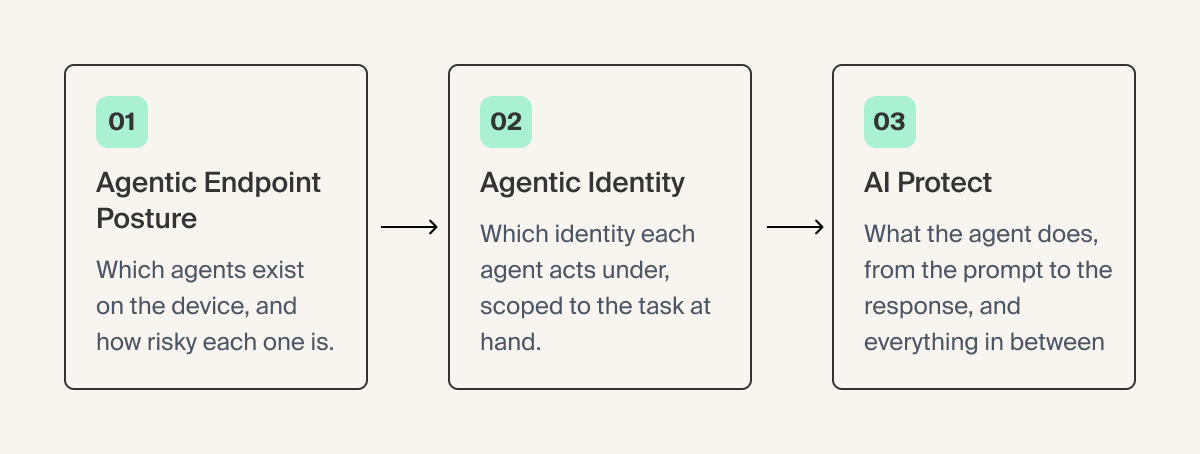
Consider an agent checking a user's unread Slack threads. The tool call is the agent asking Slack for that data. The tool response is the list of messages that comes back. AI Runtime Protection inspects both, in full content, not a metadata summary. Multiply that across a session, and you get a complete record: which agent ran on which device, what it called, what it touched, and what came back. This data is enriched with context, such as the conversation topic and violations that have occurred. AI Runtime Protection then continuously processes this data to identify important, actionable insights that help you understand what users and agents do in your environment and any risky actions they take.
This visibility is used to automatically detect and stop threats and risky actions. What one interaction hides, the session reveals.
What one interaction hides, the session reveals
Real-time classifiers sit inline and catch known threat types the moment they occur: prompt injection, jailbreak, agent drift, malicious URLs, malicious MCPs, data leakage, and unwanted content. Island built them as small, single-purpose models rather than sending every check through a general-purpose large language model. That design keeps them fast enough to sit on the wire without adding friction to the interaction.
Island AI Runtime Protection incorporates a long list of guardrails from data protection, security, web filtering, to ensuring all the interactions are well behaved with content moderation.
On top of that, every tool and skill usage is inspected, from which skill is used, to what was the bash command that ran, and whether it was a destructive one.
When AI Runtime Protection stops an agent, it tells the agent why. Most security tools only know how to talk to a person, so a block just ends the interaction. An agent drafting a customer reply that tries to include a full account number gets stopped and told why, and it rewrites the reply without the number instead of failing the task outright.
Beyond enforcing policy at runtime, AI Runtime Protection brings risky sessions and agentic activity across the organization into view, the kind no single interaction would expose on its own. Two detection engines do that work inside Island's own infrastructure. The first catches known patterns across an entire session. The second, agentic investigators, examines the data the way a person working an incident would, with no fixed rule to follow. Consider an agent that pulls account data from Salesforce and writes it to a personal Google Drive. Static rules won’t flag that on their own. An agentic detector reads the sequence and raises it as an incident.
No blind spots: one policy engine across every agent surface
None of this works from one vantage point, so AI Runtime Protection runs at every control point an agent can touch: the Island Enterprise Browser, the Island Extension, Island Desktop, the Island Network, the Island MCP Gateway, the Island browser MCP server, an LLM Gateway integration, inference hooks, API integrations (including the Claude Compliance API), EDR and MDM integrations, and open telemetry ingest.
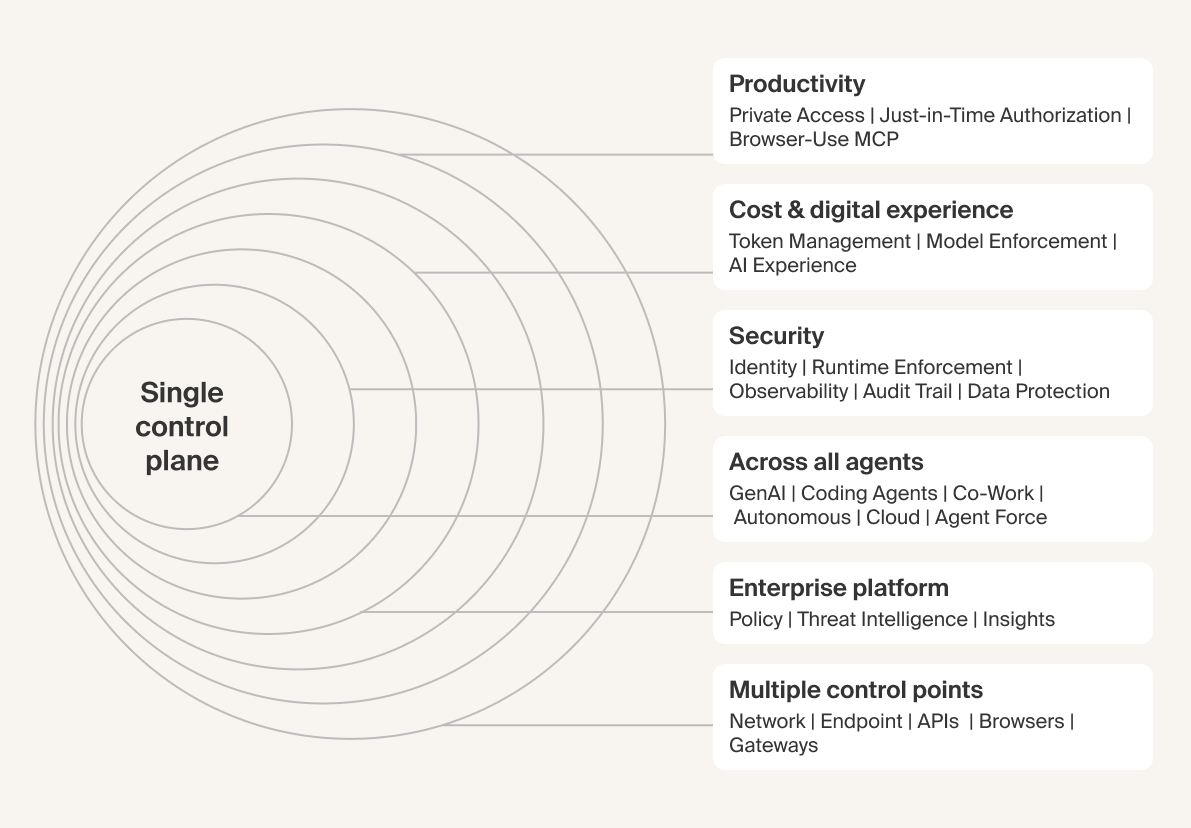
Coverage alone isn't the differentiator. Two things come out of covering every control point natively, and neither is easy to copy: breadth and depth.
Breadth is coverage of the agent itself, not just one surface. Any agent, on any vendor's stack, gets covered fast, because there's a control point to plug into no matter how it's deployed. Covering the agents you already know about isn't enough; you need a path in for the ones you haven't found yet.
Depth is what breadth buys you: the full session, not fragments of it. Because AI Runtime Protection sits at every control point directly, it sees what an agent requested on the network, which files it touched on the endpoint, what was pasted into it in the browser, and the full content of every prompt and tool call, tied into one chain from the instruction that started it to the action that ended it. This gives organizations complete control over what tools, MCP servers, and skills are allowed to be used by agents, including in what scenarios that access is allowed, what users and user groups whose agents can access them, what device security posture is required for access, and many other granular attributes.
Here is an example: an agent asked to summarize an email hits a hidden instruction it was never supposed to follow. It downloads a script to act on it. The script pulls a sensitive file off disk, and that file leaves the endpoint for an external domain. A network tool sees only the last step, a file leaving on the wire. An endpoint tool sees a file get touched. Neither sees the email, the hidden instruction, or the tool call that ran the script, so each logs a low-severity event that never connects to the others. AI Runtime Protection sees the whole chain, from the email to the egress, tied to the session and the person who asked for the summary.
.png)
The bottom line
Agent risk lives in actions, not headcount, and that math already outpaces the per-user model most security tooling was built on. Agents are already inside the organization, taking actions nobody is watching, on surfaces most of the current stack was never built to see.
Closing that gap takes complete visibility of the entire agent lifecycle: the prompt, every action taken, every resource interacted with, and the response. Threats, risky actions, and destructive actions need to be detected in real-time and prevented. Island AI Runtime Protection gives organizations complete control over what agents are allowed to do, including what tools, MCP servers, and skills they can use, in what scenarios, for which users and groups, and on which devices. All of this is governed by policy with complete audit trail.
To learn more about Island AI Runtime Protection, schedule a demo.
FAQs
What does Island AI Runtime Protection cover that point solutions don't?
Most point solutions cover only part of an AI interaction. AI Runtime Protection covers everything that happens once an agent starts working. That covers the prompt it receives, the response it generates, every tool call it makes, the files it accesses, the skills and sub-agents it invokes, and everything that comes back from all of it. AI Runtime Protection surfaces the risk in those actions, blocks a harmful one before it runs, and enforces policy at runtime.
Does AI Runtime Protection take action or only provide visibility?
AI Runtime Protection takes preventative measures against agent actions based on policy and detections. For example, AI Runtime Protection can detect when an agent is attempting to exfiltrate sensitive information outside of corporate-owned resources or to perform an unintended destructive action. When it does, it prevents that action from being performed, provides context to the agent on why the action cannot be performed, and logs the action for the administrator.
How does Island AI Runtime Protection work with Agentic Endpoint Posture and Agentic Identity?
Agentic Endpoint Posture discovers which agents and agentic resources exist, and Agentic Identity governs which identity each one acts under. AI Runtime Protection then uses this information to allow organizations to govern all agentic actions by policy, detect threats and risky actions in real time, and prevent those same actions.
What happens to the agent's task when an action is interrupted?
AI Runtime Protection tells the agent why. Most security tools simply end an interaction when a policy is violated, frequently only returning an error code. With AI Runtime Protection, an agent that violated a policy gets stopped and told the reason, allowing them to continue working with full knowledge of what is and isn’t permitted.
What does Island add on top of a vendor's compliance API for EU AI Act conformance?
We provide complete visibility into every AI conversation and agent action. This creates one comprehensive audit trail exportable for SOC 2, ISO 27001, and EU AI Act conformance.
.avif)
Tamar Cohen is a Product Manager at Island, leading AI Protect. Her work focuses on defining how enterprises can safely operationalize AI, from preventing sensitive data leakage to controlling how AI agents execute actions across production environments.

.png)
.png)
.svg)
.svg)

