.svg)
Where AI Security Breaks Down
Research from 455 cybersecurity practitioners documents how agentic AI, browser blind spots, and governance gaps are reshaping enterprise security strategy (and how leaders are responding).
.png)
Enterprise security programs spent years building perimeter defenses, compliance frameworks, and identity controls. Now, though, AI tools are becoming embedded in daily workflows faster than security teams can evaluate, approve, or write policies to govern them, and the perimeter is suddenly irrelevant.
Cyber Security Tribe's 2026 Annual State of the Industry Report puts hard numbers on where security programs stand today. Surveying 455 cybersecurity leaders across technology, healthcare, finance, and manufacturing, the report found that AI governance, agentic automation, and browser-layer visibility are their foremost challenges in 2026, as the pace of AI adoption continues to outrun the controls meant to manage it.
Key findings from the report include:
- AI governance exists on paper but enforcement is inconsistent and not always effective
- Agentic AI is already in production, and the risks are underestimated
- Traditional security priorities are under pressure from new threat categories
- The browser remains the least visible yet most exploited layer in enterprise security
Together, these and other data-supported results illustrate the security risks and governance challenges cybersecurity professionals are contending with heading into 2026 — and the solutions they are pursuing.
1. AI governance exists on paper, but enforcement is the real problem
The report finds that, for the majority of organizations, AI governance policies exist but enforcement does not necessarily follow. Acceptable-use frameworks rely on staff compliance, and employees consistently choose the path of least resistance to get work done. Without a technical control layer that can see what's happening inside a browser session and act on it in real time, policy is effectively guidance — not governance.
- 70% of organizations have AI security policies in place
- 27% are still actively developing them
- 6.7 out of 10 is the average self-reported strictness rating for those policies (with 54% rating their policies at 7 or higher)
The browser is where AI tools, SaaS applications, sensitive data, and employee workflows all converge. Yet most organizations are still protecting that environment from the outside in, relying on policies that depend on employee compliance, network-layer controls that can't see inside a live browser session, and governance frameworks that weren't designed for managing autonomous AI agents.
The enterprise browser was built to handle all of these issues inside the browser where work takes place. Instead of asking employees to self-govern which AI platforms they submit company data to, Island lets security teams define which AI tools are approved, automatically block sensitive data from reaching unsanctioned platforms, and maintain complete audit trails of AI interactions without blocking productivity or creating friction that drives workarounds.
2. AI is both a major attack surface and a major cyber strategy
The report reveals a paradigm shift in enterprise security as AI makes it increasingly possible to detect threats in real time instead of reacting to incidents or audits after the fact.

The attack surface that agentic AI creates, and that these leaders are moving to protect, lives in the browser and the applications employees interact with every day. In 2026, however, leaders are using AI to fight AI-related vulnerabilities, leveraging LLMs and advanced analytics to anticipate threats, detect vulnerabilities in real time, and make proactive, data-driven decisions.
“Every CISO’s dream is to automate threat detection and response,” said report contributor Amar Badri, Mastercards’ Vice President of Enterprise Risk Transformation.
3. Investment priorities reveal where the pressure is highest
Agentic AI crossed from emerging concept to operational reality faster than most security programs anticipated. As one cybersecurity professional explains in the report, organizations are discovering that AI solutions integrated into business processes can bypass the traditional security tools designed to monitor access, credentials, and API calls, typically receiving less scrutiny than human employees.
Security leaders are directing budget toward the areas where existing controls are visibly failing:
- The top three security investments these organizations are prioritizing in 2026: Zero-trust network access (46%); IAM (Identity and Access Management, 42%); and Risk & Compliance solutions (34%).
- Only 6% are including traditional endpoint security and network-based detection and response in their 2026 cybersecurity budgets
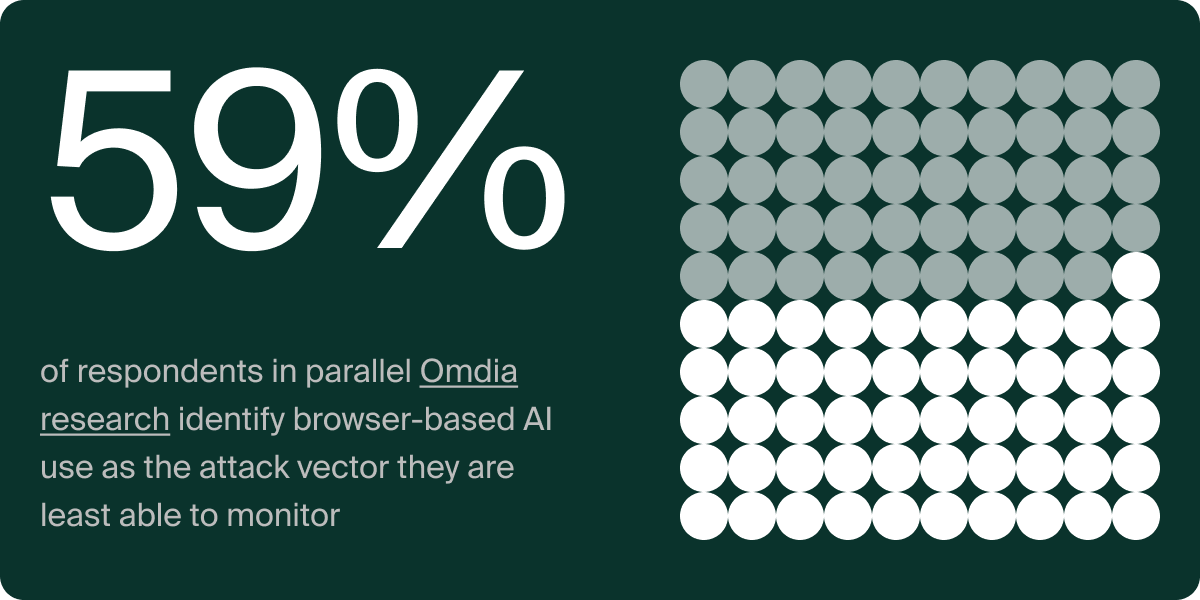
- 59% of respondents in parallel Omdia research identify browser-based AI use as the attack vector they are least able to monitor
Half of all respondents (50%) expect their security team size to remain unchanged in 2026. Budget restrictions that prevent hiring were ranked as the single top concern about employees across the entire survey. The pressure to do more with the same resources is making tool consolidation and architecture efficiency a strategic priority, not just a cost-saving exercise.
Island directly addresses this dynamic. By consolidating what traditionally required multiple overlapping tools — DLP, ZTNA, CASB, extension management, access controls — into a single browser-native platform, organizations reduce both licensing overhead and the operational complexity of managing separate stacks. The same policy framework that governs a managed corporate device extends equally to an unmanaged BYOD device or a third-party contractor's machine, without additional agents, proxies, or infrastructure.
What security leaders actually want: visibility where work happens
The Cyber Security Tribe’s 2026 State of the Industry Report makes clear that security leaders understand where their blind spots are. The AI tools employees are using every day operate entirely within the presentation layer, invisible to the network-level controls most organizations still depend on and not yet adequately governed or controlled by organizational security policies.
The report shows that, while security leaders overwhelmingly support AI adoption within their organizations, they are very concerned about how to control AI use. They are looking for solutions that handle AI access management for employees, role-based permissions for AI use, and detailed logging for all AI-related activity that happens in their organization. Now that AI interactions are a material record of work, the third and fourth items on this list illustrate the need for powerful reporting capabilities in order to comply with regulated discovery of AI.
Beyond AI-specific vulnerabilities, most organizations lack adequate visibility or control over what happens in the browser. Endpoint protection platforms have limited visibility into browser activity. SASE platforms cannot see local actions like copy, paste, file saves, or print. When respondents were asked what they expect from an enterprise browser, security risk reduction was the leading answer (82%). Zero Trust capabilities, data loss prevention, and AI controls rounded out the most-requested capabilities to close the gaps practitioners are experiencing in their current security stacks.
The Island Enterprise Browser is built to close exactly those gaps. Island operates within the presentation layer to provide security teams the real-time visibility and control that network-based tools fundamentally cannot. Security controls work in the background without disrupting users, AI governance is enforced at the point of interaction rather than after the fact, and every user action involving sensitive data is visible, governable, and auditable — whether the employee is on a managed device, a personal laptop, or a third-party contractor's machine.
Read the report for more and deeper insights
This overview covers the key findings from Cyber Security Tribe's 2026 Annual State of the Industry Report: AI governance gaps that policies alone can't close; agentic AI adoption that is moving faster than the controls designed to govern it; and a sustained investment push toward Zero Trust, identity, and data security driven by intensifying regulatory pressure.
But the report goes well beyond what we've covered here. It also examines:
- How cybersecurity hiring criteria are shifting as AI reshapes entry-level roles and experience requirements, and what skills senior leaders are prioritizing that didn't exist three years ago
- How boards are being briefed — and where their understanding breaks down — and what it takes to earn durable support when security decisions start affecting cost, timelines, and risk tolerance
- How organizations are approaching post-quantum cryptography readiness at a time when most haven't yet begun preparing and lack of internal expertise is the number one barrier
Download the complete Cyber Security Tribe 2026 Annual State of the Industry Report to see all the data.
FAQs
Q: The report found 70% of organizations have AI policies in place but depend primarily on voluntary compliance by employees. Can Island help with policy enforcement?
Policies that rely on employee compliance are guidance, not governance. Island enforces AI policy at the point of interaction — automatically blocking sensitive data from reaching unsanctioned AI tools, restricting which platforms employees can submit company data to, and maintaining complete audit trails of AI activity. The control is technical, not behavioral.
Q: If traditional security tools like SASE and endpoint protection can't see inside a browser session, what are organizations actually missing?
Copy-paste actions, file transfers, AI prompt submissions, and credential use all occur at the inside the browser where network-based tools have no visibility. Island operates natively at that layer, making every user interaction with sensitive data visible, governable, and auditable in real time.
Q: The report identifies agentic AI as a fast-growing vulnerability. How does Island help organizations govern AI exposure and risk?
Because Island controls the presentation layer, it can define boundaries around which applications AI agents can interact with, what data they can access or move, and where that data can go. That governance applies consistently across managed devices, unmanaged devices, and third-party contractor machines — without additional agents or infrastructure.
Q: Security budgets are flat but the threat surface keeps growing. How does Island help organizations do more with the same resources?
Island consolidates capabilities that traditionally required separate tools — DLP, ZTNA, CASB, extension management, and access controls — into a single browser-native platform. That reduces both licensing overhead and the operational complexity of managing multiple overlapping stacks.

Andrew is a Product Marketing Manager at Island, working closely with the product and engineering teams behind all of Island's products. With over 12 years in cybersecurity, Andrew has built deep, hands-on expertise across network security, identity and access management, cloud native security, browser security, and AI security. He works close to the product, using the tools he's responsible for daily, building and maintaining demo environments, and translating technical capabilities into real-world security outcomes. His work bridges the gap between how a product actually works and why it matters.




.png)
.svg)
.svg)

