Island MCP Gateway: Control agent access
The Island MCP Gateway gives every AI agent a single governed way to reach the tools it needs, with nothing to deploy
AI agents are only as useful as the resources they can reach. The Model Context Protocol (MCP) is how AI apps and agents reach SaaS apps, such as Salesforce, Slack, Jira, Google Drive, and GitHub, and internal systems. Users often turn on MCP connectors so their agents can use tools associated with these apps, such as retrieving a record, closing an issue, or deleting a document. Security is often left without a way to adequately see and control this activity.
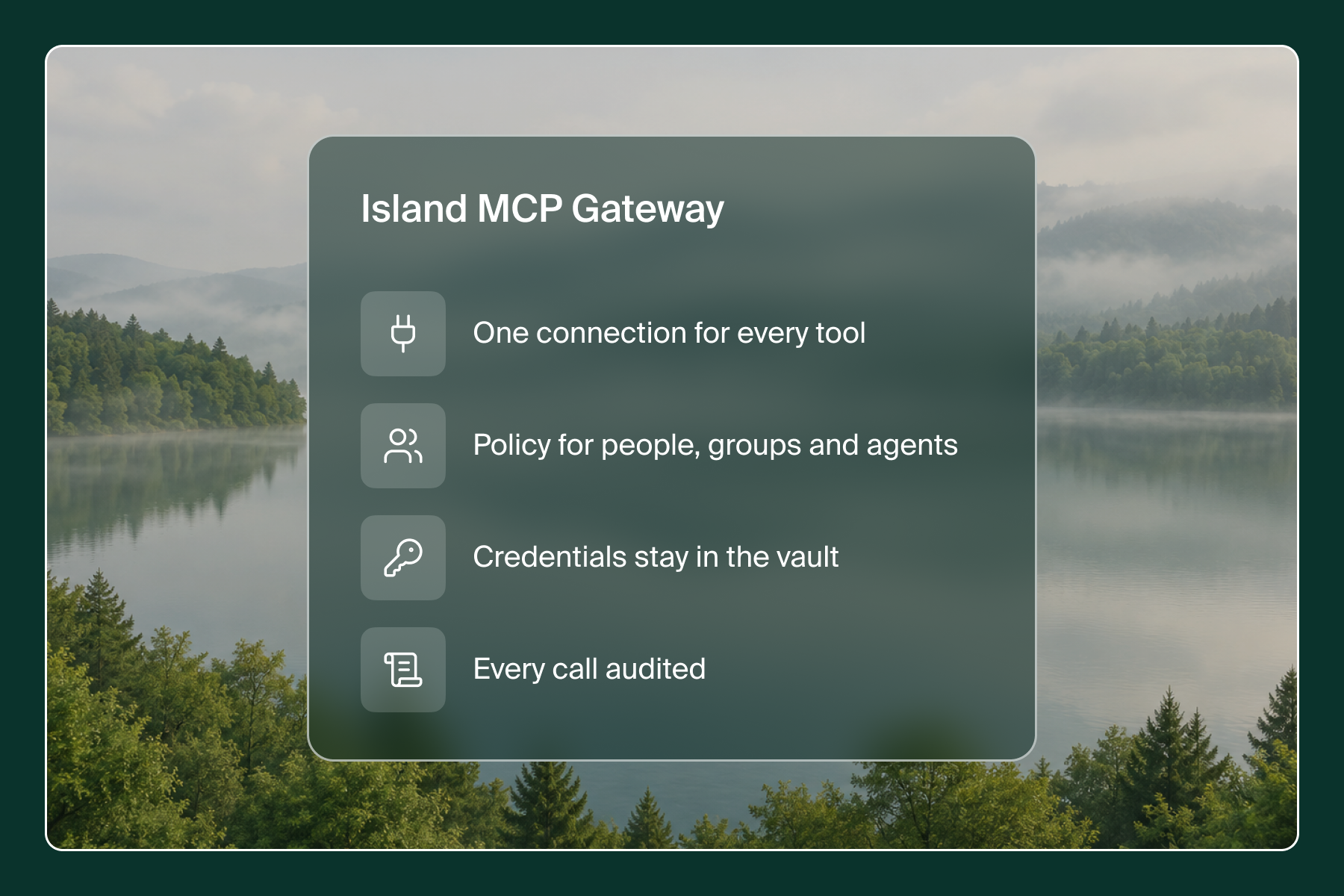
The Island MCP Gateway is a cloud-hosted gateway that an AI client connects to once, in place of configuring many MCP servers separately. The gateway then brokers all MCP connections, giving organizations access control, data protection, and governance over every tool call. To do this, it utilizes Island’s proven data loss prevention, networking, and digital experience monitoring capabilities.
MCP today, one server and one token at a time
Without an MCP gateway, MCP servers are connected client by client. Each connection holds its own long-lived token, usually in a config file the agent can read. Nobody decides centrally which tools an agent may call, which resources it can access and nothing inspects what goes into a tool call or what comes back. No attributed record shows what an agent did, or on whose behalf, outside of the destination apps themselves.
The servers themselves carry their own risk. Island threat research scanned 33,563 public MCP servers, and nearly half returned at least one security finding.
Security teams end up with two bad options. They can block MCP connections and lose the productivity, or allow it without guardrails, which risks data loss, exfiltration, or destructive actions.
The Island MCP Gateway
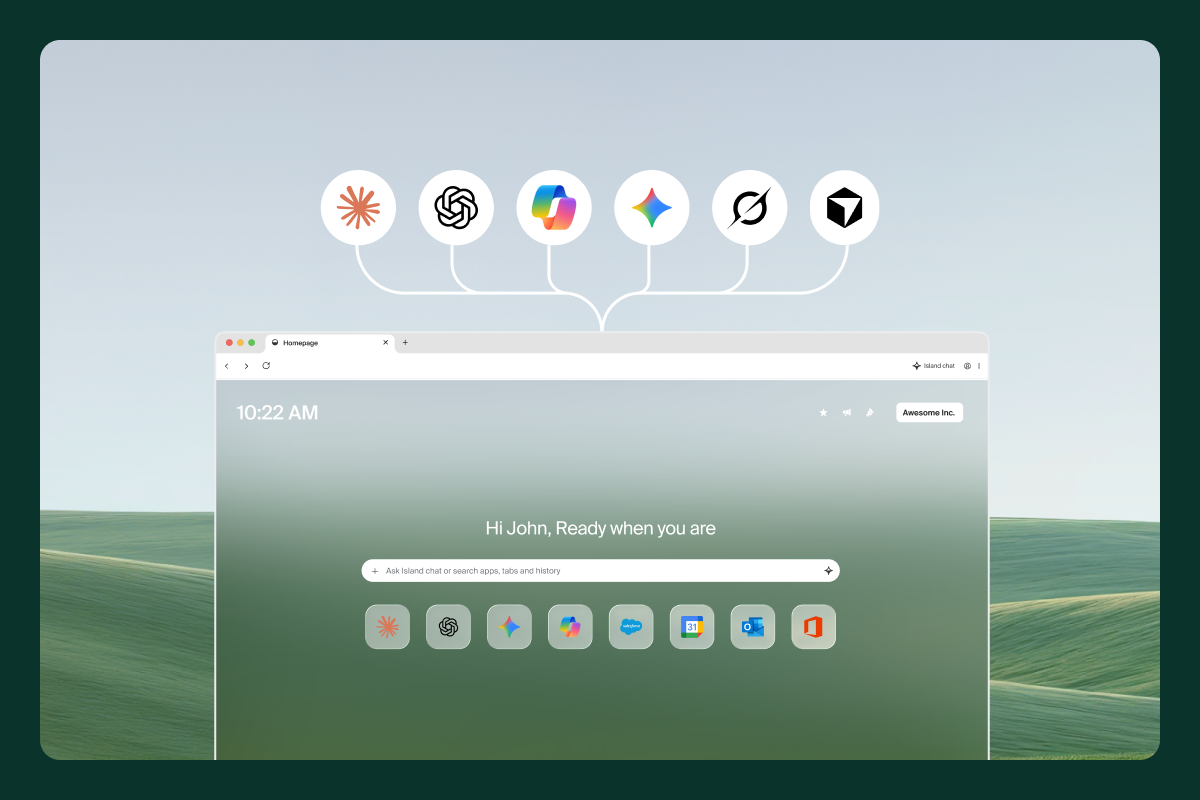
An AI client adds the MCP Gateway like any other remote MCP server, with one URL and one sign-in. It is AI Client agnostic, works with MCP-capable clients such as Claude, Cursor, GitHub Copilot, and Codex. Headless and cloud agents connect the same way, through any standards-compliant MCP client.

Now instead of a client connecting directly to the MCP server, the gateway acts as a controller. Policy decides which integrations and tools each user, group, or agent can reach, when, and under what circumstances.
The gateway does two jobs at once. For teams building with agents, it is a curated, one-click way to connect to the tools they already use. For security teams, it allows them to control who can call what, inspects traffic in both directions, and keeps a full audit trail.
Keeping agents on the governed path
A well known challenge of gateways is ensuring that users and agents are unable to go around them to circumvent policy enforcement. Island solves this by using Island Desktop or the customer’s existing mobile device management (MDM) solution to keep traffic pointed at the gateway and Island Network to block other MCP hosts. Agent hooks add runtime control over MCP servers that run locally on a device. Agentic Endpoint Posture finds the unsanctioned AI tools and MCP servers already in use across the organization, allowing admins to govern them through the gateway.
Every tool call runs the same pipeline
Every call passes the same steps. The gateway resolves the agent and caller's identity, and Tools Policy decides if access is allowed. Sensitive data in the tool call is identified and allowed, redacted, or blocked according to policy. Island Vault holds all MCP credentials, preventing AI apps and agents from accessing them directly. When a tool call is approved, Island injects the credential upstream and forwards the call to the MCP server. The response gets inspected as well, and every interaction becomes an attributed audit event.
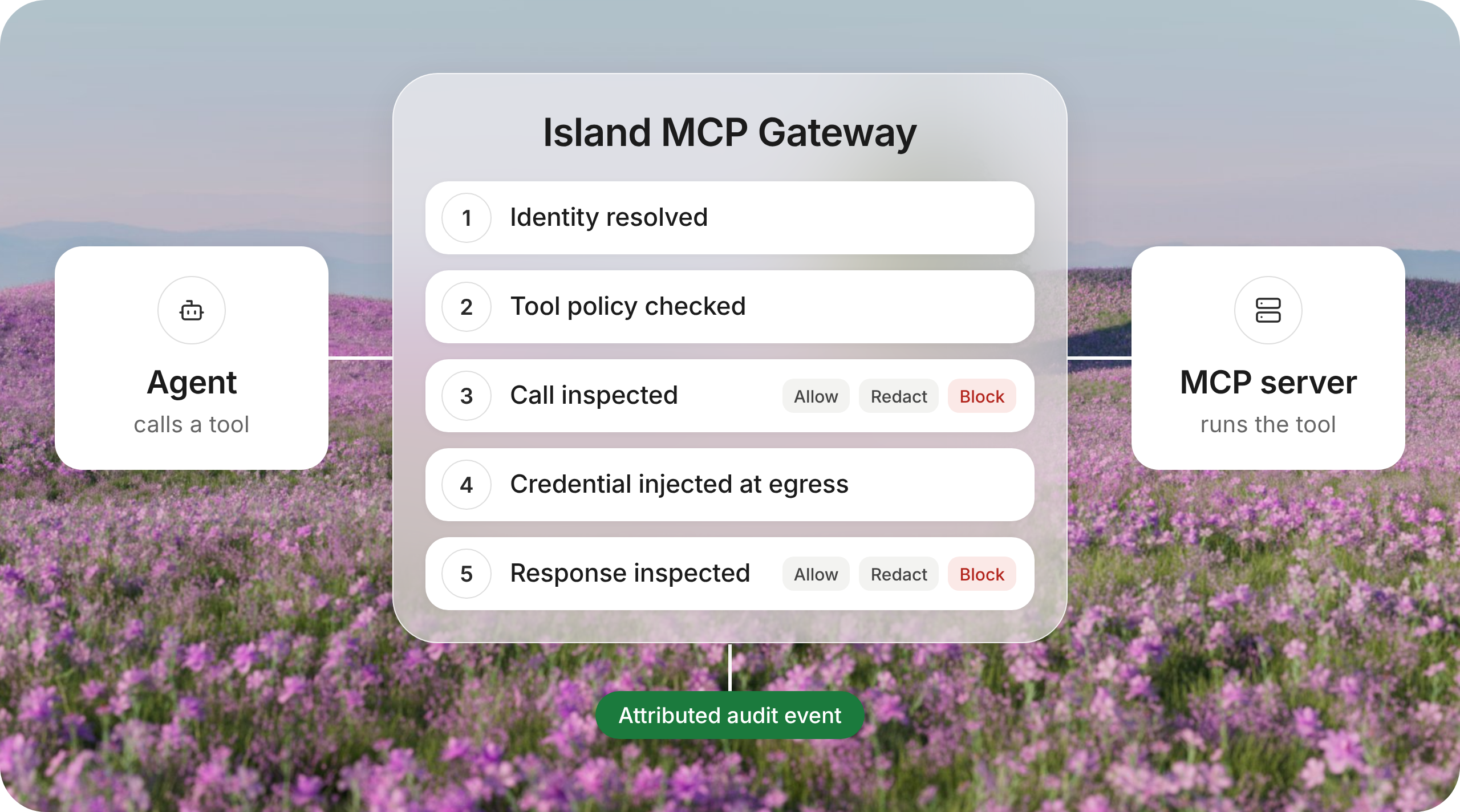
Built-in tool search keeps the tool footprint small, so a large catalog does not flood the model's context window.
Inspection reads intent as well as content. The gateway requires the AI client to state its reasoning for each tool call, and runtime protection weighs that reasoning with the call.
Access tokens never reach the agent
The agent gets results, never secrets. That is the core guarantee of the MCP Gateway.
The Island MCP Gateway supports several different authentication methods, giving administrators control over how they want users to identify their agents and how agents should access company resources. Island Vault stores every credential encrypted and injects it only on the upstream call. The agent authenticates to the gateway, and the gateway authenticates onward.
Block one agent from one tool at the gateway and the underlying credential stays intact, so nothing else that uses it breaks. This also simplifies credential rotation. Simply cycle the credential on the MCP Gateway and everything else works as it should without ever noticing the change.
Policy for people, groups, and agents
A tools policy is granular. Admins allow tools by risk category, or by exact tool, for each user, group, or agent. A common starting point is a read-only or no-delete rule on customer relationship management (CRM), human resources, and storage systems. Users can also turn integrations, categories, or individual tools on or off for themselves, within what admin policy allows.
Internal MCP servers with no inbound exposure
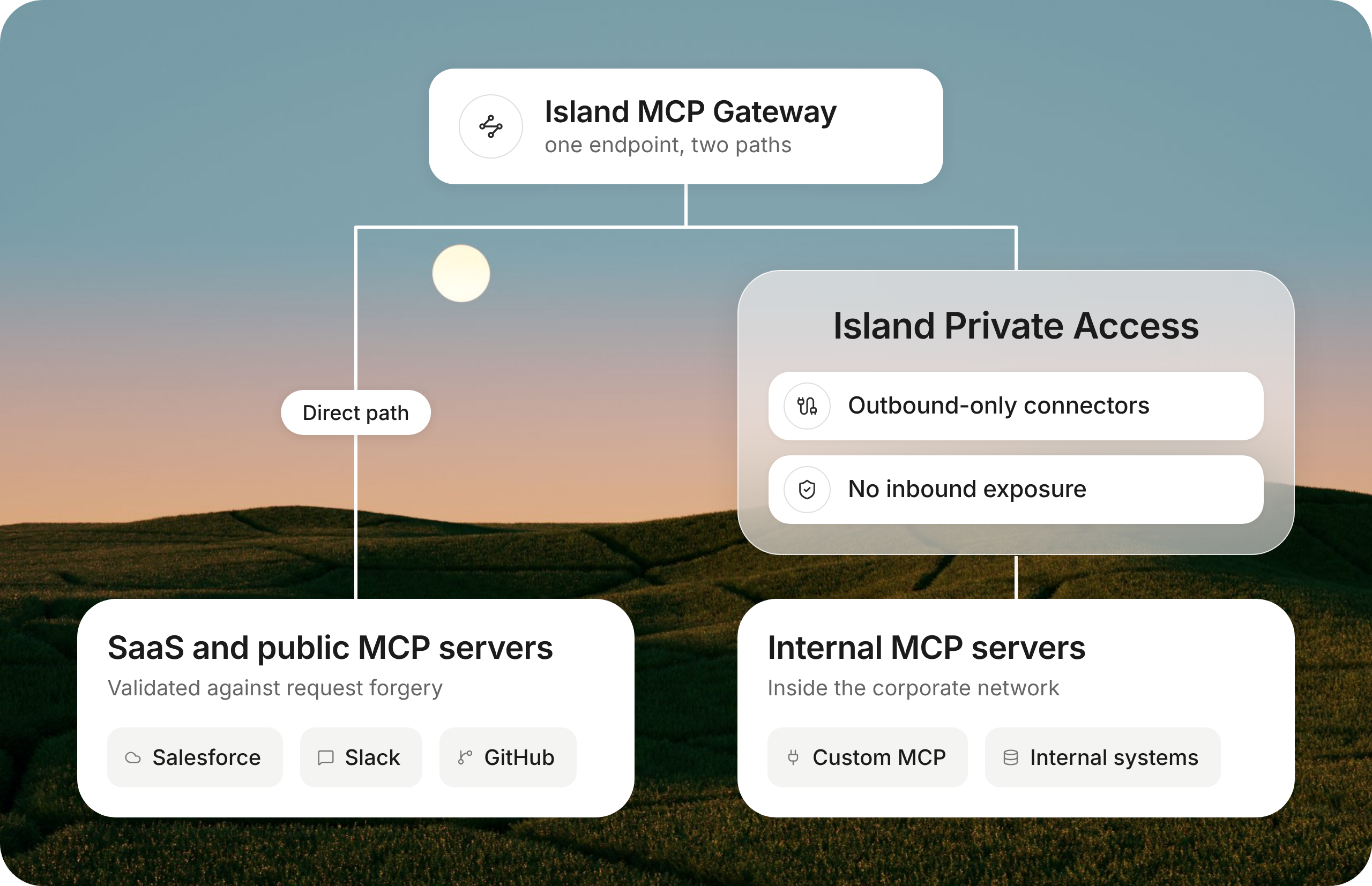
Traffic to SaaS and public remote MCP servers takes the direct path, validated against server-side request forgery. Traffic to internal servers marked for private access travels through Island Private Access and its outbound-only connectors. Agents reach the MCP servers an enterprise builds for its own systems, and those servers stay off the public internet.
A record of what every agent did
Every interaction produces an audit event attributed to the user and agent behind it, and events are exported to your SIEM. This gives administrators a record of every time an agent attempted to access a company resource, which can then be used for compliance or forensic investigations. Additionally, payload artifacts, such as images, documents, or other files, can be stored for additional context.
One control plane for all agents
The MCP Gateway is the tool-call control point of the Island Enterprise Agentic Control Plane, the architecture in which one policy governs human and AI workers alike. Through it, every agent in any client reaches its tools on one governed path, where Island verifies identity, inspects data in both directions, keeps credentials out of the agent's hands, and ties every action to the person behind it. Agents get the reach that makes them useful while security gets the governance it needs, all from a single control plane that covers all agents and AI apps.
To see the Island MCP Gateway in action, schedule a demo.

Gal Navon is a Product Manager at Island, where he leads non-human identity and the MCP Gateway. He builds products that give enterprises visibility and control over the identities and access of AI agents across their organization, allowing them to safely adopt generative artificial intelligence and AI agents.