Operational resilience in financial services: what regulators expect when the cloud goes dark
Regulators in the EU, UK, US, and Canada now write their rules around one assumption: a critical provider will fail. They want proof your firm can keep working when it does.
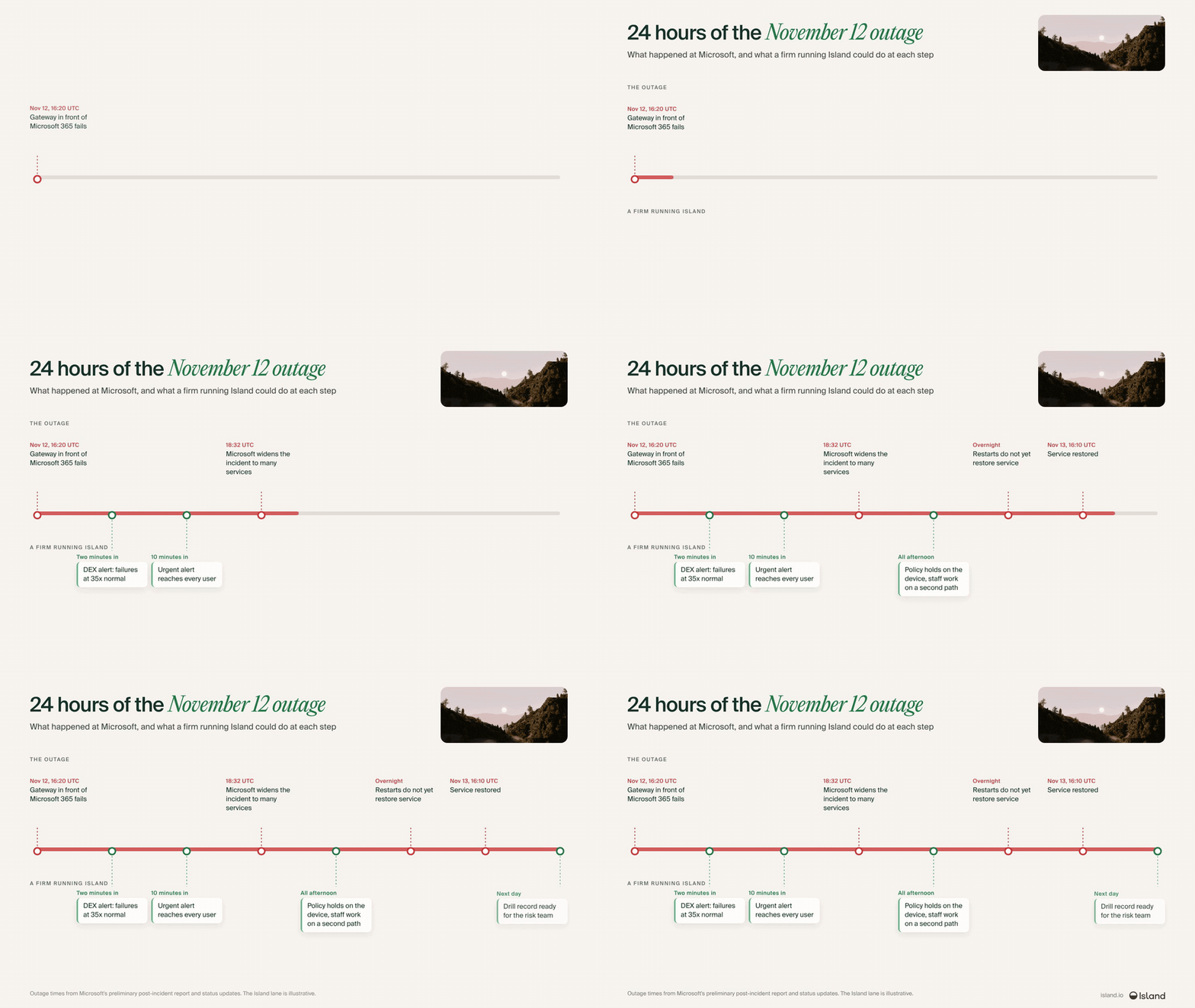
On November 12, 2026, a fault in the network gateway that fronts Microsoft 365 disrupted Exchange Online, Teams, SharePoint, and Copilot for users around the world. Microsoft's preliminary post-incident report places the start at 4:20 PM UTC that Thursday and the end at 4:10 PM UTC the next day. For close to 24 hours, many organizations lost email, chat, file sharing, and the link scanning that sits in front of the inbox, all at once.
No customer can prevent an outage at a hyperscaler. A firm can decide how much of its work depends on one provider staying up, and what its people can still do when that provider goes down. Operational resilience comes down to those two questions. In financial services, supervisors in the EU, the UK, the US, and Canada ask them alongside the board, and several expect written evidence of the answer.
One outage removes several safeguards together
Most continuity plans were written for a lost data center or a flooded office. Today's risk looks different. Identity, email, collaboration, link protection, and security alerting often come from the same provider, so when it fails, the tools a team would use to coordinate the response fail with it. During the November outage, IT teams at many firms had no easy way to tell employees what was happening, because the usual channels were the ones that were down.
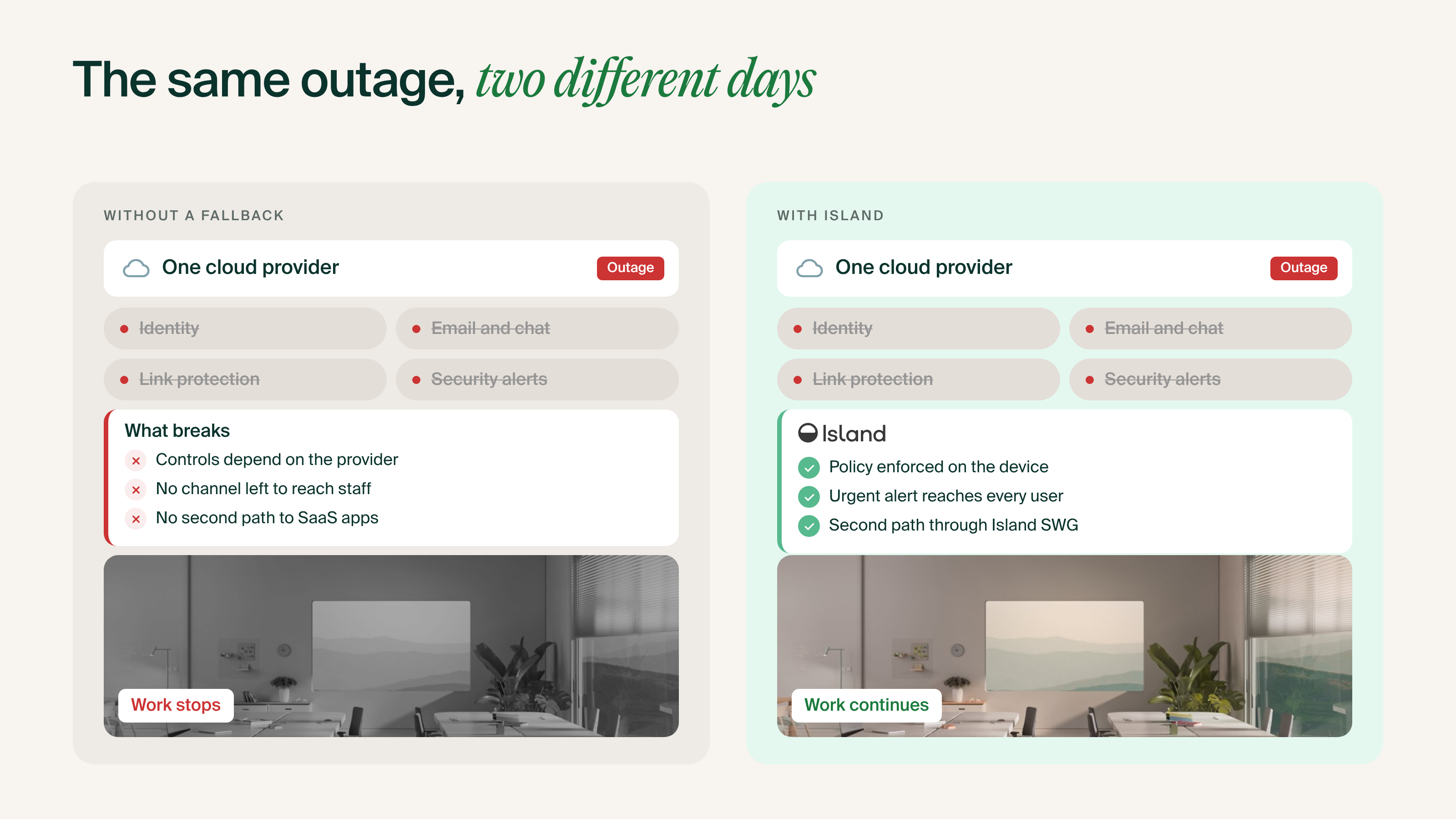
Regulators have spent the last six years writing that scenario into their rules. The work traces back to the Basel Committee's Principles for Operational Resilience, published in March 2021, which shifted supervisors' attention from preventing every disruption to keeping critical services running through one. Each jurisdiction has since turned that idea into its own requirements.
What regulators in Europe and North America expect
Europe
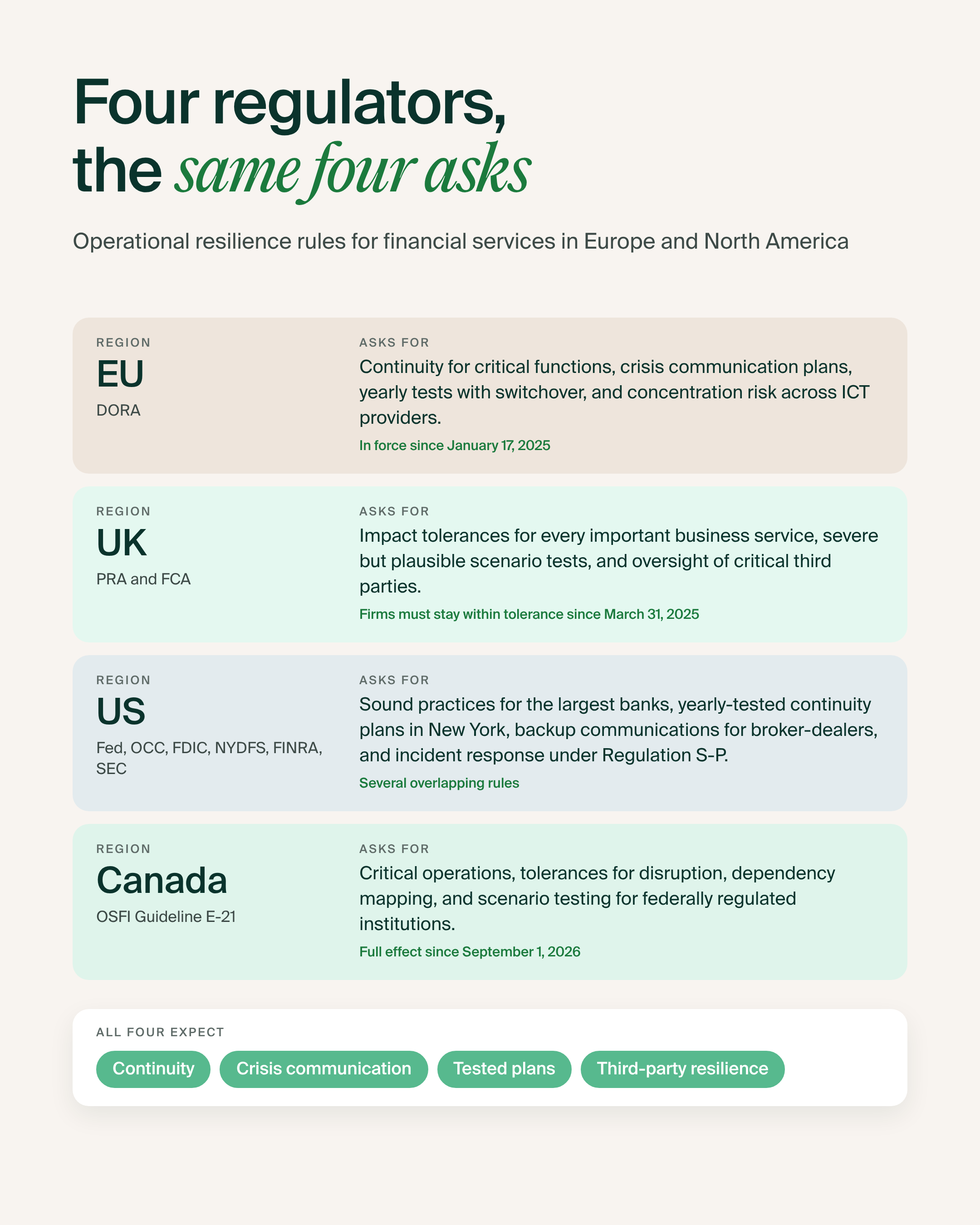
The Digital Operational Resilience Act (DORA) has applied to EU financial entities since January 17, 2025. It requires continuity plans for critical functions, crisis communication plans, yearly tests that include switchover to redundant capacity, and an assessment of concentration risk across information and communication technology (ICT) providers. Designated critical ICT providers now fall under direct EU oversight.
United Kingdom
Since March 31, 2025, firms regulated by the Prudential Regulation Authority (PRA) and the Financial Conduct Authority (FCA) must stay within an impact tolerance for each important business service, even when a supplier fails. A separate regime, in force since January 1, 2025, lets regulators oversee critical third parties directly.
United States
No single rule applies. The Federal Reserve, the Office of the Comptroller of the Currency (OCC), and the Federal Deposit Insurance Corporation (FDIC) set sound practices for the largest banks. The New York Department of Financial Services (NYDFS) requires a continuity plan with a communication plan, tested every year, and Financial Industry Regulatory Authority (FINRA) Rule 4370 requires backup communications with customers and staff. The Securities and Exchange Commission (SEC) added incident response and service provider breach notice to Regulation S-P.
Canada
Guideline E-21 from the Office of the Superintendent of Financial Institutions (OSFI) has been in full effect since September 1, 2026. Like the UK rules, it asks federally regulated institutions to identify critical operations, set tolerances for disruption, and test against severe but plausible scenarios.
What the rules have in common, and where Island fits
Read side by side, the four regimes ask for the same few things. This is where each one appears, and how Island helps a firm meet it.
Each regime assumes that a provider will eventually fail, and asks what the firm can still do when it does.
The four moments of a disruption
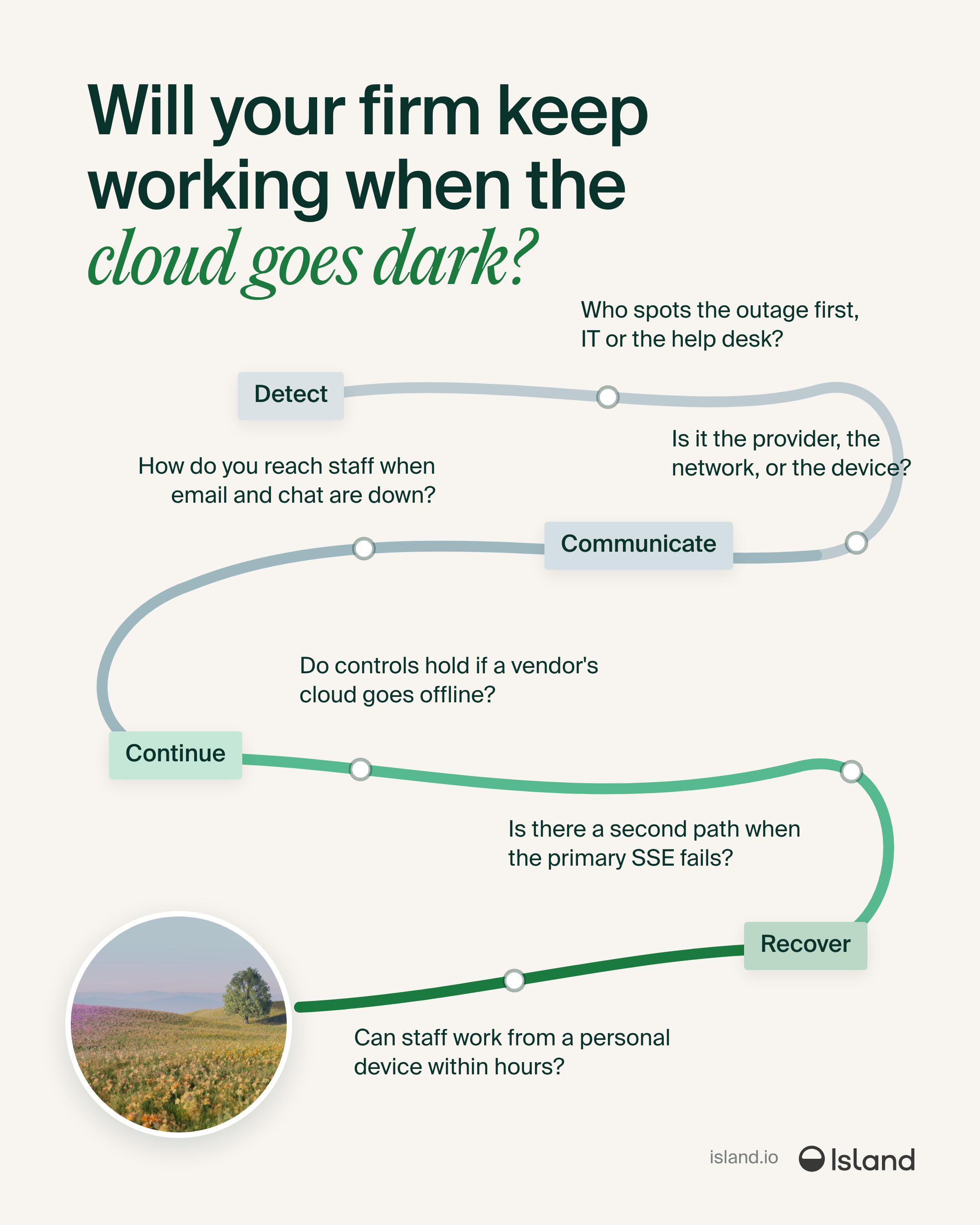
Every outage moves through the same sequence. Someone has to notice it, people have to be told, work has to continue, and the organization has to recover. Island builds a capability into each moment, across the Enterprise Workspace, Network, and Data product lines.
Detect
Help desk tickets are a slow sensor. Island Digital Experience (DEX) measures page loads, HTTP errors, connection failures, and crashes from the user's side, and it raises a real-time alert within one to two minutes when ten or more employees hit the same failure on a business-critical app. The alert can go to the console, to Slack, or to ServiceNow.
DEX also shows what kind of failure it is. In one large customer's data from the November outage, failed connections to Microsoft 365 ran at 35 times normal, and the number of devices with failed connections rose from 664 to 9,497. Other sites on the same devices stayed flat, which points at the provider and lets IT stop chasing the network and the endpoints.
Communicate
When email and chat are down, the browser is still open. Island Enterprise Communication puts an urgent alert at the top of each targeted user's screen, with a title, the facts people need, and an optional link to details. Admins choose whether users can dismiss it. During the November outage, one insurer used Enterprise Communication to tell its whole workforce what was down and what to do next. That is the backup employee channel that FINRA Rule 4370, NYDFS 500.16, and DORA Article 14 all ask firms to plan for.

Continue
The Island Enterprise Browser enforces policy on the device. It checks in with Island's cloud for policy changes, and an admin decides what happens if that cloud is unreachable: keep applying the last policy received, or lock the browser until the connection returns. Local Resilience Mode goes a step further, letting first-time users sign in and receive policy from locally stored files when Island's cloud is down.
Island is a provider in your continuity plan too, and every regime above expects you to treat it as one. Because policy runs on the device, an outage on Island's side leaves controls in force.
The network has more than one path as well. Island Private Access (IPA) runs on two independent network fabrics, connectors in a group fail over to each other, and cloud proxies span multiple regions. Island Secure Web Gateway (SWG) can serve as an alternate inspected path beside an incumbent security service edge (SSE). One payments processor used exactly that during an outage at its SSE provider, routing staff around the failure through Island until service returned. For a supervisor asking about concentration risk, that is a second option with its own infrastructure and the same policy.
Recover
The hardest scenario is losing the corporate environment itself, after ransomware or a forced shutdown of domain controllers. Shipping replacement laptops is slow. With Island, staff can install the browser on a personal device, sign in with a fresh identity, and work under the same data controls from the first session. One hospital shut down its domain controllers after an incident, stood up a new identity provider in minutes, and ran on personal laptops for weeks. A bank bought Island for 7,000 users for the same reason: to run a minimum viable bank on any device if its primary environment is lost.
Test it before you need it
An untested plan gives no evidence that it will work, and evidence is what supervisors on both sides of the Atlantic now ask for. Run drills that take Island's cloud out of the path, simulate an identity provider outage, activate Local Resilience Mode, and onboard a small group to personal devices. User events, admin events, and DEX data record what happened, which gives the risk team a record of each drill for a DORA test report, a UK or Canadian self-assessment, or a US examination.
Five questions for your next resilience review
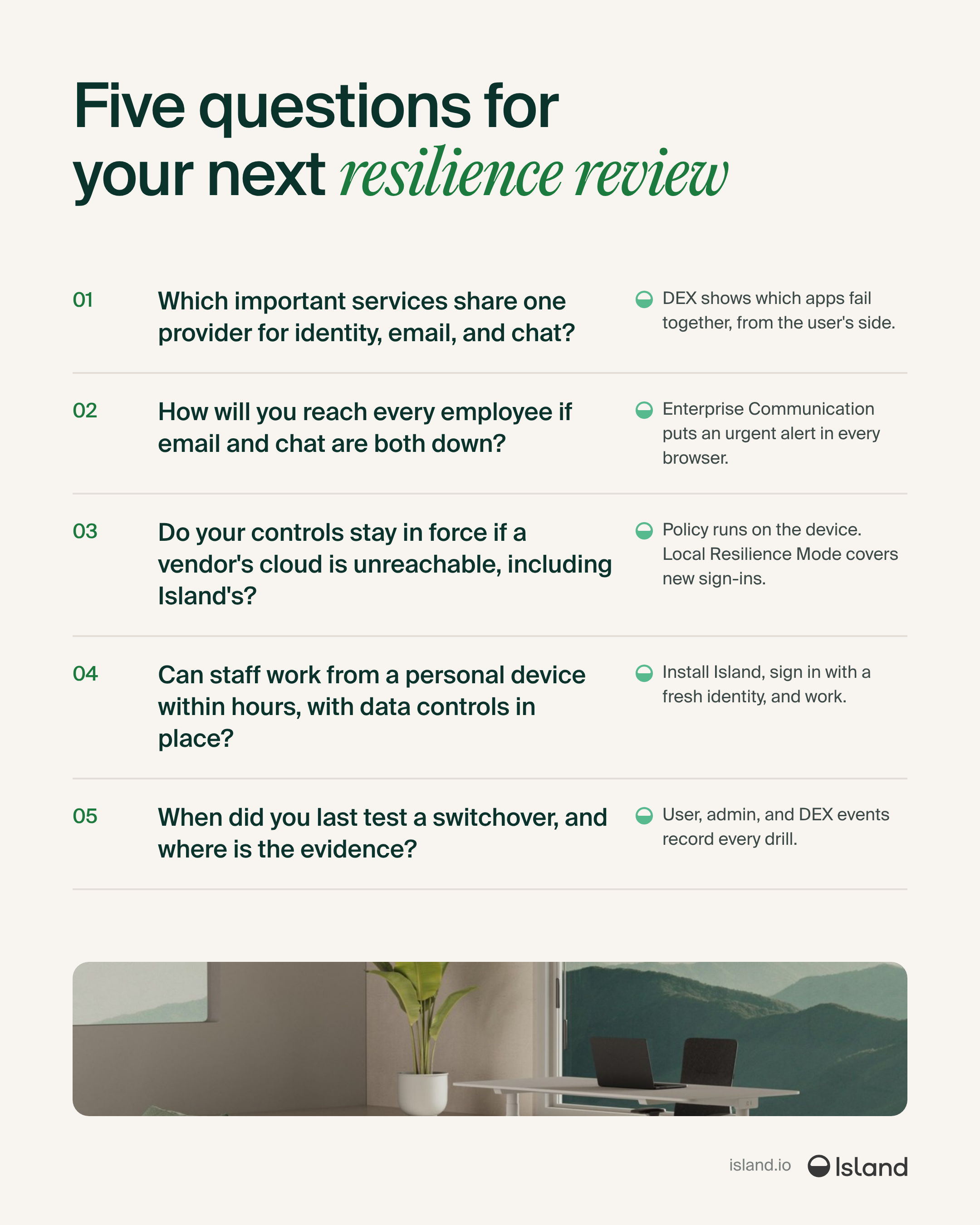
- Which important services share one provider for identity, email, and chat?
- How will you reach every employee if email and chat are both down?
- Do your security controls stay in force if a vendor's cloud is unreachable, including Island's?
- Can staff work from a personal device within hours, with data controls in place?
- When did you last test a switchover, and where is the evidence?
Island's operational resilience brief for financial services maps these capabilities to DORA and the UK rules. Schedule a meeting with Island to walk through your plan.

Matt is the Field CTO, EMEA, at Island, bringing over 30 years of information security expertise, including more than a decade specializing in data and AI security across complex enterprise environments. He works between customers, product, and engineering, turning real-world security challenges into practical technical strategy. He focuses on helping organizations protect the way people actually work, giving them full visibility and control over what employees and AI agents are doing without slowing anyone down. He previously spent 13 years at Varonis, most recently as Field CTO, EMEA. Before that he was Director of Sales Engineers for the UK, where he led the UK sales engineering organization for more than eight years. Earlier in his career, Matt held senior technical roles at Lumension, Websense, and Integralis. He holds a BSc (Hons) in Information Technology from Middlesex University.