.svg)

Key takeaways
- An AI security platform is the unified environment that gives security teams visibility and control over how people use AI at work, so the organization can adopt AI without giving up data protection or governance.
- The core problem it solves is a visibility gap: AI use is spread across sanctioned and unsanctioned tools, and most of it looks like ordinary web traffic.
- The capabilities that matter are visibility at the point of use, data protection across every AI entry point, policy that still lets work happen, and governance you can audit.
- The most durable place to deliver these controls is the point of use, which for most work is the browser.
- Island builds AI protection, governed AI access, and data controls into the environment itself, instead of adding another tool to the stack.
Introduction
Most organizations are under pressure to adopt AI quickly, and their people are already moving. Employees paste customer data into a chatbot, summarize a contract in a new assistant, or try a tool no one has reviewed. The work gets done, but security teams often can't see where company data is going.
That's the gap an AI security platform is meant to close. It's a category that has grown up fast, and the label gets stretched to cover very different things.
This article explains what an AI security platform actually is, the capabilities that define one, and how to tell a real platform apart from a single-purpose feature.
What an AI security platform actually does
An "AI security platform" is the set of controls that lets an organization use AI safely across the business. It gives security and IT teams a clear view of how AI is being used. From there, they can protect data as it moves into and out of AI tools, and set policy without standing in the way of the work.
The word "platform" matters here. A platform governs AI wherever it shows up, from public chatbots to embedded copilots to internal models. A single feature, like a filter on one approved tool, only covers the narrow slice it was built for. The difference between the two is the difference between governing AI and hoping people use only the tool you sanctioned.
Why most security stacks miss AI
Most security stacks were built for a world where data moved through known paths, like files, email, and managed applications. AI breaks that assumption in a few ways.
First, AI use is distributed. People reach for whatever helps them finish a task, so activity spreads across approved tools and a long tail of ones no one has reviewed. Public tools like ChatGPT sit one browser tab away from sensitive work.
Second, AI traffic looks normal. A prompt is just text sent to a website, so it blends in with everyday web activity. Network tools see a connection, not the sensitive data inside the prompt.
Third, the data-exit paths are new. Information leaves through prompts, file uploads, and copy and paste into an AI tool, not the channels older controls were tuned to watch. That's why most data protection tooling has a blind spot for AI, and why the gap between AI adoption and AI governance keeps widening for most teams.
The capabilities that define an AI security platform
If a tool claims to secure AI, these are the capabilities worth checking. Together they describe what a platform does that a point feature can't.
Visibility at the point of use
You can't govern what you can't see. A platform should show which AI tools people use, who uses them, and what kind of data goes in, including the unsanctioned tools that never show up in a procurement list. Visibility has to reach the moment a person interacts with the tool, not just the network boundary around it.
Data protection across every AI entry point
The platform should inspect and control sensitive data as it moves toward AI, whether through a prompt, an upload, or a paste. This is data loss prevention applied to a new surface, and it needs to cover every AI entry point rather than a single approved app. Strong data protection here is what lets a security team say yes to AI instead of blocking it outright.
Policy and control that still lets work happen
Good controls are graduated, not binary. A platform should let a team allow a tool while redacting sensitive fields, warn a user before they paste regulated data, or route a request to an approved model. The goal is to keep people productive while keeping data safe, so security feels like a guardrail rather than a roadblock.
Governance and auditability
Finally, a platform should produce a record. Leaders need to show regulators and auditors how AI is governed, which means consistent policy, clear logs, and reporting that holds up. Recognized references like the NIST AI Risk Management Framework and the OWASP Top 10 for LLM Applications give teams a shared vocabulary for the risks a platform should address. Those risks range from "prompt injection" to sensitive data disclosure.
Why the browser is the natural home for AI security
These capabilities have to live somewhere, and the most practical place is the point of use. For most knowledge work, that point is the browser.
Almost all AI interaction happens through a browser tab, whether it's a public assistant, a SaaS app with AI features, or an internal tool. The browser sees the prompt before it's encrypted and sent, sees the file before it's uploaded, and sees the response before a person acts on it. That makes it the one place where a platform can apply policy with full context, across every tool, without installing a separate agent for each one. It's the same last-mile logic behind zero-trust access: control works best closest to where the user and the data actually meet.
How Island approaches AI security
Island treats AI security as part of the environment, not a tool bolted onto the side. Because work already happens in the browser, the controls live where AI is used.
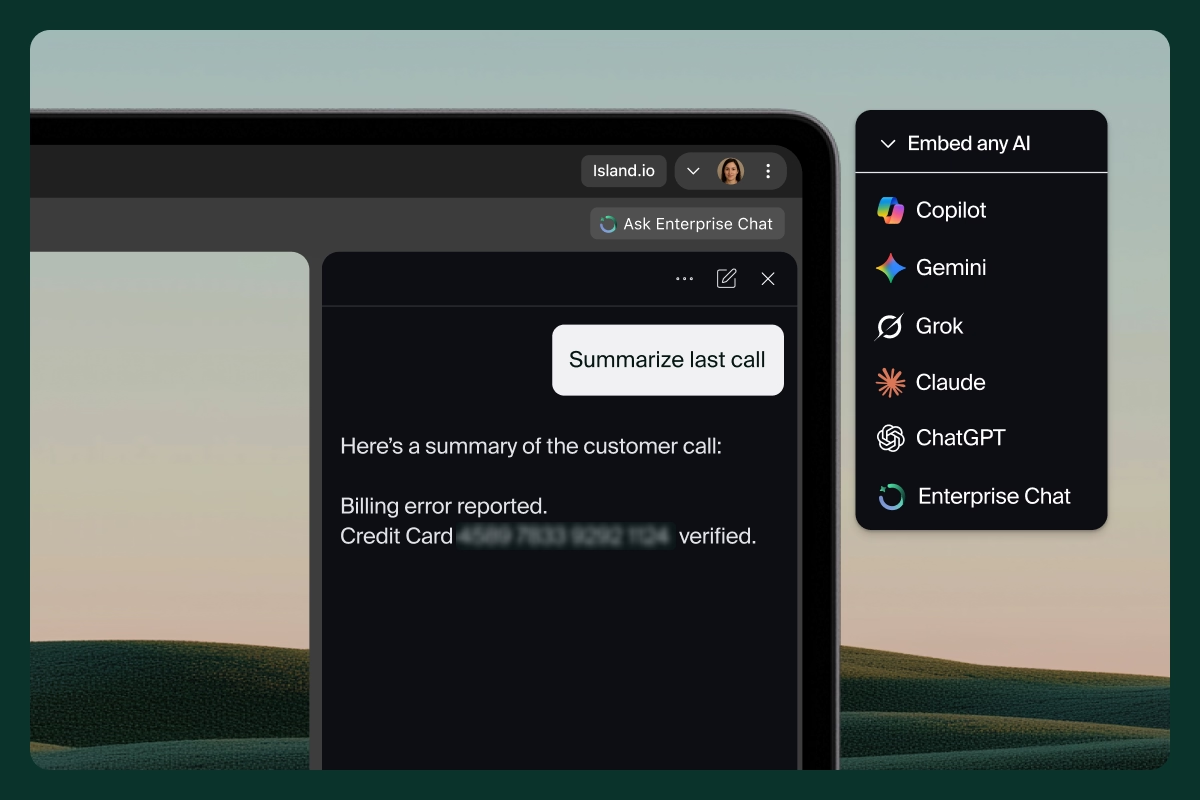
Island Enterprise AI brings these capabilities together. AI Protect gives security teams visibility and control across AI entry points, so they can say yes to AI with the data protection to back it up. A governed AI experience lets organizations bring preferred AI providers into daily workflows under policy, rather than leaving people to find their own. For teams that want a structured starting point, Island also offers a practical playbook for security teams.
The throughline is simple. When visibility, data protection, policy, and governance share one environment, AI security stops being a patchwork and starts being a property of how work gets done.
Conclusion
An AI security platform isn't a single product you switch on. It's the combination of visibility, data protection, graduated policy, and governance that lets an organization use AI broadly without losing track of its data. The platforms that hold up deliver those controls at the point of use, where people and AI actually meet, and treat governance as something built in rather than added later. For most enterprises, that's how AI moves from a source of anxiety to a capability they can trust.
FAQs
Is an AI security platform just DLP for AI?
Data loss prevention is part of it, but not the whole. A platform also gives you visibility into which AI tools people use, graduated policy that can allow a tool while protecting data, and governance you can audit. DLP for AI is one capability inside that larger set.
How is this different from the security features built into our AI vendor?
A vendor's controls only cover that vendor's tool. People use many AI tools, including ones no one has approved, so per-vendor settings leave gaps. An AI security platform applies consistent policy across every AI tool, sanctioned or not, from one place.
Do we still need a platform if we only allow one approved AI tool?
Usually yes. Approving one tool rarely stops people from trying others when it helps them finish a task. A platform gives you visibility into that real-world usage and lets you steer people toward the approved option instead of assuming they already use it.
How does an AI security platform handle unsanctioned or "shadow AI" use?
It watches the point of use rather than a list of approved apps. Because most AI runs through the browser, the platform can see a new or unreviewed tool the moment someone opens it, then apply the same data protection and policy it applies everywhere else.
Where should AI security controls sit in our architecture?
As close to the user as possible. Controls at the network edge see a connection but not the sensitive data inside a prompt. Placing controls at the point of use, in the browser, lets the platform act with full context across every AI tool, which is the same last-mile thinking behind zero-trust access.
How does an AI security platform map to frameworks like NIST or OWASP?
Frameworks describe the risks and the governance you should be able to show. The NIST AI Risk Management Framework and the OWASP Top 10 for LLM Applications give you a shared vocabulary, and a platform is how you put that vocabulary into practice with visibility, control, and an audit trail.

Island is defining the future of work for people and AI agents. Its enterprise agentic control plane helps organizations enable, govern, and audit agentic workforces alongside people. Island boosts productivity across devices, browsers, applications, networks, and data while protecting sensitive information, simplifying access, and helping enterprises scale AI safely.


.svg)
.svg)

