.svg)
Delivering on the 2026 Cyber Strategy for America
How Island operationalizes the six pillars of The Cyber Strategy for America

The 2026 Cyber Strategy for America lays out an ambitious albeit high-level vision: shape adversary behavior, streamline regulation, modernize federal systems, secure critical infrastructure, sustain technological superiority, and build cyber talent. At its core, the strategy emphasizes resilience, deterrence, innovation, and national competitiveness.
It’s no longer viable to tread water in the new AI era. Specifically, this moment calls for unique and immediate action. Island meets the moment by focusing on a safer, faster, and familiar workplace for U.S. federal agencies. The Cyber Strategy for America reinforces this central truth: the browser is now the operating system of mission support—and modernizing it is foundational to achieving national cyber resilience.
Below, we examine the Strategy’s six pillars through the lens of enterprise browser security and explain how Island directly operationalizes its objectives.
1. Shape adversary behavior: shifting from reaction to control
The Strategy calls for proactive disruption of adversaries, cost imposition, and denial of safe haven. Most cyberattacks—phishing, SaaS account takeover, session hijacking, data exfiltration, malicious extensions, and AI-powered social engineering—now originate or execute through the browser. One of the more innovative recent attacks, Shady Panda, changed the behavior of extensions after millions of downloads and years of use.
Island introduces immediate adversarial friction at the point of interaction, increasing the cost of exploitation across every browser session:
- Session-level access controls that continuously validate user activity and intent
- Per-connection inspection of all web activity to maintain real-time visibility and reduce adversarial dwell time
- Browser-native, integrated DLP controls governing data movement in context
- Enforcement against unauthorized or malicious browser extensions to limit attacker tooling and persistence
- Reputation-based controls that evaluate destinations, content, and behavior to proactively reduce exposure to risk
- Protections against credential reuse that prevent the leverage of compromised identities
- Granular, policy-driven enforcement dynamically applied across user, device, and session context
Deterrence begins by assuming exploitation, raising costs, and continuously monitoring to detect threats.

2. Promote common sense regulation: from fragmentation to alignment
The Strategy calls for “streamlining cyber regulations” and reducing compliance burdens so that defense is not reduced to a checklist. In practice, however, the federal cyber landscape is defined by overlapping frameworks and authorities—including FedRAMP, DoW Impact Levels, NIST controls, FISMA, FIPS standards, RMF processes, NSA guidance, CISA directives, OMB memoranda, Executive Orders, NIAP, APL, and dozens of other ‘best practices.’
Each framework was created with a valid purpose. But in aggregate, they often create:
- Redundant control mappings
- Duplicative or greater costs
- Duplicative reporting obligations
- Lengthy authorization timelines
- Compliance-first security cultures
- Conflicting interpretation of requirements by practitioners and auditors
Instead of reinforcing one another, these layers can unintentionally drive competing regulatory gravity—where agencies and vendors optimize for passing audits rather than reducing real-world risk.
The compliance paradox
The Strategy warns against “costly checklists that delay preparedness, action, and response.” This is particularly relevant in federal procurement and cloud authorization environments, where:
- FedRAMP baselines must align with NIST SP 800-53 controls
- DoD Impact Levels add additional boundary expectations
- FISMA reporting overlaps with agency-specific risk metrics
- RMF implementation varies across departments
- OMB and EO directives introduce new modernization mandates
The result can be a compliance maze that slows deployment of innovative security technologies—especially those that do not fit neatly into legacy perimeter-based architectures.
True regulatory alignment requires reducing friction first. Compliance is not mission support. Success is mission support. Adversaries are never encumbered by regulatory conditions – they adapt to what’s in front of them. Speed is essential.
Island addresses this challenge by redefining how security and compliance align with mission support. By consolidating enforcement into a single enterprise workspace with clear data boundaries, Island reduces the need to reconcile overlapping controls across fragmented layers. This simplifies alignment with common frameworks, while enabling faster deployment and more consistent, policy-driven security.
3. Modernize and secure: operationalizing zero trust
The Strategy calls for accelerating modernization, implementing zero-trust architecture, adopting post-quantum cryptography, transitioning to the cloud, and deploying AI-powered cybersecurity. These objectives align directly with NIST SP 800-207, which defines Zero Trust Architecture (ZTA) as a model built on continuous verification, least-privilege access, and explicit trust decisions across its core pillars.
But zero trust cannot succeed if it is implemented only at the network layer. In a SaaS and AI-driven environment, the browser session is the new perimeter.
Why AI exposes gaps in traditional zero trust
The Strategy promotes AI-enabled defense—but AI also magnifies asymmetry:
- Users experiment with and rely on AI tools, often without the agency even being aware of it
- Practitioners try to balance between fully blocking and allowing all AI tools, which could bring chaos
- Attackers use AI to expedite every phase of their campaigns
Traditional zero trust implementations—focused on identity providers, gateways, and network segmentation—were not designed for a world where sensitive data is pasted into AI models. Without shifting enforcement to the interaction layer, zero trust becomes static while AI-driven risk becomes dynamic.
Zero trust modernization requires a new enforcement plane
NIST 800-207 defines centralized Policy Decision Points (PDP) and distributed Policy Enforcement Points (PEP). In modern federal environments, the most consistent enforcement point is the browser itself—the interface for SaaS, internal apps, and AI systems alike.
Island functions as:
- A browser-embedded policy enforcement point
- A centralized policy control plane
- A continuous monitoring surface aligned to zero trust telemetry
In the AI era, modernization is not just cloud migration or micro-segmentation. It is securing the last mile of user activity—where identity, device, application, network, and data converge.
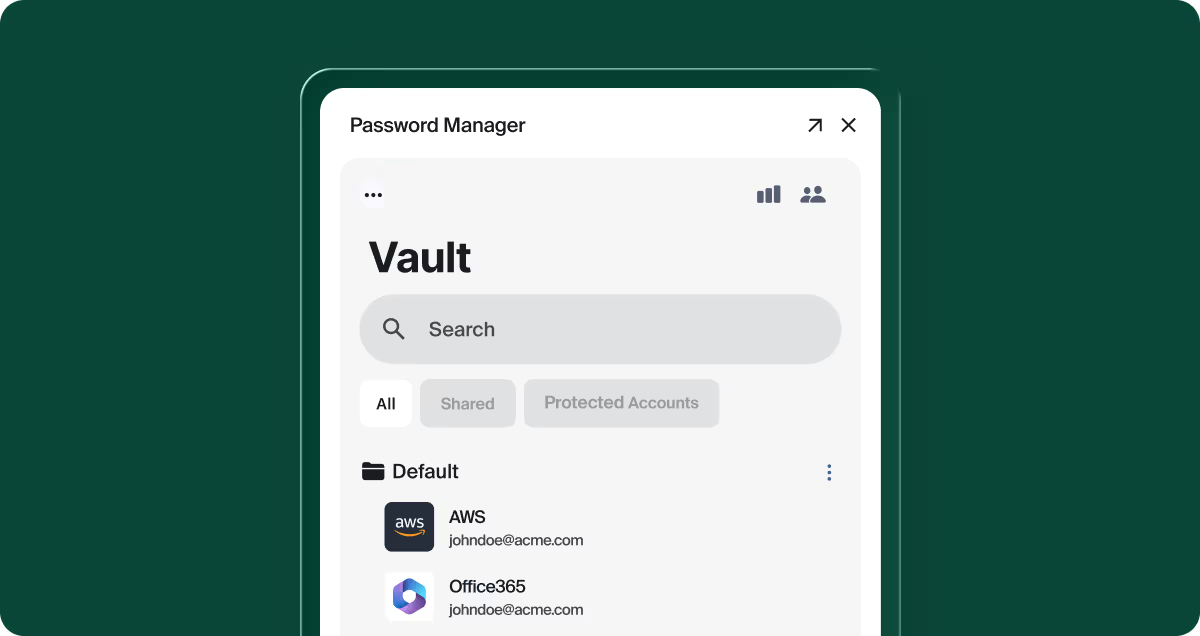
4. Secure critical infrastructure: modernizing password and privileged access in the browser era
The Strategy calls for hardening critical infrastructure and denying adversaries initial access across sectors, including energy, finance, telecommunications, healthcare, water, and defense-adjacent systems. Across all of them, one weakness has persisted for decades: passwords.
From shared administrator credentials to overprivileged accounts with standing access, credential abuse remains one of the most common and scalable intrusion vectors in critical infrastructure.
Privileged access management: necessary but incomplete
Over the past decade, sectors have invested heavily in Privileged Access Management (PAM) tools to vault credentials and rotate secrets. While critical, PAM alone does not eliminate the underlying dependency on passwords. Vaulting a password does not remove:
- Browser-based credential replay
- Session token theft
- Copy/paste exfiltration of privileged data
- AI-assisted misuse of authorized access
- Human error inside high-risk sessions
- “ShadyPanda” activity—evasive, low-noise attacker behavior that mimics legitimate users and bypasses traditional controls
The problem is not only how credentials are stored—it is how users interact with systems once access is granted.
Modernization requires changing the method of work itself.
Raising adversarial costs by changing the method
For decades, attackers have benefited from credential-centric architectures because they are predictable. If they obtain the password—or the session token—they win.
Changing the method of work inside critical infrastructure environments immediately increases adversarial costs:
- No reusable credentials → password spraying loses value
- Device-bound sessions → stolen tokens become less portable
- Browser-enforced restrictions → data exfiltration becomes harder
- Granular session logging → detection and attribution improve
- Application-level segmentation → lateral movement shrinks
Instead of scaling cheaply across thousands of targets, adversaries must now bypass identity binding, device controls, and in-session enforcement—significantly increasing operational complexity and risk.
Deterrence is not only about offensive capability. It is architectural friction imposed on attackers that raises adversarial costs.
5. Sustain superiority in critical and emerging technologies: scaling AI securely across the enterprise
The Strategy calls for securing the AI technology stack, protecting data, promoting generative and agentic AI, and ensuring U.S. leadership in emerging technologies. Sustaining superiority, however, requires more than defending models and infrastructure. A myriad of DOW Strategy documents from Data Strategy to AI Strategy to Fulcrum IT all create a different variance on the same principle: get leading-edge capability to your stakeholders more quickly on the device they’re carrying, in a way they can use it, that doesn’t create undue risk.
From the perspective of Island as the enterprise agentic control plane, that means focusing on four practical outcomes, all governed at the browser layer where work actually happens.
Managing AI visibility and control
Organizations need clear visibility into which AI tools are being used—and by whom.
Island provides identity-bound monitoring and policy-based control over approved and unapproved AI platforms, preventing shadow AI and protecting sensitive data at the point of prompt submission.
Streamlining personalized AI for end users
AI must be tailored to role and mission—but governed.
Island binds AI access to user identity and role, enforcing least-privilege data controls inside the browser so personalized AI can be delivered securely and consistently.
Enabling AI-based process automation
Agentic AI can automate workflows—but requires guardrails.
Island applies real-time controls and logging to AI-initiated actions within enterprise apps, ensuring automation scales productivity without expanding risk.
Publishing AI apps at enterprise scale
Innovation stalls when AI deployment is fragmented.
Imagine shipboard sailors in D-DIL conditions publishing mission-support apps directly in their browser without losing the same zero-trust and organizational controls they need once bandwidth returns.
AI superiority doesn’t just require powerful systems; it requires governance of how they are accessed, personalized, automated, and deployed—securely and at scale.

6. Build talent and capacity: simplifying security to scale an AI-ready workforce
The Strategy calls America’s cyber workforce a strategic asset. Building that asset, however, means removing the unnecessary complexity that burdens everyday work.
For years, users have been asked to navigate:
- IPSec VPN clients
- x.509 certificates and smart cards
- Proxy configurations
- Thick clients and remote desktop tools
- Proprietary, unfamiliar interfaces
Each layer adds friction, training overhead, and misconfiguration risk. Security becomes something users must manage—rather than something that protects them automatically.
Contrast that with a Chromium-based browser.
Every employee already understands how to use one. No instruction manual. No specialized onboarding. No TTPs. The browser is the most intuitive enterprise interface ever created.
Modernization should consolidate secure work into this familiar environment—not force users into fragmented tools designed for legacy network models.
Island embeds enterprise-grade security directly into the browser experience users already know. Instead of teaching employees how to configure tunnels or manage certificates, organizations can enforce identity, device, data, and AI controls transparently within the workspace itself.
As generative AI becomes central to work, the broader workforce—not just security engineers—must learn to:
- Use AI responsibly
- Protect sensitive data in prompts
- Evaluate AI outputs critically
- Avoid overreliance on automation
An enterprise browser provides the ideal environment to both govern and train AI usage—enabling safe experimentation inside policy guardrails.
If the future of work is browser-based and AI-assisted, then the future of workforce development should be as well.
Vision to enforcement
When combined with the promise and risks of AI, one thing is certain: the methods of the past will not achieve success in the future.
What is required is structural change at the layer where users, data, AI, and applications intersect:
- Deny adversaries easy access
- Reduce bureaucratic paralysis
- Evolve from failed past government security attempts
- Secure AI while accelerating its adoption
- Harden critical infrastructure at its most exploited seams
- Build talent in an environment that is simple, scalable, and mission-aligned
Island operationalizes these structural changes by transforming the browser—the primary interface for federal, critical infrastructure, and private-sector work—into a unified enterprise agentic control plane. It embeds zero trust at the session layer, raises the cost of credential abuse, governs AI in real time, simplifies secure access, and aligns compliance with execution rather than paperwork.
The 2026 Cyber Strategy for America calls for strength, speed, coordination, and innovation. In an AI-accelerated threat landscape, incremental perimeter defenses or bolt-ons are insufficient. Security must move to where work actually happens.
Today and tomorrow, that place is the browser.

Scott Montgomery has a tenured career building information security and privacy products, helping organizations increase their defensive posture, evangelizing to technical audiences and the greater public, and driving shareholder value. Scott loves making difficult infosec concepts more accessible to wider audiences. He has presented to numerous audiences as a lecturer and has also testified before Congress. Scott has designed, built, tested, fielded, certified, sold, and supported a wide range of information security and privacy products, notably during a ten year stint with McAfee. He has also held multiple Chief Technology Officer positions, including for private and public organizations. A native Philadelphian, Scott, his wife, two kids, and two standard poodles now live just outside Washington DC in suburban Maryland.



.svg)
.svg)

