.svg)
Island is a Gartner® “Customers’ Choice” for Secure Enterprise Browsers
The latest Gartner Voice of the Customer for Secure Enterprise Browsers report names Island the only vendor to be given the Customers' Choice distinction.

The latest Gartner Voice of the Customer for Secure Enterprise Browsers report names Island the only vendor to be given the Customers' Choice distinction. Published on August 18, 2026, the report aggregates verified end-user reviews rating vendors across user interest and adoption versus overall user experience.
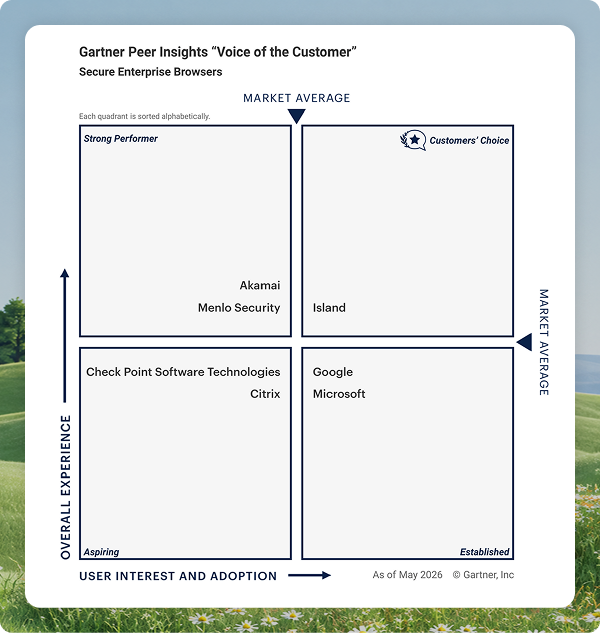
A 5-out-of-5 overall rating
Island holds a 5.0 out of 5.0 overall rating across 331 reviews, with 98% of reviewers willing to recommend Island as a solution. That is the highest willingness to recommend of any vendor in the report. Ninety-five percent of those reviews are five-star, with none lower than four stars.
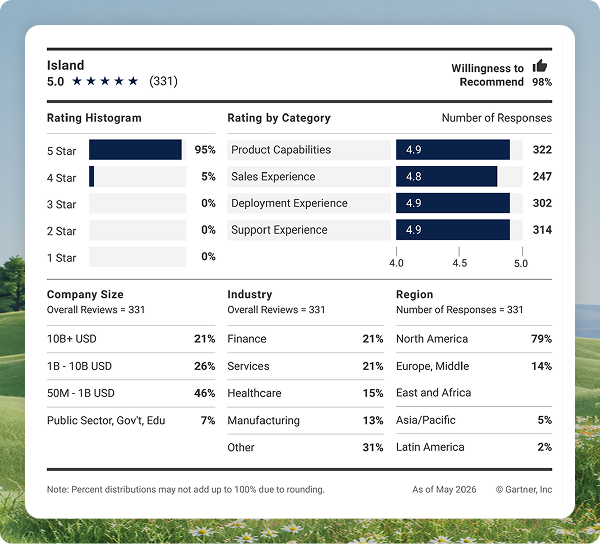
Island also scored highest in all four categories Gartner measured: product capabilities, deployment experience, support experience, and sales experience. Deployment and support scoring alongside product capabilities is a significant comparison, given that enterprise security tools frequently rate well on capability but less well for what’s required to implement, operate, and maintain them. In our opinion, the Gartner data shows that Island customers are highly satisfied with both aspects.
A powerful enterprise browser with excellent admin controls and a familiar user experience
The sample behind the numbers
Gartner published 1,331 reviews across the secure enterprise browser enterprise market. Island accounts for 331 of them, roughly a quarter of the market's total review volume and the largest response base of any vendor in the report, more than the next two vendors combined. End users submitted those reviews over 18 months, ending in May 2026.The Island team is proud of sustaining the highest 5-star rating across the highest number of customer reviews in this entire report.
The reviews come from IT and security leaders who run secure enterprise browsers in production. The reviewer base spans company sizes and industries. Island drew the largest share of large-enterprise reviewers of any vendor in the report. Twenty-one percent of reviews come from organizations above $10B in revenue and 26% from the $1B - $10B range. By industry, finance and services account for 21% each, healthcare 15%, and manufacturing 13%. Reviews from vendor partners and from companies below $50 million in revenue are excluded under the Gartner methodology.
Enterprise browser market context
Gartner defines the market as solutions delivering enterprise security policy and control through a centrally managed custom web browser, plug-in, or browser extension. “SEBs provide security and policy enforcement for web, SaaS and private applications, as well as browser hardening delivered through the browser rather than at the endpoint OS or network level. SEBs also enable visibility, control and auditability of web application data accessed by end users from managed or unmanaged devices without the need for in-line decryption of web traffic.”
Voice of the Customer is a peer-based document that reflects what practitioners reported about their own deployments.The Gartner analyst evaluation of enterprise browser is found in the separate, Market Guide for Secure Enterprise Browsers.
Read the full report
The complete report, including per-vendor summaries and the full methodology, is available here.
Gartner and Peer Insights are trademarks of Gartner, Inc. and/or its affiliates.
Gartner Peer Insights content consists of the opinions of individual end users based on their own experiences with the vendors listed on the platform, should not be construed as statements of fact, nor do they represent the views of Gartner or its affiliates. Gartner does not endorse any vendor, product or service depicted in this content nor makes any warranties, expressed or implied, with respect to this content, about its accuracy or completeness, including any warranties of merchantability or fitness for a particular purpose.
Gartner, Voice of the Customer forSecure Enterprise Browsers, Peer Contributors, 18 August 2026.
FAQs
What is a secure enterprise browser?
A secure enterprise browser delivers security policy and controls through a centrally managed browser, plug-in, or extension rather than through the endpoint operating system or the network. Enforcement happens where the work happens — inside the session, at the point where a user copies, pastes, uploads, prints, or prompts. That placement also gives security teams visibility and auditability of web application data on both managed and unmanaged devices, without in-line decryption of traffic.
Will our existing web applications work in it?
Yes. Island is built on Chromium, so modern web applications behave the same as they do in Chrome or Edge, and users get an interface they already know. Legacy applications that depend on theInternet Explorer rendering engine are handled through IE Legacy Mode, which swaps the rendering engine rather than requiring the application to be rewritten.
Can we govern contractors and BYOD users without managing their devices?
Yes. Because the controls are delivered through the browser itself, they apply on any device, managed or not. A contractor or non-employee downloads and installs the browser on a personal machine and gets governed access to authorized applications — no MDM enrollment, no VDI session, no agent on a device you don't own. Island evaluates device posture at access time, including OS patch level, disk encryption, active MDM and EDR agents, network, and geolocation, and enforces different access levels based on what it finds.
Do network security tools do the same work as the Island browser?
No, because they only monitor what happens on either side of a session and are unable to see what’s happening in the browser. Network tools observe traffic, EDR observes the endpoint but not what happens inside the application, identity tools observe the credential but not the context of its use, and CASB observes the service-side action but not the intent behind it. None of them sees the full chain from user action to data movement, which is why incidents tend to surface weeks later, reassembled from four consoles. Modern encryption compounds the gap: TLS 1.3, QUIC, and certificate pinning limit what a proxy can inspect even when traffic does route through one.
How does Island govern AI agents?
AI and agents routinely operate both in the browser and beyond it. Island is a single control layer that spans the browser, the endpoint, and the cloud: a real-time picture of every agent running in the environment regardless of vendor, along with the MCP servers, skills, code packages, and extensions those agents are using. Island assigns each agent its own identity with permissions scoped to its specific task, so an agent doing one job can't reach resources meant for another. Every action is recorded as an audit trail covering the full chain, including the prompt that triggered it, the tool calls it made, and the data that moved as a result. Token spend is tracked per user, team, and project, with rate and budget controls, so cost is visible before the invoice arrives.

Andrew is a Product Marketing Manager at Island, working closely with the product and engineering teams behind all of Island's products. With over 12 years in cybersecurity, Andrew has built deep, hands-on expertise across network security, identity and access management, cloud native security, browser security, and AI security. He works close to the product, using the tools he's responsible for daily, building and maintaining demo environments, and translating technical capabilities into real-world security outcomes. His work bridges the gap between how a product actually works and why it matters.



.png)
.svg)
.svg)

