.svg)
The Role of CASB in Modern SASE: Island SaaS API Protection
Most SASE stacks treat CASB as an afterthought. Island SaaS API Protection extends unified policy into data-at-rest across your SaaS tenants, with out-of-band visibility, AI session monitoring, and remediation that goes directly to the people who own the files.
Enterprise AI adoption isn’t waiting for security to catch up. Employees are using shadow AI agents while many SaaS apps are embedding AI capabilities directly into the user experience, often with little notice or ability to control. Most security tools watch only a sliver of this activity, and the data feeding these assistants, the documents in your SaaS tenants, often sits overshared, misconfigured, and exposed long before an AI ever touches it.
Island’s SaaS API protection, our cloud access security broker (CASB) solution, monitors your corporate resources out-of-band to identify SaaS risk, such as resources with overly permissive sharing, misconfigurations, over-privileged accounts, and more, before they turn into security incidents. In addition, Island provides visibility into AI usage, identifying sensitive data, security violations, token usage, project sharing permissions, API usage, and more.
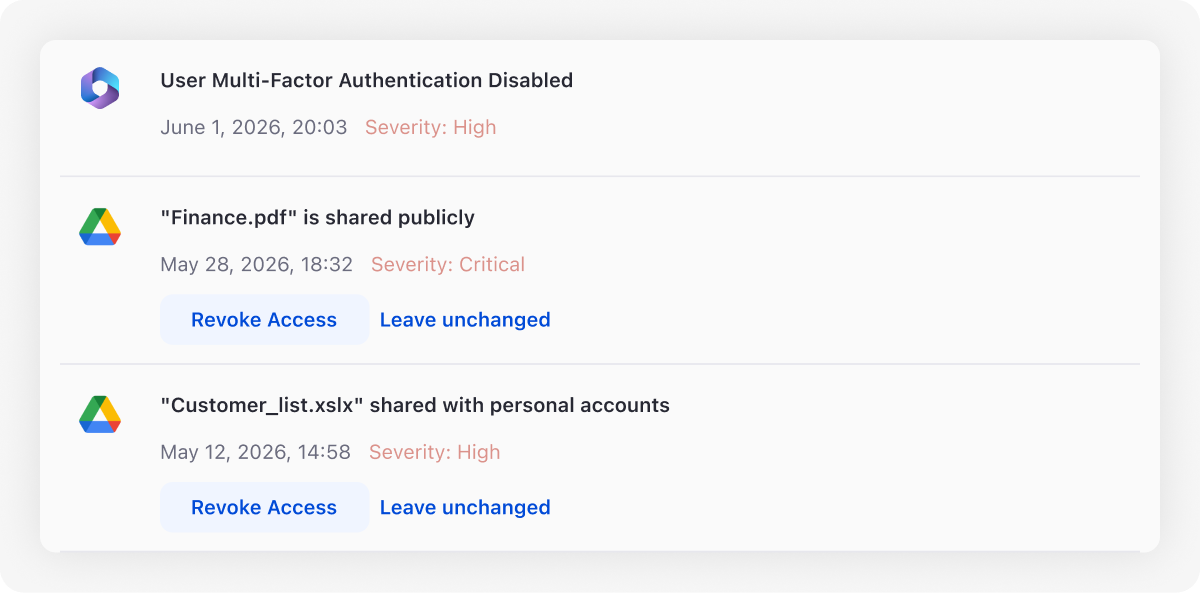
What separates Island from other CASB providers is our end-user communications. Administrators do not have the context necessary to revoke access to resources. After all, some documents need to be shared outside of the organization for the business to function. Instead, Island alerts users to their own SaaS risk directly on the homepage, along with a one-click button to remediate it. For example, it will alert a user to a document shared with anyone who has the link and give them the option to restrict access without leaving the homepage.
Why CASB belongs in SASE, and why it usually feels separate
SASE was supposed to converge networking and security so that one platform could see and govern work wherever it happened. CASB belongs in that picture because so much of work now lives inside SaaS: Google Docs, files in Drive and OneDrive, records in Salesforce, conversations in Slack. Inline enforcement covers what users do during a live session. It does not cover data at rest, who else has access to it, or how the tenant is configured.
A document shared with “anyone with the link” stays exposed long after the user is done working with it. A dormant admin account with no MFA does not show up in proxy logs. An over-privileged service account in Salesforce is invisible to a Secure Web Gateway (SWG). CASB exists to see and fix those things by connecting directly to the SaaS app through its API.
The problem is rarely the API model. The problem is the seams. Most SASE stacks bolt CASB on as a separate module with its own classifiers, its own admin UI, its own ticket flow, and its own learning curve.
In addition, admins rarely have the context necessary to respond to findings. Revoking outside access to a sensitive doc could cripple a partnership, disrupt contractor operations, or impact an ongoing negotiation. Because of this, most organizations end up ignoring all but the most critical CASB findings, potentially leaving the organization open to data loss.
What Island SaaS API Protection does
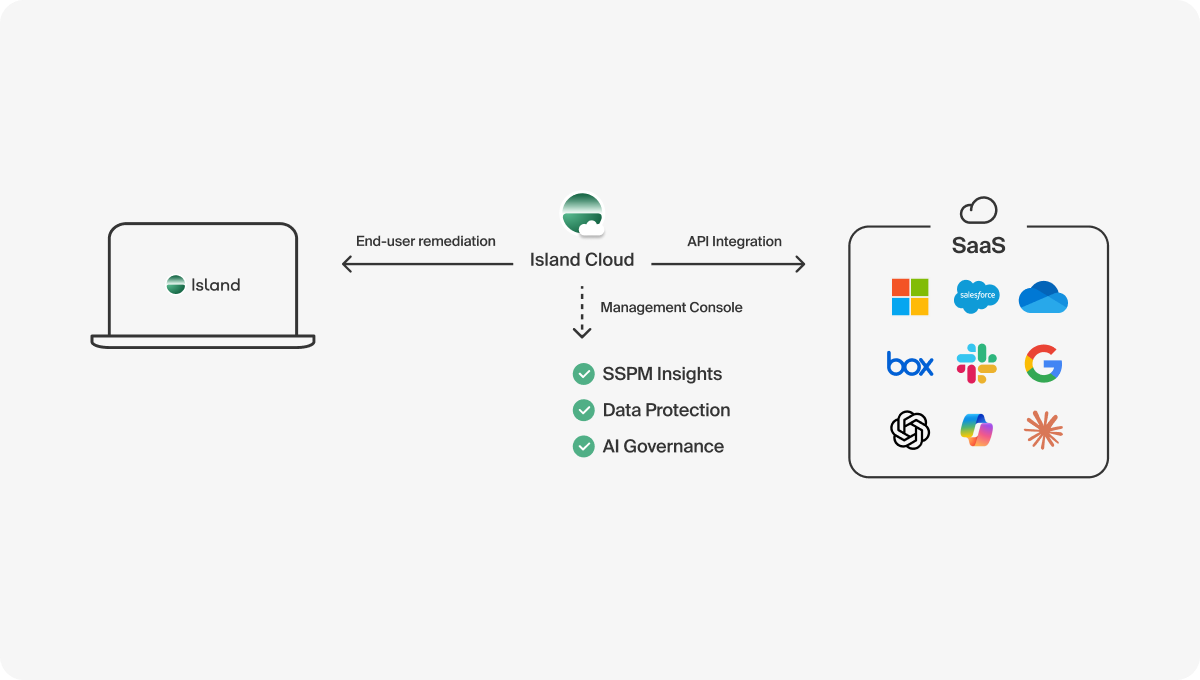
Island SaaS API Protection connects to managed SaaS applications through their native APIs. No agents in the SaaS app, no PAC files, no traffic rerouting. The Island Cloud polls each integrated tenant on a schedule, evaluates what it finds against policy, and either generates a finding for review or remediates the issue directly.
The module delivers:
API-native visibility into users, files, configurations, permissions, and sharing activity across every integrated tenant.
A unified policy and DLP engine shared with the rest of the Island Enterprise Agentic Control Plane, so the same PII, PCI, and confidential-data detectors used on the endpoint also run against data at rest in SaaS.
SaaS Security Posture Management (SSPM) that surfaces oversharing, misconfigurations, dormant users, missing MFA, over-privileged accounts, and public shares before they turn into incidents.
Content-aware scanning at scale, with an initial three-month look-back per app and incremental scans afterward so only changed resources are re-evaluated.
When a user owns a file that violates a SaaS API Protection policy (a sensitive document shared publicly, for example), a widget on the Island Browser homepage surfaces it for them. The user can revoke the offending permission directly from the widget, in which case the finding is marked “resolved” automatically. Or they can dismiss the file as appropriate, which marks the finding ignored. Or they can open the file to review it.
This works because Island is already the user’s browser. The same trust boundary used for SaaS access, DLP, and AI governance is used for SaaS posture remediation. IT does not have to chase down owners through Slack or email. The owners see the issue in the workspace they already use, and they fix it themselves.
For the SASE story, this matters more than it might sound. Posture findings have always had a remediation problem. The console fills up, the security team triages, the asks pile onto IT, and nothing actually gets cleaned up. Island uses the surface the user is already on to distribute the work back to the people best positioned to do it.
Extending posture to the AI sessions acting on your data
The same API-native model that governs data at rest also extends to the AI applications acting on that data. Island connects to enterprise AI platforms through their native APIs and identifies risks, monitors usage, and provides a variety of insights
Across your AI providers, Island monitors:
Session content: Chats, uploaded files, attachments, and tool calls. Island’s data protection engine reads it and identifies PII, PHI, and PCI, source code, secrets, and more. Risky content gets flagged, and policy violations are raised as findings and insights, enriched by everything Island already knows from the browser, network, and endpoint.
Projects and shared knowledge: The projects users build, retrieval-augmented generation (RAG) data, access permissions, and the sessions tied to each user.
Workspaces and rate limits: The workspaces a platform organization uses for API access, the keys generated in each, the agents and agent sessions running against them, and the rate limits configured.
Cost and token usage: Token consumption and cost broken down by model and by user, allowing you to monitor token spend and make informed decisions about AI cost.
This is where the pillars compound. Consider an account manager prepping a quarterly business review. They ask an AI assistant on their laptop to pull highlights from the last quarter; it reads local call notes, a renewed contract, a usage export, and a churn-risk worksheet, then calls a connected Salesforce tool to retrieve pipeline numbers and writes a draft back to disk. Nothing leaves the device through a channel a traditional DLP can see. Later, they upload that draft alongside the usage export to a cloud AI app and ask it to shape a customer-facing narrative.
Island can also see and control AI activity on non-enterprise accounts. If a worker accidentally uploads company data to their personal ChatGPT account, for example, Island not only sees that activity but can block the request and prompt the user to switch to their enterprise account. This is possible because Island leverages multiple deployment methods, including endpoint, secure web gateway, the browser, and out-of-band API access.
Island then correlates this data to surface actionable insights, such as:
- Improper data access
- High or missing API rate limits
- Sensitive data shared in projects with many users
- High and anomalous token usage
The use of expensive models for simple prompts that more affordable models could handle. How it fits the rest of the SASE picture
Island’s Modern SASE enforces most controls at the last mile, on the device, reserving network-based enforcement for use cases that actually need it. Inline controls cover the live session. SaaS API Protection covers the other half of the SaaS problem: what is in the tenant when no user is actively working in it.
A few things stitch the two together:
One identity model. Findings tie back to the same users, groups, and roles that the rest of Island enforces against.
One DLP engine. A detector defined for credit card numbers in uploads is the same detector that scans Salesforce attachments and OneDrive files at rest. Define once, enforce everywhere.
One console. SaaS API Protection findings live in the same admin UI as other Island policies, Island Private Access configuration, and AI Protection controls.
One Insights view. Cross-module Insights surface the highest-impact issues across your environment, including SaaS API Protection alongside everything else.
Where this leaves you
CASB is non-negotiable for anyone that takes SaaS security seriously. But it isn’t enough on its own, and operating a CASB solution in a silo comes with extensive costs in management and effectiveness.
Island SaaS API Protection extends the unified policy model into data-at-rest within SaaS apps. It uses the user’s own browser as the remediation surface. And it feeds findings back into the same dashboard that already governs browsing, access, data, and AI.
That is what modern SASE looks like when the CASB pillar is not an afterthought.

Avishai is a Product Group Manager at Island, responsible for the Data protection, Extension platform and AI Security domains. His work focuses on browser infrastructure, modern data protection & secure AI enablement across enterprises worldwide.
.png)
.png)


.svg)
.svg)

