.svg)
AI Changed the Enterprise Workspace. Has Your DEX Kept Up?
Your employees are using more applications than ever, from AI tools to everyday SaaS. Do you know which ones are actually working?
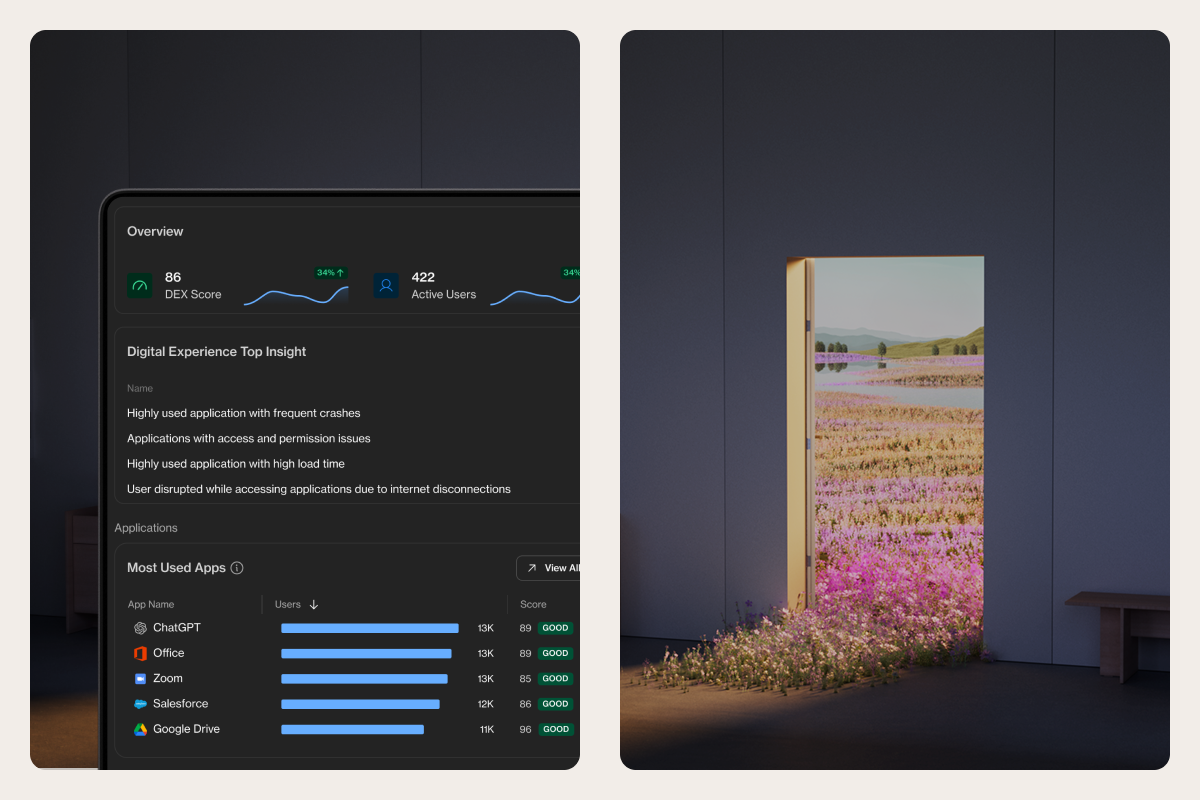
Introduction
AI has fundamentally changed how work gets done. Copilot drafts the email. ChatGPT summarizes the meeting. A dozen other AI agents handle tasks that used to take hours. The promise is clear: a more productive, more efficient enterprise workforce.
But here's what the AI rollout exposed. Most enterprises have no reliable way to measure whether these tools are actually working for employees. Is adoption real, or are employees routing around them? Is the experience good enough to build a habit around? Are you paying for token usage on tools that aren't delivering value? These aren't questions most DEX platforms were built to answer.
Instead of purpose-built AI visibility, most enterprises fall back on tools that predate the AI era entirely. A DEX tool from their SASE vendor for network visibility. A standalone platform for device and endpoint health. Two separate products, which means IT has to switch between them to piece together the full picture. And even then, neither one gives deep visibility into the AI apps employees now rely on every day.
Island Digital Employee Experience was built to solve the problem that those tools can't reach, with full-stack visibility across the application, device, and network layers, proactive diagnostics, and real-time remediation, in a single platform. And unlike tools that depend on a specific network infrastructure, Island DEX works across any environment.
Even with two DEX tools, you're still guessing
Legacy SASE architectures redefined how enterprises secure hybrid work. But security and experience are different problems, and the tools built to solve one were never designed to serve the other.
Take the two most common DEX setups. If you have a SASE vendor with built-in DEX, you get network-layer visibility: latency, tunnel performance, proxy errors, etc. What you don't get is the actual employee experience. Whether the page loaded, how long it took, or whether the API call completed. If you have a standalone endpoint DEX tool, you get device and application experience data, but it has no awareness of your network infrastructure. To get the full picture, you need an integration between the two. And even then, the data lives in separate systems that don't share a timeline.
So eventually, the root cause analysis becomes a reconstruction job. IT stitches together fragments that don't align to explain an incident the employee stopped caring about an hour ago. Meanwhile, the underlying problem repeats. At scale, that's not just an operational inefficiency. It's a measurable drag on performance.
Island replaces both. One platform. Every signal. No integration required.
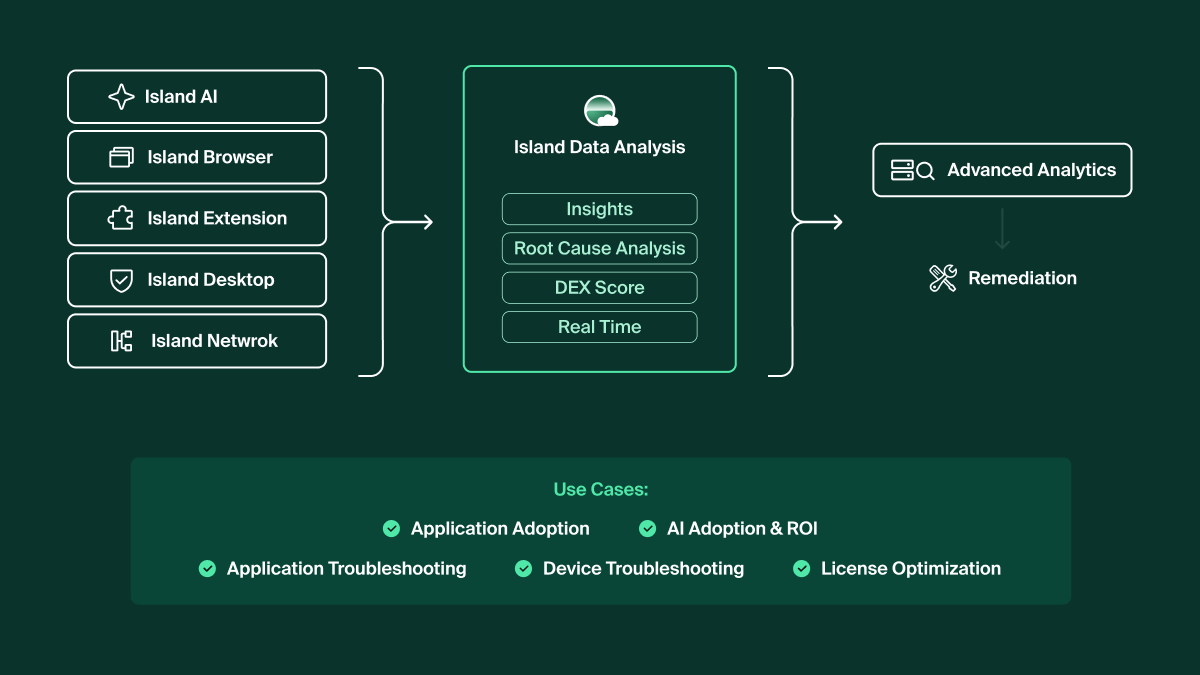
See, diagnose and fix across every layer
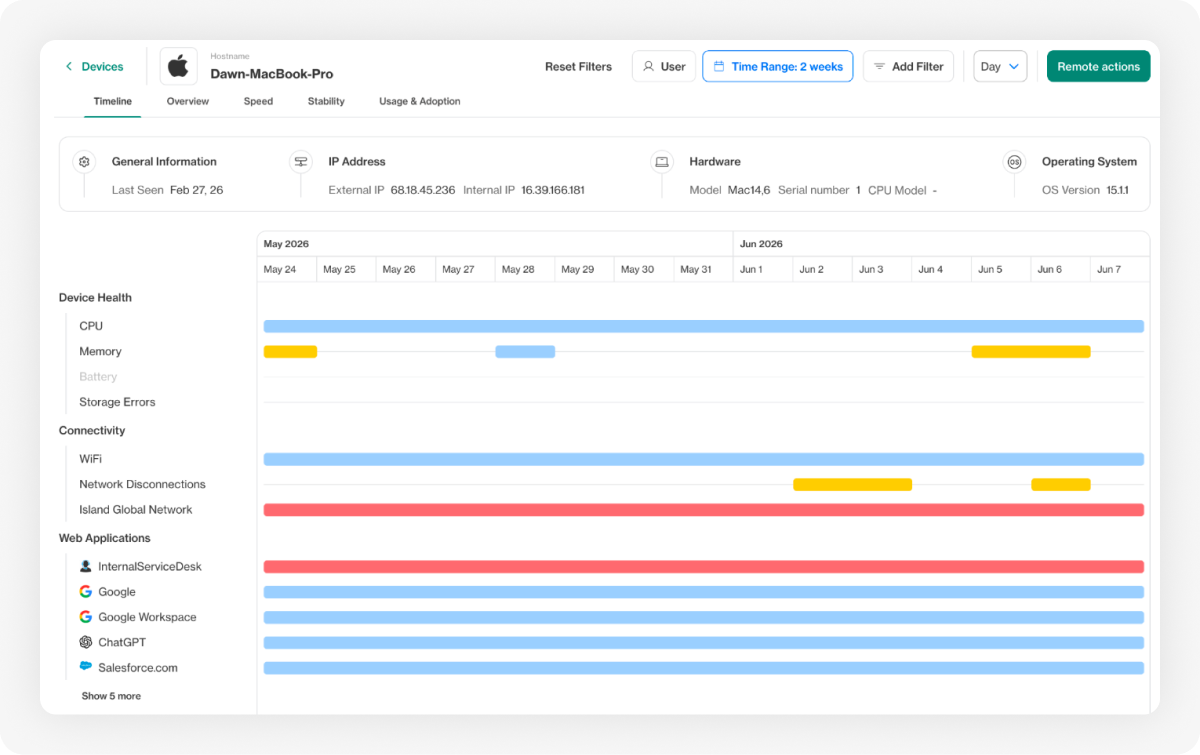
Island DEX brings three layers of signal into a single platform, on a unified timeline.
Application
Page load times, web vitals, API response latency, and HTTP error rates are captured directly at the point of interaction without proxy distortion. Native desktop applications get the same depth. When a business-critical application goes down, IT knows in real time, before the first ticket is filed and before productivity loss compounds across the organization.
Device
CPU utilization, memory pressure, battery health, and storage errors are all surfaced alongside application and network signals, enabling IT to make targeted decisions rather than fleet-wide assumptions. And when a device issue is identified, Island doesn't just surface it. IT can act directly: communicating with the end user, triggering automated remediation remotely, prompting the user to clear storage, or asking whether a tool they haven't used in months is still needed. No ticket required.
Network
Most DEX tools that claim network visibility sit behind the same proxy infrastructure they're trying to observe. What they report as network performance is already filtered through the enforcement layer. Latency added by the proxy appears as application slowness, and the real source stays invisible.
Because Island operates at the endpoint and within the network path itself, it captures network signals from the device itself, like Wi-Fi signal strength, connectivity events, DNS resolution delays, and offline incidents, and from the network infrastructure directly, including proxy errors, tunnel disconnections, and path performance data. A standalone DEX tool without SSE can only see one side. Island sees both.
That's the difference between knowing the network had an issue and knowing it was the network that caused this specific user's experience to degrade at this specific moment.
When all three are correlated in real time, the answer becomes obvious fast. The Wi-Fi dropped at 2:13 pm. The API response spiked at 2:14 pm. Three users, same building. That's not a Salesforce problem. That's a network path problem. Visible in seconds, not hours.
Three layers. One timeline. And for the first time, IT doesn't have to choose between knowing what the network did and knowing what the employee experienced
Managed and unmanaged: covering the entire workforce
Most DEX platforms require an OS agent that requires admin privileges, which means BYOD employees, contractors, and frontline workers on unmanaged hardware fall outside the visibility picture entirely. This is the workforce that often has the worst experience and the least representation in IT data.
Island covers it all. Managed devices get full-stack coverage across application, device, and network layers. Unmanaged BYOD environments get the same depth of visibility without an agent. The contractor on a personal laptop. The partner accessing an internal tool remotely. They're all in the picture, with the same signal depth as the managed fleet.
When IT spots a performance pattern, they're seeing the actual affected population, not just the managed subset of it. That completeness matters, because the employees IT can't see are often the ones having the worst time.
AI turns DEX into a business conversation
Every time an organization deploys a new application, the same questions follow. Are employees using it? Do they know how to use it? Is it delivering the value the business expected? Traditionally, those answers came from surveys, anecdotal feedback, and renewal conversations that happened too late.
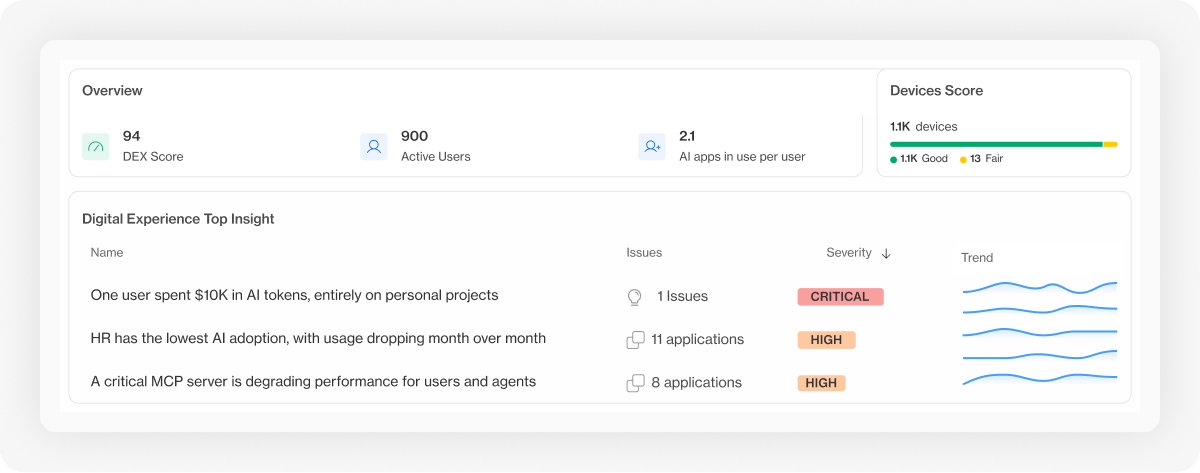
Island DEX surfaces detailed user metrics and analytics across every application: time-on-task, active engagement, and utilization patterns, not just access events. IT and Finance get a clear view of utilization across the environment, so license decisions are based on data, not assumptions.
Nowhere does this matter more than with AI. Deploying an AI tool used to mean rolling out a license and tracking logins. That's no longer enough. When a workforce runs on Copilot, Gemini, Claude, Cursor, and a growing list of AI-assisted workflows, application performance is only part of the answer. A slow AI tool is friction in every task, but poor adoption, untrained users, and wasted token spend are equally costly, and none of it shows up in latency metrics.
When 58% of employees have opened a new AI platform fewer than five times in six months, that's not an IT metric. It's a change management signal with budget implications. Island surfaces which teams are underusing a tool, whether the barrier is user experience friction, a training gap, or a poor fit, so IT can act before the investment is lost and before the renewal conversation happens.
When experience scores drop for a critical application, Island shows whether that maps to lower engagement and abandoned sessions, giving IT the data to make the case for remediation to leadership in terms they care about.
The cost case for complete DEX visibility
Complete DEX visibility has a direct impact on cost.
Faster root cause and zero-touch remediation reduce MTTR and minimize the productivity loss that compounds every hour a critical application is down. Real-time alerts on business-critical application outages mean IT is responding before employees are impacted, not after. Experience-led device refresh cycles replace hardware when the data justifies it, not on an arbitrary schedule, protecting budget without compromising employee performance.
Software metering across the application estate, including AI token usage, gives IT and Finance the evidence to make right-sizing decisions with confidence, at renewal and in between.
Conclusion
Most DEX platforms give IT part of the picture. Island gives IT all of it: every layer, every user, managed or unmanaged, in one place. Reducing tickets is just the beginning. The real value is faster root cause, smarter license decisions, AI adoption that actually sticks, and an IT team that spends its time on work that moves the business forward.
Schedule a demo to see Island DEX in your environment.
FAQs
What is Island Digital Employee Experience (DEX)? Island DEX is a full-stack digital employee experience platform built into the Island Enterprise Agentic Control Plane. It gives IT teams complete visibility across the application, device, and network layers, all in a single platform, on a unified timeline, to see, diagnose, and fix experience issues before they impact productivity.
Which environments and application types does Island DEX cover? Island DEX covers browser-based SaaS applications, internal web apps, AI tools, and native desktop applications across the application, device, and network layers. It surfaces detailed user metrics and analytics for every application: who is using what, how often, for how long, and whether the experience is driving or limiting productivity. It extends the same depth of visibility to managed and unmanaged BYOD devices.
How does Island DEX reduce application tickets? By surfacing issues in real time before employees notice them, Island shifts IT from reactive to proactive. Automated insights identify the root cause across the application, device, and network layers simultaneously, so IT resolves problems before they generate tickets rather than after.
Does Island DEX integrate with SIEM platforms? Yes. Island provides open, documented APIs and syslog forwarding for SIEM ingestion, giving teams a complete audit trail across every enforcement point. Every event is logged with user identity, destination, action, and outcome, in one place.
Does Island DEX provide proactive alerting? Yes. Island delivers real-time alerts when business-critical applications go down or experience scores drop, giving IT the context to act immediately, before productivity loss compounds across the organization.
What does "See. Diagnose. Fix." mean in practice with Island? See: Island surfaces a unified view of experience across every application, device, and network signal in real time. Diagnose: correlated signals across all three layers pinpoint the root cause without manual reconstruction. Fix: IT can trigger zero-touch remediation, communicate directly with end users, prompt self-service resolution, or escalate with full context, all from a single platform.
What remediation capabilities does Island DEX include? Island closes the loop from insight to action. IT can trigger automated fixes, communicate with end users directly, guide them through self-service steps such as clearing storage or updating an application, and confirm whether underused tools are still needed, with or without user involvement.
Why choose Island DEX over standalone DEX tools or SASE-native solutions? Standalone endpoint tools don't see the network. SASE-native DEX tools measure experience through the same proxy used for enforcement, distorting the data before it's captured. Island sees all three layers: application, device, and network, in a single platform, with no integration required, covering managed and unmanaged environments equally.
How does Island DEX help reduce costs? Island attacks cost from multiple angles: faster root cause and zero-touch remediation reduce MTTR, real-time application alerts minimize downtime, software metering enables license right-sizing, experience-led refresh cycles protect device budgets, and AI token usage tracking eliminates wasted spend. Every layer of visibility translates directly into cost intelligence.
How does Island DEX support AI adoption programs? Island measures actual engagement with AI tools, not just access to events. That visibility shows whether adoption is real, where it's stalling, which employees need training, and whether the experience is sustaining or limiting usage over time.

Tom Schneidman is a Product Manager at Island, responsible for the Digital Experience product domain. His work focuses on helping enterprises understand and improve how their people work, turning application and workforce experience data into actionable insight that drives productivity, efficiency, and better outcomes across the organization.


.png)


.svg)
.svg)

