.svg)
Five ways your current SASE is failing you right now
Backhauling, broken SSL inspection, and shadow AI blind spots all trace back to one problem: enforcement built for the network can't see the work happening in the browser.

SASE was the right answer for its era. Instead of racking VPNs, firewalls, and proxies as boxes in a data center, you bought them as managed services in the cloud, and it made life easier for IT and users alike. But the era legacy SASE was built for is gone. Data moved to SaaS. Work moved to unmanaged devices. AI tools arrived. And the model that made sense back when everything ran through the network is now failing you in five specific ways:
- A performance tax on every session
- SSL inspection that increasingly can't inspect
- Blind spots that hide what users actually do
- Zero Trust that falls apart on unmanaged devices
- A "converged" stack that keeps growing
All five problems share the same root cause. SASE is, at its foundation, a network security solution, but enforcement built for the network breaks down when the work happens in modern browsers engineered to resist data interception. A proxy sees packets and connections, but it can’t see the intent, the file, or the response. AI only intensifies these problems: AI interactions happen at the point of intent, not in the network, and traditional SASE is fundamentally a network security solution.
The solution isn't a better proxy. It's moving enforcement to where the work actually happens: the endpoint, at the browser's presentation layer. Here are the five ways Island’s “perfect packet” model changes SASE in the age of the modern browser
Problem 1: The performance tax
In legacy SASE you need to backhaul traffic all the way to a distant proxy, for every session, regardless of what that session is. This is a tax. The users feel it, IT has to manage it, and organizations must implement SASE Digital Experience Monitoring (DEM) to constantly monitor that nothing is breaking for their users. And AI just made this performance tax even worse.
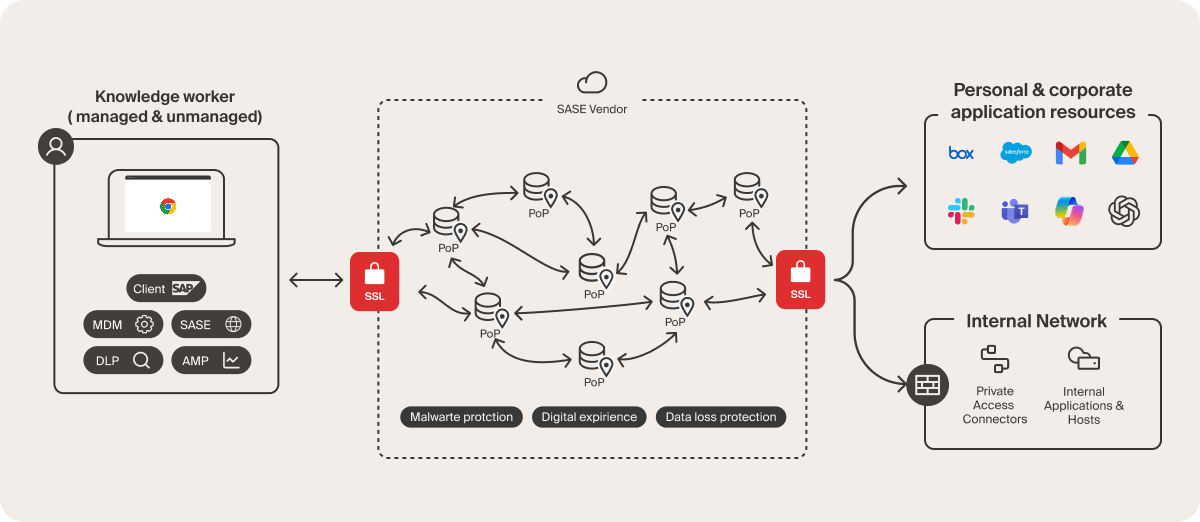
An example of how this looks in practice: a user in Detroit is routed to the closest point of presence, in Toronto. The session needs to be SSL-decrypted, which takes some time, then brought into the point of presence. Here you apply all the different policies, plus DEM to monitor how much you impact that user. and then finally egress out of Toronto. That's not where the user is, and this is now how these applications were intended to be accessed. So, beyond the performance tax, it also just breaks applications when you backhaul and isolate traffic.
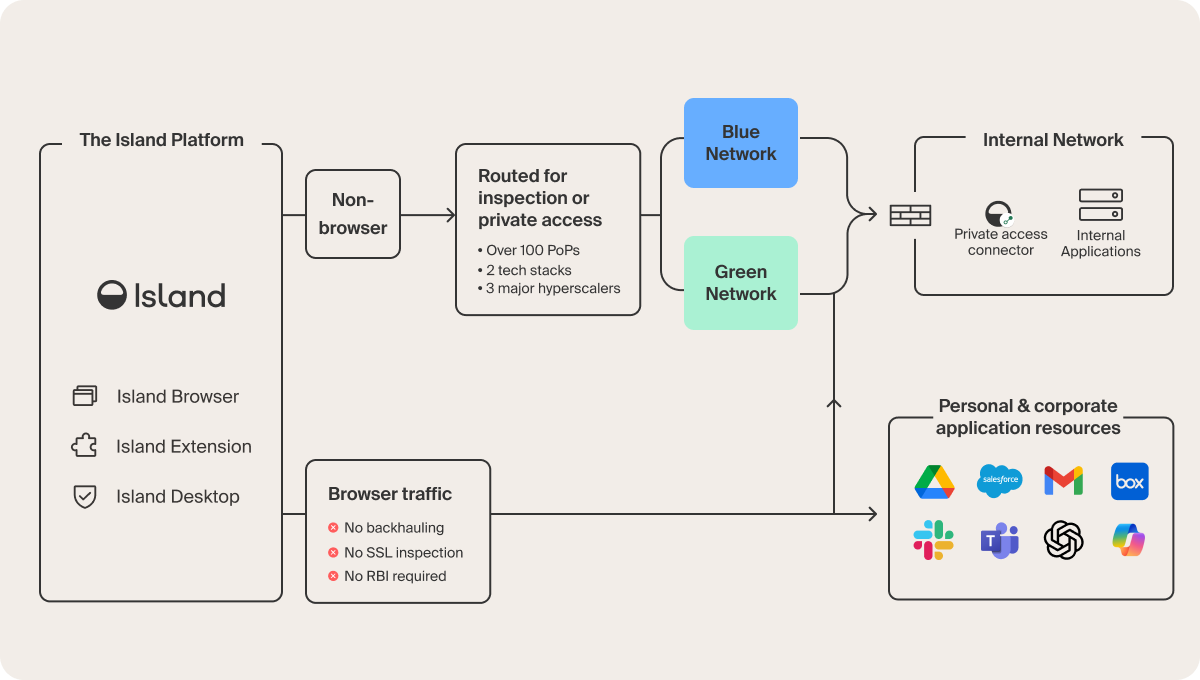
With Island, when work happens in the browser, the browser just goes directly to the application. It doesn't matter where the user is or where the application is. Traffic just moves directly. There is no performance tax because there is no backhauling, no decryption step, and we apply policy right in the browser itself. So you get the performance without the detour. You get the policy enforcement without the tax.
Problem 2: SSL break-and-inspect is breaking
SASE depends on SSL inspection to decrypt, analyze, and re-encrypt secure network traffic, and this inevitably adds latency. There's an even bigger issue that you’re definitely familiar with if you personally manage a secure web gateway or SASE solution: The internet wasn't designed for break and inspect. The modern internet is engineered to resist data interception, but traditional SASE was engineered to depend on it. So not only does SSL introduce latency, but there are times you just can't do it completely. TLS 1.3, SSL pinning, QUIC, and quantum-resistant encryption make sessions harder and harder to break open. When a secure web gateway can't decrypt fast enough, traffic waits and IT feels it. When it can't decrypt at all, most teams simply bypass it and let the traffic through. In conversations with organizations running secure web gateways, Island routinely finds their solution is blind to 60 to 70 percent of all traffic, and because they can't see it, they just let it go through.
Island’s modern perfect packet SASE architecture applies policy on the endpoint, at the DOM, before anything needs to be decrypted. Users don't wait on latency, IT stops managing SSL exclusions, and your security actually sees what's happening.
Problem 3: Blind spots and lack of control
A proxy sees a connection and packets, which is fine from a purely networking perspective. From an intent perspective, though, even if you do manage to decrypt everything you still have no real visibility into what happened on that connection or what the user actually did. This is when security starts to break down for all browser traffic, and the problem becomes more and more serious with AI.
Shadow AI is a particularly tricky blind spot. When a user uploads a file to a non-sanctioned AI application that uses a web socket or handles the file in an unexpected way, your proxy is blind to it. Legacy SASE leaves two options: block the app entirely and stop your users from working, or allow it and go blind to what they upload into the LLM.
From the Island perspective, though, AI is just a web application. Island sees the shadow AI, the context, the file, and the response, and acts on everything inline. When the user clicks "upload file," Island is there at the point of interaction. It sees the browser access the file and can scan it regardless of how it moves over the network, then block it based on the data protection policies you set. You get visibility where it actually matters.
Problem 4: Zero Trust that can't reach the device
When SASE started out, most devices were managed and unmanaged endpoints weren’t really an issue. But, today, users want to work from wherever they are on whichever device they are on, which poses a challenge: implementing Zero Trust access using SASE on these unmanaged endpoints is not easy.
You need to deploy an agent, but deploying that agent and steering traffic on a device you don’t own is a challenge. Sometimes it’s the user's own device and they just don't want to install it, or a contractor’s externally managed device that blocks it. Your IT team must choose between not using that device at all, implementing VDI or shipping a laptop, or just being completely blind to what the user is doing. None of these is a good solution.
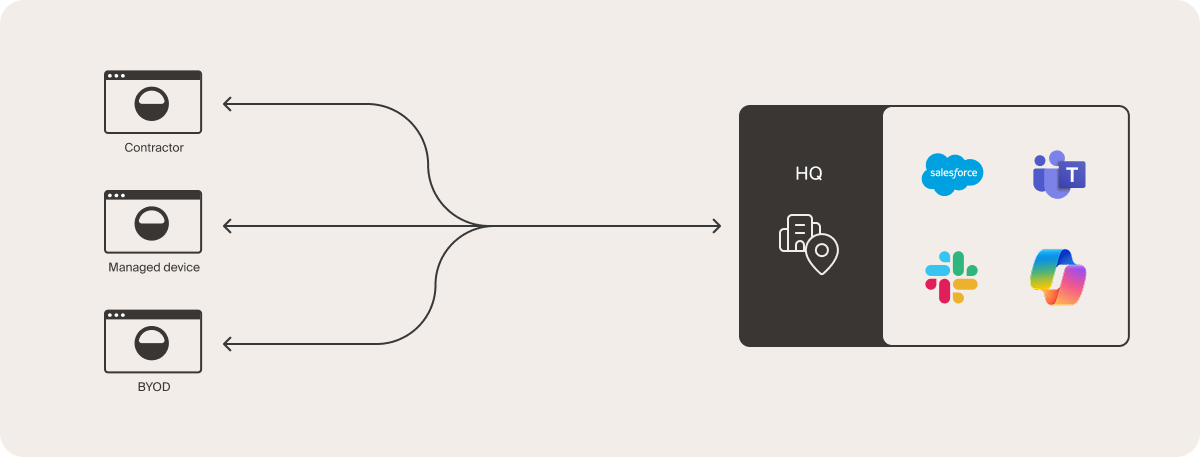
With the Island browser or Island extension, though, the device doesn’t matter. Users download it, log in, and get access to all your organization’s applications, whether SaaS, private, or desktop. It installs like Chrome or Zoom; there’s no need for IT to enable granular privileges, and they get full visibility. Who the user is, what the device posture is, whether the device is encrypted, whether endpoint protection is running, and where they're connecting from. Same policy, same experience, same control on a BYOD laptop, a BPO's managed device, or a corporate endpoint.
Problem 5: Complexity and operational drag
Traditional SASE promised convergence into a single, secure platform. But when you deploy it, you realize that you also need VDI because you can't control the data where it leaves the application itself. You need DLP for the same reason. Then you still need VPN because you have some applications that just don't work with ZTNA. You need endpoint protection because you need to trust the device that accesses the data and you need a secure web gateway for all the SSL inspection. You implemented SASE, but you still need all these different vendors and solutions on top of it to fully deliver the security that SASE promised.
Island gives you all of this in a true single platform. You have one pane of glass. You have a single place where you manage all the data, all the policy enforcement for your users. You don't need a VPN, and most orgs won't need VDI anymore. For unmanaged devices, you no longer need to deploy an EDR or a DLP solution. It's a single platform instead of a fragmented stack.
Modern SASE: The perfect packet
When policy can be enforced on the endpoint itself, at the point of user interaction at the DOM level before a packet ever reaches the network, you get what Island terms “the perfect packet.”
In the legacy SASE model, a packet leaves the device "raw" and is first hauled to a proxy, then decrypted and inspected before policy can be applied. After that it’s re-encrypted, and forwarded to the application your user is working within.
All the problems of using SASE today—the latency, the blind spots and lack of control, the SSL break-and-inspect, the complexity and operational drag—arise because you are doing that security work on the packet in transit. Island’s perfect packet architecture moves the work to the source. Policy is applied in the browser at the presentation layer so, by the time traffic becomes packets on the wire, it's fully visible and already governed.
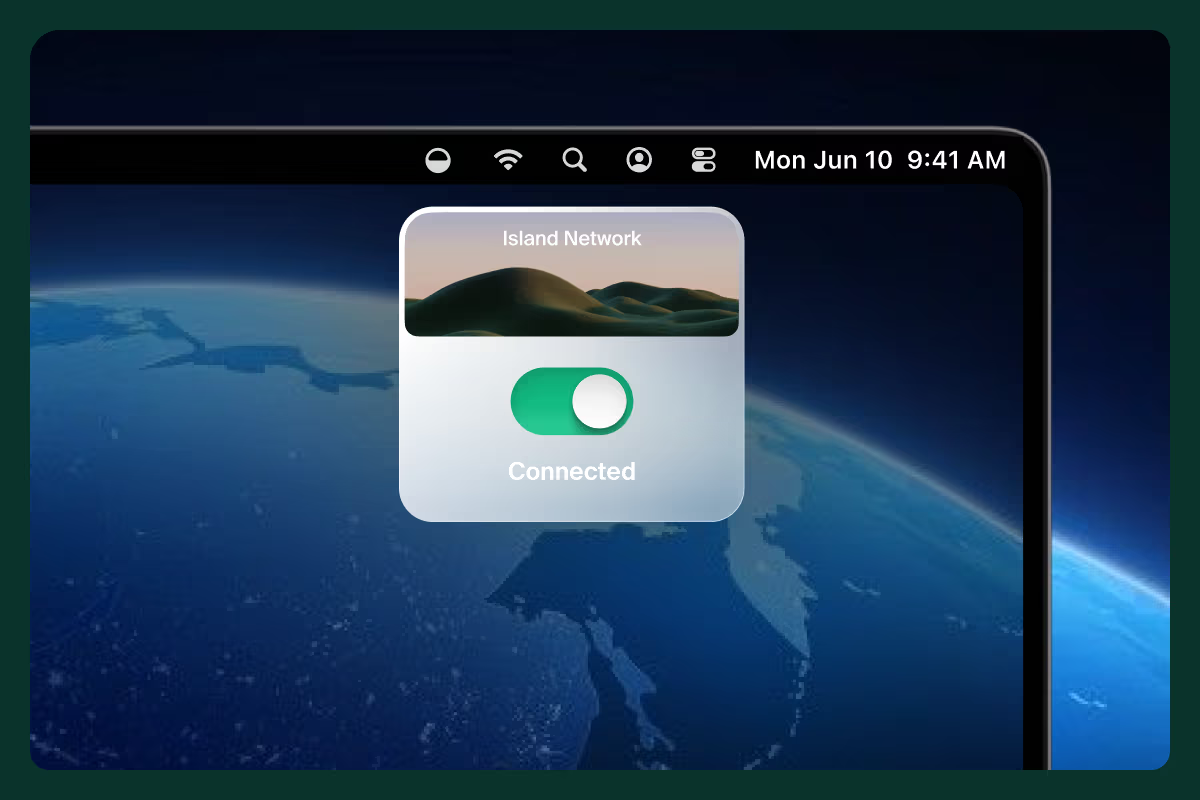
Because that packet needs no inspection, it can take the most direct path. It will go straight to the application for browser traffic, or via the shortest route through the Island network for private and non-browser apps — riding a resilient, premium, active-active network built to carry it. In short, "perfect" means already compliant at origin, and therefore free to travel the ideal path without the detours and decryption the old model forced on it.
None of these problems get solved by tuning the proxy. They get solved by moving enforcement off the network and into the browser, where the work, and the intent behind it, actually lives. That's the perfect packet: performance without the detour, enforcement without decryption, visibility where it matters, the same Zero Trust on every device, all in a single browser-based platform.
The future of work is built in, not bolted on. You can learn all about it in this 20-minute webinar: 5 Ways the Perfect Packet Model Changes SASE.
FAQs
Is Island a replacement for SASE, or does it work alongside it?
For most organizations, Island replaces the stack SASE was supposed to consolidate. Because policy runs in the browser at the presentation layer, you no longer need a VPN, and most teams won't need VDI. On unmanaged devices, you can drop the separate EDR and DLP tools too. Some organizations keep parts of their existing network security in place during a transition, but the goal is a single browser-based platform, not another layer on top of what you already run.
How does Island handle SSL inspection if it doesn't decrypt traffic?
It doesn't need to. Legacy SASE depends on breaking open encrypted traffic in transit, which modern encryption like TLS 1.3, SSL pinning, and QUIC increasingly resists. Island applies policy on the endpoint at the DOM, before anything is encrypted and sent. Your security sees what's happening without the decryption step, and IT stops maintaining SSL exclusion lists.
Can Island secure contractors and BYOD users without a managed device?
Yes, and this is where legacy SASE struggles most. Users download the Island browser or extension, log in, and reach your applications, whether SaaS, private, or desktop. It installs like Chrome or Zoom, so IT doesn't need granular device privileges. You still get full visibility into who the user is, the device posture, whether it's encrypted, and where they're connecting from. The same policy applies on a personal laptop, a BPO's managed device, or a corporate endpoint.
What happens with shadow AI and unsanctioned AI tools?
Legacy SASE gives you two bad options: block the AI app entirely and stop people from working, or allow it and go blind to what they upload. Island treats AI as just another web application. When a user clicks "upload file," Island is there at the point of interaction. It sees the file, scans it regardless of how it moves over the network, and can block it based on the data protection policies you set.
What does "perfect packet" actually mean?
It means the packet is already compliant when it leaves the device. In the legacy model, a raw packet gets hauled to a proxy, decrypted, inspected, re-encrypted, and forwarded, and every problem with SASE today traces back to doing that work in transit. Island applies policy in the browser first, so by the time traffic becomes packets on the wire, it's fully visible and already governed. Because the packet needs no inspection, it can take the most direct path to the application.

Roi is a Director of Product Management at Island, responsible for Island's modern SASE, networking, and data protection solutions. With over 10 years in the field, Roi brings deep technical expertise in networking, endpoint, and the real-world challenges IT and security teams face when rolling out and operating these tools across the enterprise. His earlier work in in-depth research gives him a hands-on understanding of how things actually break, and what it takes to make them work at scale.



.svg)
.svg)

