.svg)
What Zero Trust Access Looks Like at the Last Mile
Island Private Access enforces zero trust where work actually happens, covering every session, app, and protocol, for every identity - human or agent.
%20(1).png)
Here's the uncomfortable truth about most zero trust deployments: they stop too early.
VPNs were the original offender. They connect users to the entire network, rather than specific applications, and treat authentication as a permanent hall pass. Traditional ZTNA fixed the network-level overexposure, but enforcement still happens above the device and below the application. IT gets visibility into who connected. Not into what they did. And as AI agents begin accessing private applications, internal APIs, and data sources on behalf of users, the access model that was already falling short now has to handle non-human identities it was never designed for. AI agents are calling tools via MCP, querying data, and chaining actions at machine speed. Zero trust that authenticates a human at login has nothing to say about a non-human identity making thousands of calls after it.
Island Private Access closes that gap, and the way it does so is what makes it unique. By building ZTNA into the Island Enterprise Agentic Control Plane, organizations can extend secure, policy-governed access to unmanaged and BYOD devices without requiring an agent. No VDI. No reverse proxy. No compromises on data control. Contractors, BYOD users, and newly acquired teams get access to exactly what they need (and nothing else) with the same last-mile protections that apply to a fully managed device. For native desktop applications and all other device traffic, Island Desktop extends the same model to the endpoint, completing coverage across every app, protocol, and access scenario under one policy engine.
The access problem hasn't been solved; it was just relocated
The VPN model was simple: authenticate once, access everything. That simplicity was also the vulnerability. A single compromised credential could expose large portions of the internal network. Lateral movement wasn't just possible, it was easy.
ZTNA moved the enforcement point and narrowed the scope of access from network-level to application-level. That's a genuine improvement, but the enforcement still lives at the network layer, and the gaps are predictable. And the problem is about to scale. AI agents now need the same access to private applications, internal APIs, and data sources that human users do, but at multiples of the volume. An agent calling an internal tool via MCP, querying a private database, or pulling data from an internal system is a private access request. Traditional ZTNA wasn't built for non-human identities operating at that scale, and VPNs certainly weren't.
Unmanaged devices reveal this most clearly. Contractors, BYOD users, seasonal workers, newly acquired teams are examples. Every enterprise deals with these scenarios constantly. Supporting them without a managed device has always meant choosing between bad options.
- Deploying an agent on hardware IT doesn't control.
- Standing up reverse proxies that require certificate delegation and break application UX.
- Provisioning VDI that costs too much and performs too poorly to justify.
None of these are zero trust by design. They're workarounds and each one is a gap.
Many organizations discover another layer to this problem. Legacy workflows built on server-to-client traffic (VoIP systems, IT management tools, patch servers) simply break when VPN is replaced with standard ZTNA. So the VPN stays.
What if ZTNA was built into the workspace?
A seasonal hire. An acquired team. A vendor who needs access for two weeks. In the old model, each of these is an IT project. With Island Private Access, it's a browser install.
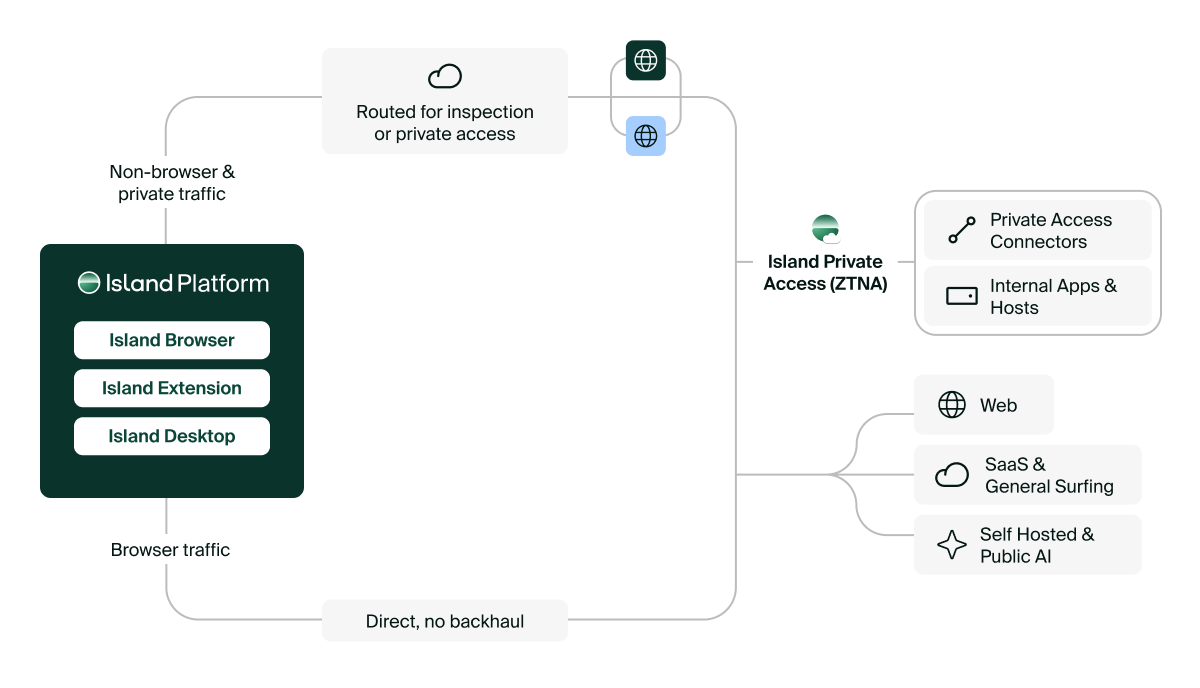
ZTNA is built directly into the Island Enterprise Browser and Extension, covering web, RDP, and SSH access with no agent required. When a user opens an internal resource, the browser detects the destination, intercepts the request, and routes it through the closest Island Cloud Point of Presence. Policy is evaluated, access is granted to that application only, and nothing else on the network is exposed. Because enforcement happens inside the browser, last-mile data controls apply throughout every session (e.g. clipboard, downloads, printing, screenshots, and watermarking) regardless of whether the device is managed. For native apps and all other device traffic, Island Desktop extends the same model to the endpoint. The same policy engine governs AI and agent access to private resources, ensuring that tool calls, API requests, and data retrieval from internal systems are evaluated by identity, posture, and context, just like any human session.
Neither enforcement point requires the other. Both are independently useful. Together, they cover the full surface of modern work.
Under the hood: how access actually works
Three components work together to broker access without exposing the network.
The client. For web, RDP, and SSH, ZTNA runs inside the Island Enterprise Browser or Extension. No dedicated client required, no manual connection step, no version conflicts. Download and install it the same way you would Zoom or Chrome. For native application and all-device traffic, Island Desktop intercepts DNS at the endpoint and routes traffic to Island Cloud selectively. WireGuard handles encrypted transport across all ports and protocols.
Island Cloud. Every session is evaluated continuously at the nearest point of presence: identity, device posture, geolocation, originating application, and target application. Island operates 100+ PoPs across AWS, GCP, and Azure, with dual independent network architectures providing automatic failover without disruption. A regional outage on one cloud provider does not produce a user-facing disruption.
The connector. A lightweight virtual machine deployed inside the customer's private network establishes an outbound-only connection to Island Cloud. No inbound listeners. No open firewall rules. No public-facing attack surface. Private resources stay invisible to the internet, and traffic is delivered through the outbound tunnel to the target application with full policy enforcement.
The result: internal applications that behave exactly as expected, for users who never had to think about a VPN.
Infrastructure built for resilience
Island's global network runs two fully independent overlay networks, each built on different technology stacks and separate cloud providers. The system monitors performance continuously, with automatic failover to the second network as a safety net, should degradation ever occur. This isn't redundant PoPs on a shared architecture. It's genuine infrastructure independence, designed so that a regional cloud outage on one provider doesn't produce a user-facing disruption.
Application health checks run continuously as well, giving administrators real-time visibility into the uptime of private resources and the ability to act before users are affected.
Zero trust for every device, managed or not
Most ZTNA solutions tell you who accessed what. Island tells you what they did with it.
Because Island enforces access at the browser and endpoint layer, and not just the network layer, it applies last-mile data protections that proxy-based ZTNA cannot reach. Clipboard controls, download restrictions, print blocking, DLP policies, and screenshot controls are all enforced at the session level, independent of the application itself. A user can be granted access to a sensitive internal resource and still be prevented from exfiltrating data from it.
This changes what's possible for unmanaged device access. Contractors, seasonal workers, BPO teams, newly acquired employees, or anyone else who needs access without a corporate-managed device can be onboarded immediately through the browser or endpoint, with full data governance, in minutes. No VDI, laptop shipping, or agent deployment on devices IT doesn't control. The onboarding process that once took days collapses to almost nothing.
Replacing VPNs and the complexity around them
The common promise of ZTNA is VPN replacement. Island Private Access delivers that, while also removing several layers of adjacent complexity.
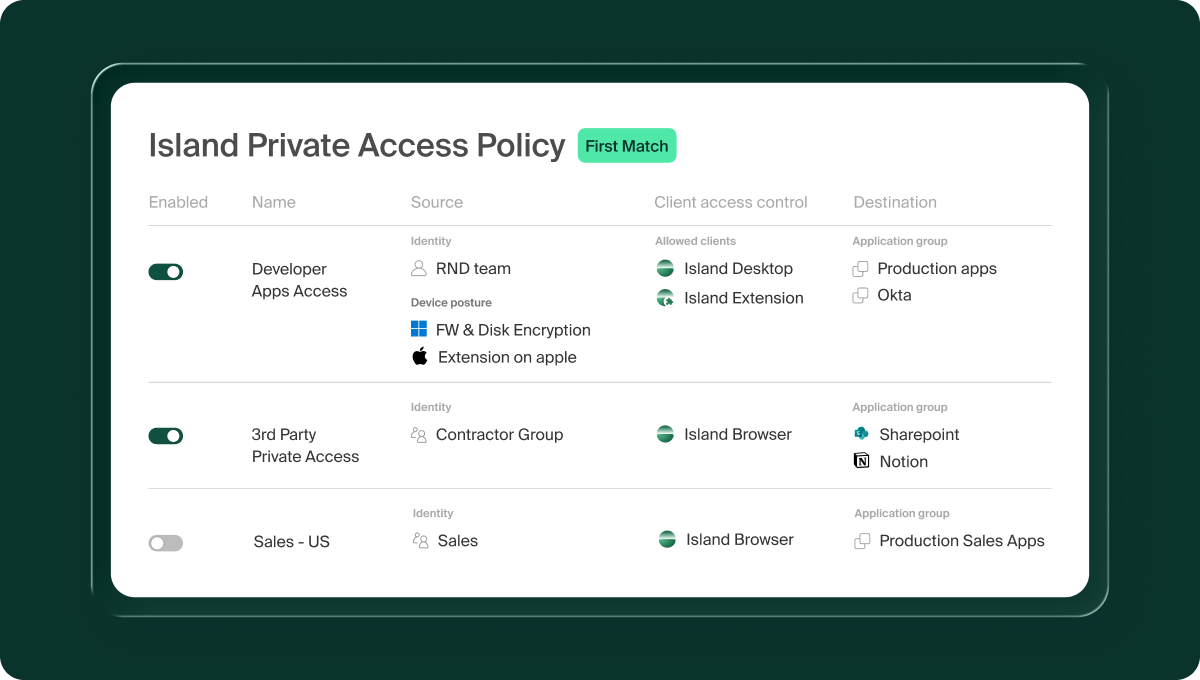
Say goodbye to VPN concentrators and the inbound firewall rules that came with them. Browser-based access requires no agent. Lateral movement risk disappears when users connect to applications, not networks. And ZTNA policy, DLP, and session monitoring all live in the Island Management Console.
For organizations already running a ZTNA solution, Island Private Access layers on without requiring replacement. The same investment is extended with last-mile data controls, deeper session logging, and native visibility into browser and endpoint activity that existing solutions don't provide.
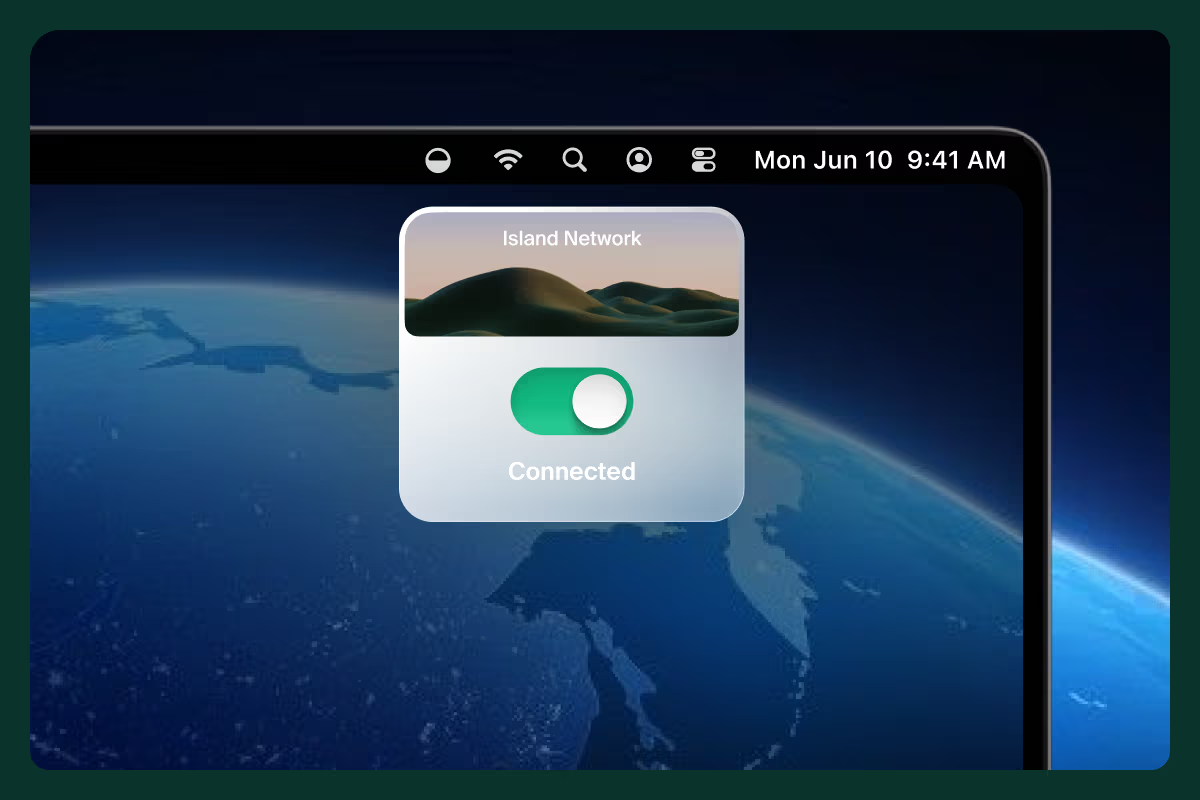
For organizations that hit the server-to-client wall, Island Private Access (IPA) goes further. It can assign the device an IP address on the customer's network, enabling server-to-client and client-to-client flows natively, so VoIP, SCCM, and remote IT support all work. Full VPN decommissioning becomes a realistic outcome, not a partial one.
Want to go deeper? The Island Enterprise Browser Buyer's Guide covers how to evaluate an enterprise browser for your organization, and the Island Enterprise Browser whitepaper walks through the full platform architecture.
Conclusion
Zero trust was never meant to stop at the network. It was meant to extend all the way to the moment a user opens an application, accesses data, or takes an action involving sensitive information. Most ZTNA solutions don't reach that far. Island Private Access does.
By building enforcement into the entire workspace, with the browser and endpoint together, Island covers the full surface of the enterprise under one policy engine, human users and AI agents alike, with application-specific access, last-mile data controls, and the resilience to keep access running regardless of where or how connections originate.
Frequently Asked Questions
What is Island Private Access?
Island Private Access (IPA) is a Zero Trust Network Access solution built directly into the Island Enterprise Browser and Island Desktop endpoint agent. Rather than enforcing access at the network layer alone, it extends enforcement all the way to the browser and endpoint, giving organizations application-specific access, session-level data controls, and a single policy engine that covers every device type, managed or unmanaged.
How is Island Private Access different from traditional ZTNA?
Traditional ZTNA tells you who connected to an application. Island Private Access tells you what they did inside it. Because enforcement lives in the browser itself, last-mile controls like clipboard restrictions, download blocking, DLP, print controls, and screenshot prevention apply throughout every session.
Can Island Private Access work on unmanaged or BYOD devices?
Yes. This is one of IPA's core strengths. Contractors, BYOD workers, seasonal employees, and newly acquired teams can gain access through the browser on any personal device without IT needing to manage, image, or provision that hardware. All data governance and session controls apply regardless of whether the device is corporate-owned.
What happens to VoIP, SCCM, and other server-to-client workflows when we move off VPN?
Unlike standard ZTNA, Island Private Access can assign the device an IP address on the customer's network, enabling server-to-client and client-to-client traffic natively. This means legacy workflows that depend on these patterns (such as VoIP systems, patch management servers, and remote IT support tools) continue to work, making full VPN decommissioning a realistic goal rather than a partial one.
Can Island Private Access coexist with our existing ZTNA solution?
Yes. IPA is designed to layer on top of existing ZTNA investments rather than replace them. Organizations that already have a ZTNA solution in place gain last-mile data controls, deeper session logging, and browser-and-endpoint-level visibility that their existing solution cannot provide, without needing to rip and replace their current architecture.

Roi is a Director of Product Management at Island, responsible for Island's modern SASE, networking, and data protection solutions. With over 10 years in the field, Roi brings deep technical expertise in networking, endpoint, and the real-world challenges IT and security teams face when rolling out and operating these tools across the enterprise. His earlier work in in-depth research gives him a hands-on understanding of how things actually break, and what it takes to make them work at scale.
.png)



.svg)
.svg)

