AI Gateways
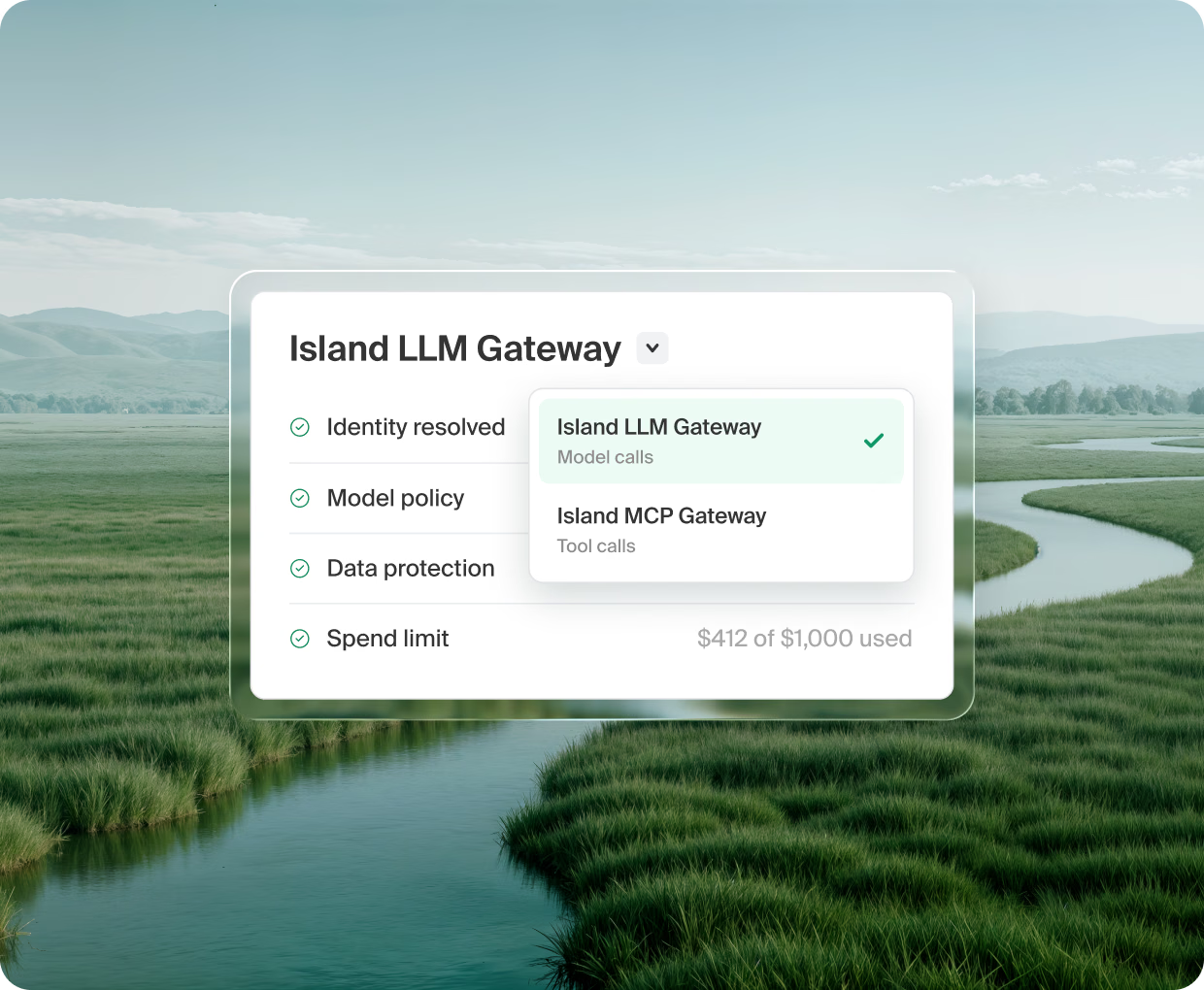
The Island LLM Gateway and MCP Gateway help you manage AI models and tools, enforce policy, and protect data.
The world’s leading enterprises run on Island.
















THE PROBLEM
Every AI request needs a key, a policy, a budget, and a record
A developer calls Claude, an agent calls ChatGPT, and a support tool calls a model nobody in IT has heard of. Similarly, the use of MCP servers has exploded. Most organizations can’t see or govern this activity.
Keys and tokens everywhere
Model provider keys and MCP tokens sit in config files and scripts the agent can read, with no central way to revoke them.
No policy on models or tools
Nobody decides which models a person can call or which tools an agent can reach. Nothing inspects the prompt, the tool call, or response.
Spend and actions with no owner
Token spend is spread across different providers and tools, and no one can put reliable controls on AI spend.
THE SOLUTION
Manage every inference call
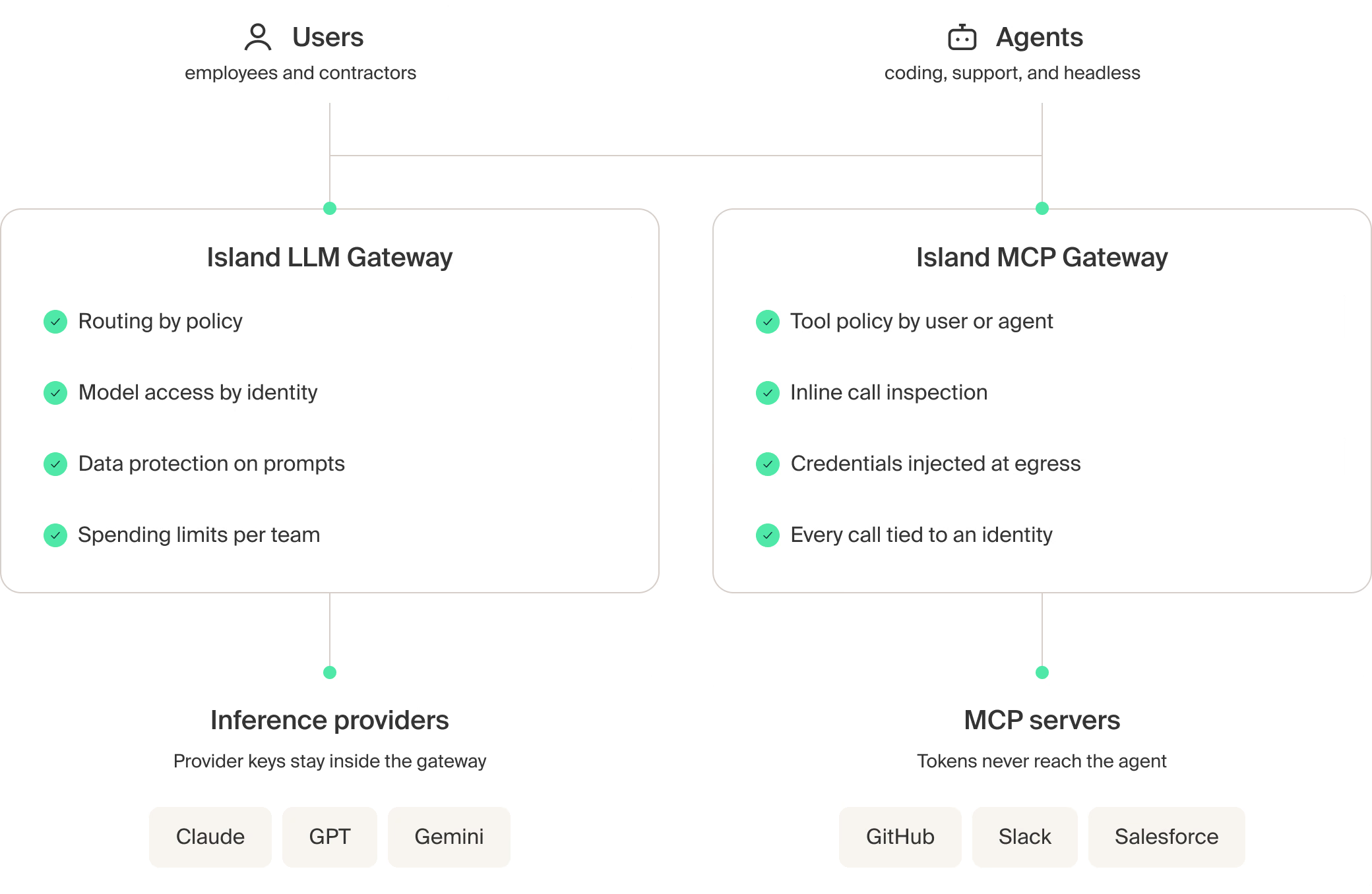
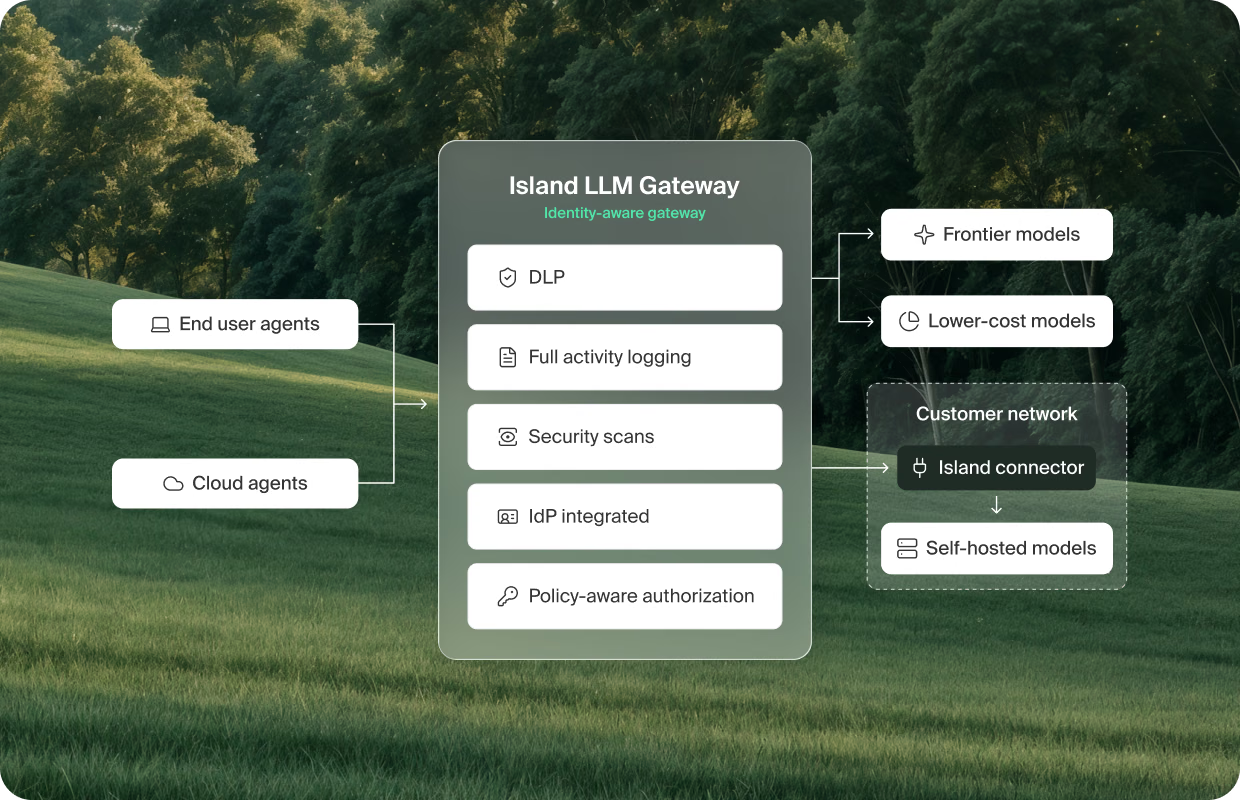
The Island LLM Gateway sits in front of the inference providers, giving you control over model use, data protection, spend limits, and more.
One API for every model
Applications send requests in the OpenAI-compatible format, and Island routes them to the right model. Teams switch models without rewriting code, and IT gets one place to see what is running.
- Switch models without rewriting code or changing agent configurations
- Route simple requests to less expensive models
- Automatically fall back to a backup provider when a model fails or hits a rate limit
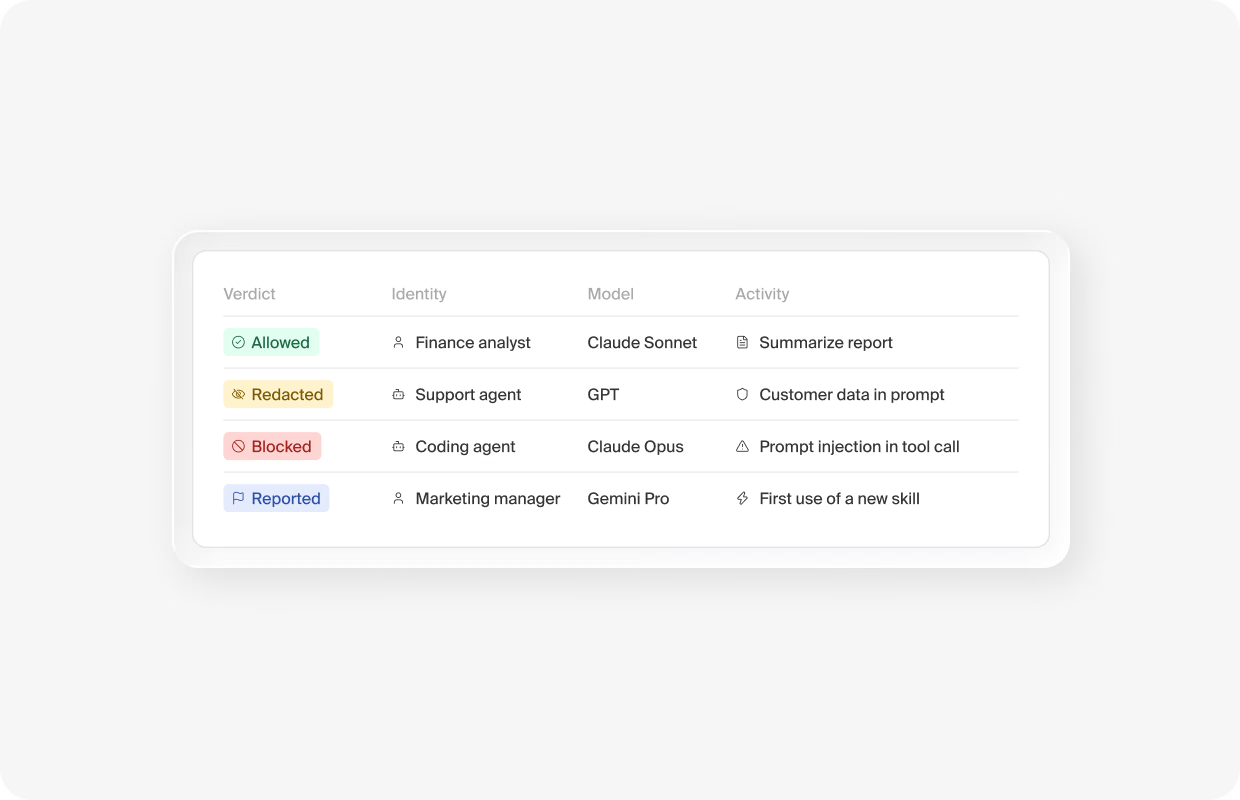
Model access tied to identity
Island LLM Gateway integrates with the organization's IdP to understand user and agent identity.
- Protect sensitive data in all AI prompts, responses, skills, and tool calls
- Detect and mitigate prompt injection and context poisoning
- Build an audit log of all AI activity across all vendors, apps, and agents
Budgets, limits, and the full cost
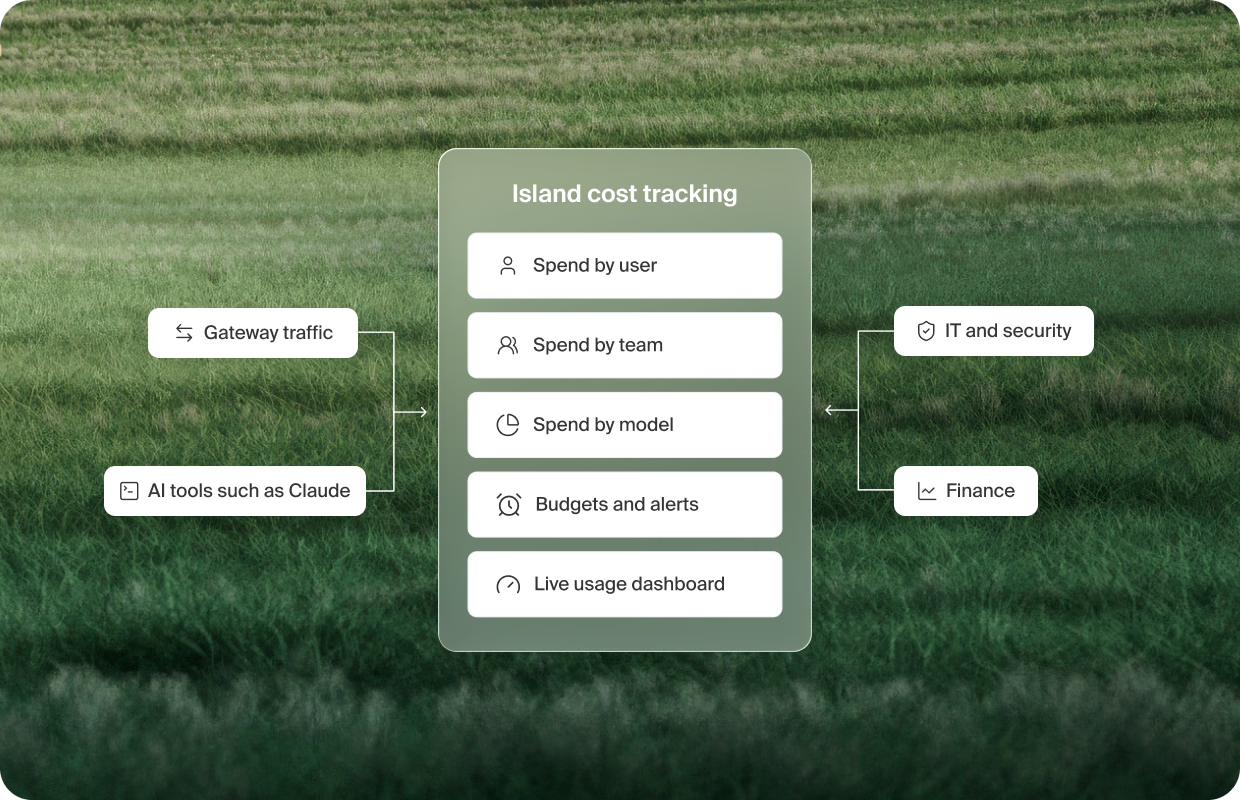
Island LLM Gateway gives IT the ability to see live usage and cost while enforcing spend limits across the organization.
- Virtual API keys give each user or team its own spending limit and token cap
- Caching trims repeat spend and response times
- OpenTelemetry ingestion includes spend from AI activity that does not cross the gateway
THE SOLUTION
Control tools and connectors
The Island MCP Gateway connects agents to SaaS and internal tools with identity-based tool policy, inline inspection, brokered credentials, and a full audit trail.
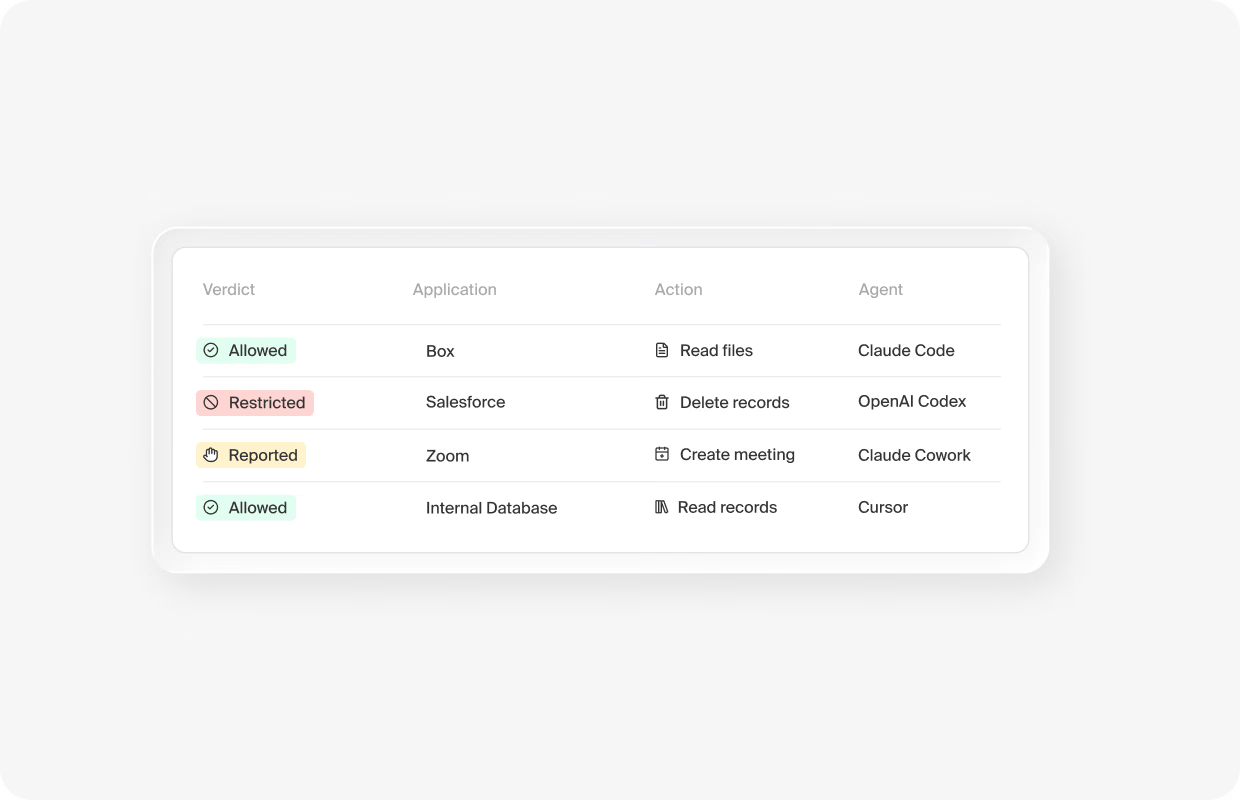
Every tool call runs the same checks
Island inspects every tool call, enforces access policies, and protects sensitive data.
- Resolves the caller's identity, then applies tool policy to decide which tools are in reach
- Identifies sensitive data and redacts information according to policy
- Reasoning-aware controls track the purpose of each tool use
Credentials stay out of the agent's reach
Island stores every credential encrypted and injects it only on the upstream call.
- Prevents agents from accessing API keys, access tokens, and credentials directly
- Uses one shared credential for the whole team, making key rotation simple
- Reduces the tool footprint and context use with a built-in tool search

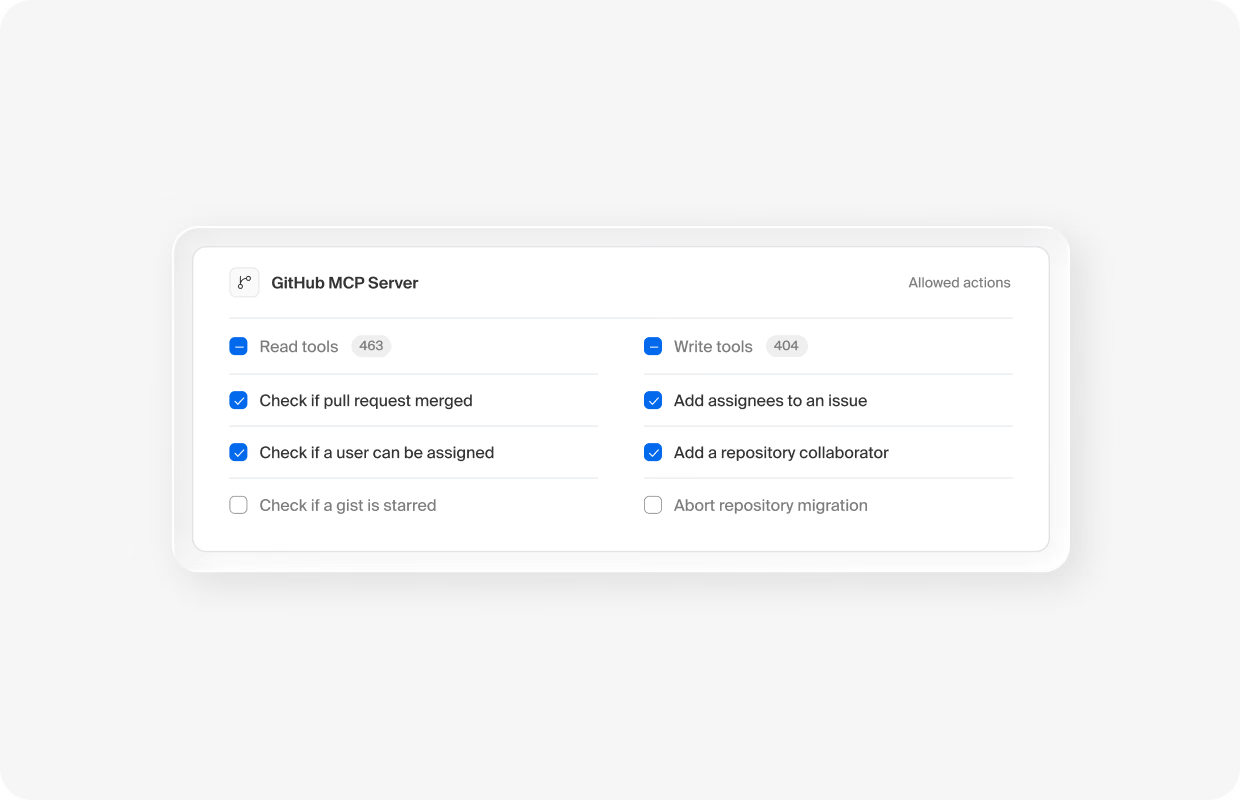
Tool access by user, group, or agent
Control what actions agents can take within each individual MCP server.
- Control tools by their action type — read, write, or destructive — or use an explicit allow list
- Use your identity provider or grant headless agents their own identity
- Build an audit log of every tool call, who is responsible for it, and what happened


Zero Trust Access
Deliver Zero Trust Access to private applications without VPNs or exposed networks.
Learn more


Secure Web Gateway
Provide precision-first web security without default backhaul or forced TLS inspection.
Learn more
Remote Browser Isolation
Apply native controls inline by default. Invoke cloud RBI only for high-risk or unknown sites.
Learn more
SaaS API
Extend visibility into SaaS apps where data lives via native APIs without rerouting traffic.
Learn more
DEX
Gain real-time visibility into employee experience across apps, network, and device health.
Learn more
FAQ
An AI gateway is a control point between the people, applications, and agents that use AI and the models and tools they reach. Island LLM Gateway governs model calls, with routing, identity-aware policy, data protection, and spending limits. Island MCP Gateway governs agent tool calls, with tool policy, inline inspection, and credential brokering. Both run under one policy and write to one audit trail.
An LLM gateway sits between applications and the large language model (LLM) providers they call. It holds the provider credentials, applies policy to each request, routes it to the right model, and records what it cost. Because it reads every prompt and holds the key for every provider, it is one of the most trusted pieces of software in the stack.
MCP is the open protocol AI clients use to discover and call tools on MCP servers. It is how Claude, Cursor, GitHub Copilot, ChatGPT, and homegrown agents reach Salesforce, Slack, Jira, Google Drive, GitHub, and internal systems. Each server an agent connects to extends what that agent can read and change in production systems.
An MCP gateway is one endpoint that AI clients connect to in place of configuring many MCP servers one by one. Behind that one URL it aggregates the integrations the organization approves, decides which tools each caller can reach, inspects what goes into each tool call and what comes back, and records what happened. Island MCP Gateway adds identity from the organization's identity provider (IdP), credential brokering through Island Vault, and the same AI Runtime and DLP policy used across Island.
An LLM gateway governs prompts and model traffic. An MCP gateway governs tool calls, meaning which tools an agent can reach, what goes into each call, and what comes back. Island offers both under one policy, so the same data protection rules apply to a prompt and to a tool call.
Island LLM Gateway puts one control point in front of every model call. Applications send OpenAI-compatible requests, and the gateway routes each one by policy, applies identity-aware access and Island DLP, adds the provider credential only when the request leaves, and enforces spending limits per user or team. Every request and every dollar traces back to a named person.
A cloud-hosted MCP gateway that gives every AI agent one governed endpoint. It does two jobs at once. For enablement, teams get a curated, one-click way to connect their agents to the tools they already use. For governance, security decides who can call what, inspects traffic in both directions, and keeps a full audit trail, all in the same console as the rest of Island.
Yes. Island LLM Gateway governs the model calls and Island MCP Gateway governs the tool calls the same agents make. Together they control how agents access tools, including access by risk, stopping agents from taking unwanted actions, and preventing data leakage through tools, under one policy and one audit trail.
Island routes each request by what the work needs, for both cost and productivity. Routine work goes to a lower-cost model and harder tasks go to a stronger one. When a primary model fails or hits a rate limit, the gateway reroutes to a backup and spreads traffic across instances and regions, and applications keep sending the same OpenAI-compatible requests throughout.
Virtual API keys give each user or team its own spending limit and token cap, and caching trims repeat spend. Most gateways count only the traffic that passes through them. Island also ingests OpenTelemetry (OTEL) data directly from tools like Claude, so the cost picture includes spend that never touches the gateway.
An LLM gateway reads every prompt and holds the credentials for every model provider. Before choosing one, ask who maintains every package inside it, how fast fixes ship, and who answers when something goes wrong. Island LLM Gateway comes from the vendor that already secures the enterprise browser, network, data, and identity, and a team at Island is accountable for it.
The common risks are long-lived tokens stored in config files the agent can read, new MCP servers added faster than security can review them, no central rule on which tools an agent may call, no inspection of tool arguments or responses, and no attributed record of what an agent did on whose behalf. Island MCP Gateway answers each one. Credentials move into Island Vault, a Tools Policy decides what each caller can reach, AI Runtime inspects every call in both directions, and every interaction becomes an attributed audit event.
A standalone MCP gateway adds one more policy to maintain. Island MCP Gateway runs on the same control plane as the rest of Island, so the AI Runtime and DLP policy that inspects an agent's tool call is the same policy that governs the browser, the endpoint, and the network, managed from the same console. Island also blocks other MCP hosts through Island network enforcement, which keeps agents on the gateway, and reaches internal MCP servers through Island Private Access without a gateway to host.
An API gateway that adds MCP support treats a tool call as one more API route. Island MCP Gateway starts from the agent. It resolves each caller through the organization's IdP or an agent identity of its own, lists only the tools that caller's policy allows, inspects the call and the response with AI Runtime, including the agent's stated reasoning, and injects the credential only at egress. It runs as a hosted service, so there is no gateway for a platform team to operate.
Yes. Island MCP Gateway is non-intrusive. It can run alongside the existing gateway as a separate resource provider, or layer with it.
No. The gateway is a standalone cloud service. Point the AI client at one URL and sign in once, or push the URL to clients centrally from the Management Console.
Island LLM Gateway integrates with the organization's IdP to understand user and agent identity, and policy decides which models each one can see and call. For Island MCP Gateway, users sign in with OAuth through the organization's IdP, and Security Assertion Markup Language (SAML) and enterprise users are routed to their own IdP. Headless agents use an Island agentic API key and get an identity of their own, so a Tools Policy can target one agent as precisely as it targets a user or a group. Every request resolves to an identity before policy runs.
No. Island LLM Gateway keeps provider credentials inside the gateway and adds them only when a request leaves for the model. Island MCP Gateway stores tool credentials encrypted in Island Vault and injects them only on the upstream call, so the agent works with the results of each call and never holds the credential.
Yes. For model calls, Island LLM Gateway applies Island DLP, with pre-built and custom detectors, including AI classifiers, that identify source code, financial records, personal data, and medical information in prompts and model responses. For tool calls, AI Runtime, Island's inline inspection stack, inspects each call before it reaches the tool and each response before it reaches the model, and can allow, redact, or block either one.
The gateway requires the AI client to state its reasoning for every tool call. AI Runtime inspects that reasoning along with the call, and admins can see it in the audit trail. The gateway strips the reasoning fields before the call reaches the tool provider, so the provider receives only the call itself.
Yes. Internal servers marked for private access connect through Island Private Access tunnels and connector groups. The connectors are outbound-only, so the servers need no inbound exposure.
Lock AI clients to the gateway with their managed settings or mobile device management (MDM), and block other MCP hosts with Island network enforcement. Agentic Endpoint Posture discovers shadow AI and unsanctioned MCP servers across the organization, so teams can sanction them and bring them under the gateway.
The gateway processes tool arguments and responses in transit and never writes them to its own database. The auditing profile decides what gets recorded, and payload artifacts go to S3 or the organization's own storage connector. The gateway routes each user to their home region and strips the agent's reasoning fields before the call reaches the tool provider.