.svg)
Can An Enterprise Browser Layer AI Governance On Top Of Existing Endpoint Protection?
Endpoint protection watches devices and files, not browser sessions — here's how enterprise browsers add AI governance without replacing existing endpoint security tools.

Key takeaways
- Endpoint detection and response was designed to catch executables and file-based threats. It wasn't built to inspect what happens inside a browser session, so a fully compliant, encrypted device can still leak data through an AI prompt.
- Point-fixes, such as CASB rules, DLP tuning, and updated usage policy, layered on top of an endpoint stack repeat the pattern that produced "shadow IT" and now produce "shadow AI," because none of them can see inside the interaction itself.
- Governance that runs at the browser layer can see and act on prompts, pastes, uploads, and MCP connections without replacing the endpoint agent or blocking AI outright.
- The practical model is complementary, not competitive: endpoint protection keeps watching device posture and processes, while Island governs the session, the prompt, and the data boundary, feeding the same SIEM either way.
- Before adding a governance layer, security teams should check coverage across all nine AI entry points mapped in Island's AI Playbook for Security Teams, rather than assume an existing tool already sees AI activity.
Introduction
Security teams that have spent years hardening "endpoint detection and response" (EDR) are now being asked a different question: can that investment also cover generative AI? The honest answer is no, not by itself. EDR was built to watch files, processes, and executables. It wasn't built to watch the browser sessions where most AI work now happens.
That doesn't mean starting over. It means understanding precisely where endpoint protection's visibility ends and where a governance layer needs to pick up. This article works through that division of labor: what each layer sees, what it structurally can't, and what to check before adding coverage on top of a stack that already works.
What endpoint protection was built to see, and what it misses
EDR was designed for executables and signatures
Endpoint detection and response tools compare running processes and files against known-bad signatures and behavioral baselines. That model works well for malware, ransomware, and unauthorized binaries. It was never designed to evaluate the content of a browser tab.
AI activity looks like scripts, configs, and prompts, not binaries
Generative AI doesn't announce itself as an executable. A prompt, a pasted block of source code, an uploaded spreadsheet, or a browser extension calling an API all look, to an EDR agent, like ordinary browser traffic. The components that make up an AI ecosystem (skills, hooks, MCP configuration files) are scripts and configs rather than compiled binaries, so signature-based tools look past them entirely.
Same-credential problem: telling a person's action from an agent's
"Model Context Protocol" servers typically run under the user's own credentials, which means an action taken by an autonomous agent can be indistinguishable, at the process level, from one taken by the person at the keyboard. An endpoint agent watching for anomalous processes has no reliable way to separate the two.
Why bolting AI governance onto the existing stack falls short
Nine entry points, one lane of coverage
Enterprise AI usage now spans nine entry points, from browser-based chat tools and agentic AI browsers to desktop apps, browser extensions, and MCP or API connections. Most monitoring efforts cover one of those lanes, usually browser-based chat, while the rest go unwatched. Island's AI Playbook for Security Teams maps all nine.
CASB, network DLP, and usage policy each have a specific blind spot
A cloud access security broker can confirm an employee visited an AI site, but it can't see the content of a prompt or distinguish a corporate account from a personal one. Network data loss prevention can scan for structured patterns like credit card numbers, but it has no way to judge the sensitivity of unstructured text or source code pasted into a chat window. Usage policy defines expected behavior on paper; it provides no visibility into what happens, and no enforcement when it doesn't. Compliance Week's 2026 AI Compliance Survey found 83% of organizations already use AI tools. Only 25% have implemented strong governance frameworks around that use, a gap that policy documents alone won't close.
Shadow AI as an architecture problem, not a training problem
When governance sits outside the environment where AI runs, it creates friction that employees route around. The same dynamic that produced "shadow IT" a decade ago now produces shadow AI is an architecture problem. IBM's 2025 Cost of a Data Breach Report defines shadow AI as AI use without employer approval. Gartner has found 98% of organizations already have employees using unsanctioned AI tools, with 47% accessing AI through personal or unmanaged accounts. That's not a training problem; it's a structural one.
What changes when governance moves to the browser layer
Visibility at the point of interaction: prompts, pastes, uploads
Gartner research puts the average knowledge worker at more than 85% of the workday inside a browser, confirming that the browser is the workspace perimeter whether or not security teams have treated it that way. A governance layer that operates there sees the prompt being typed, the file being uploaded, and the paste event itself, rather than inferring intent from network metadata.
Content-aware data boundaries instead of pattern matching
Rather than matching known patterns, content-aware controls evaluate what's being submitted and enforce a boundary in real time, allowing a sanctioned AI tool while blocking a specific category of data from leaving through it, without shutting the tool down entirely.
Extending sight to desktop apps and MCP connections
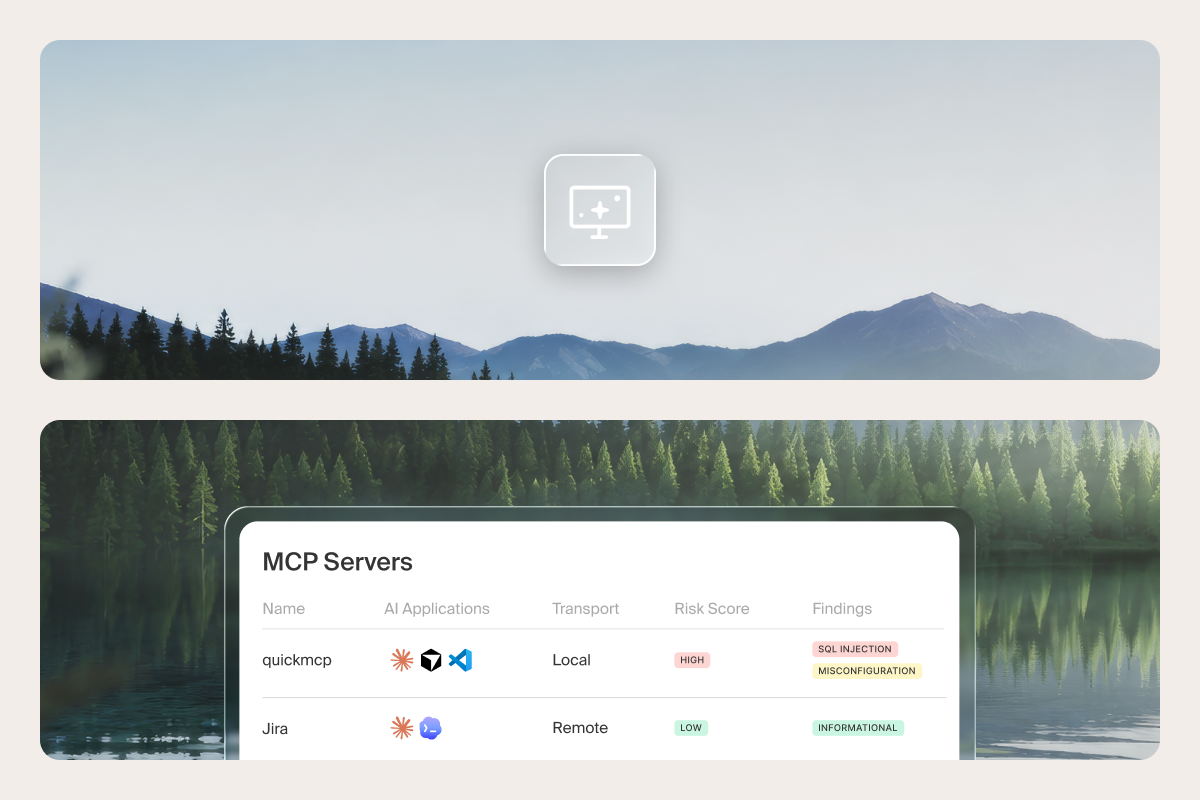
Browser-layer governance can also extend into desktop applications and MCP connections, producing a live inventory of every AI asset on every device, including local activity that no network-based tool would otherwise see.
How an enterprise browser and endpoint protection divide the work
Endpoint protection keeps watching device posture and executables
Nothing about adding a governance layer requires retiring EDR. It continues to do what it does well: device compliance, patch state, and executable-level threat detection.
Island governs the session, the prompt, and the data boundary
Island operates as a control plane for enterprise AI, following a see, understand, enforce model applied across browser, desktop, SaaS API, endpoint, and network surfaces. The Island Enterprise Browser sits at the point where the interaction happens, the layer traditional endpoint tools were never built to inspect.
Shared telemetry back to SIEM and existing security tooling
Because Agentic Endpoint Posture can deploy through an existing EDR agent or MDM for organizations that haven't yet moved to Island Desktop, the addition doesn't require ripping out what's already deployed. It extends the same telemetry pipeline security teams already monitor.
What to check before layering a governance layer on an existing stack
Coverage across all nine AI entry points, not only browser-based chat
Ask whether a proposed tool covers the nine AI entry points mapped in the AI Playbook for Security Teams, or only the most visible one. Cisco has found 48% of security professionals rank agentic AI as a top threat, yet only 29% feel prepared to secure agentic AI, a gap that narrow coverage won't close.
Enforcement, not only visibility, at the moment of the prompt
Visibility without enforcement just produces a longer incident report. The test is whether the tool can act (block, redact, or allow with a boundary) at the moment the prompt is submitted, closing the enforcement gap in AI governance rather than documenting it after the fact.
Fit with existing EDR/SIEM workflows rather than a rip-and-replace
A governance layer that requires a parallel security stack adds cost without necessarily closing the gap. The more durable model keeps the AI interaction layer distinct from device-level monitoring while feeding both into the same reporting and response workflows.
Governance as enablement, not restriction
Blocking AI outright doesn't remove the underlying risk. It relocates usage into shadow AI, where visibility drops to zero. Gartner's own numbers illustrate the scale: 57% of employees use personal generative AI accounts for work tasks, and a third admitted uploading sensitive information to unapproved tools. The alternative is governed enablement, not restriction: sanctioning the tools employees already reach for, then applying enforcement where it matters, at the point where the prompt is typed.
Conclusion
Endpoint detection and response remains essential, but it was never architected to see inside a browser session, which is where most generative AI activity now happens. Point-fixes layered on top of that stack repeat the same pattern that produced shadow IT and now produces shadow AI, because none of them can inspect the prompt itself.
Governance at the browser layer closes that gap without replacing what already works. EDR keeps watching devices and processes; Island governs the session, the prompt, and the data boundary, feeding the same SIEM and giving security teams enforcement where visibility used to stop.
If your EDR and DLP stack still can't tell you what's inside a prompt, a short walkthrough will show the difference more clearly than a policy review can. Schedule a demo to see how Island governs the browser session alongside your existing endpoint protection, without replacing it.
FAQs
Does adding Island mean replacing our existing EDR deployment?
No. Island is designed to run alongside endpoint detection and response, not in place of it. EDR continues to monitor device posture, patch state, and executable-level threats; Island governs the browser session, the prompt, and the data boundary, a layer EDR was never built to inspect. Agentic Endpoint Posture can even deploy through an existing EDR agent or MDM for organizations that haven't moved to Island Desktop yet, so the rollout extends the current stack rather than replacing it.
How is this different from tightening our CASB or DLP rules instead?
CASB and network DLP each have a fixed blind spot: CASB can confirm a user visited an AI site but not what they typed into it, and pattern-based DLP can catch a credit card number but not a sensitive paragraph of unstructured text or source code. Because Island evaluates content at the point of interaction (the see, understand, enforce model), it closes the gap those tools structurally can't reach, rather than tuning rules that were never designed to see inside a prompt.
What exactly counts as an AI entry point we need to cover?
Island maps nine entry points where AI and agents enter the enterprise, from browser-based AI chat tools and agentic AI browsers to desktop apps, extensions, and MCP or API connections. Most existing monitoring covers one lane, usually browser chat, and leaves the rest unwatched. Any governance evaluation should confirm coverage across all nine — see the AI Playbook for Security Teams — before assuming a gap is already closed.
Can Island distinguish a person's action from an AI agent's when both use the same login credentials?
This is one of the specific limits of endpoint-level monitoring: MCP servers typically run under the user's own credentials, so an agent's action and a person's action look identical to a process-watching tool. Because governance at the browser layer sees the interaction itself (the prompt, the connection request, the data being passed) rather than inferring intent from process behavior, it can apply enforcement at that layer even when credentials are shared.
Does governing AI activity mean blocking employees from using AI tools?
No. Blocking outright tends to backfire by pushing usage into personal accounts where visibility drops to zero. The intended model is governed enablement, not restriction: sanctioning the AI tools employees already use, then applying content-aware boundaries so a specific category of sensitive data can't leave through them, without shutting the tool down entirely.
What is shadow AI, and does strong endpoint protection already prevent it?
Shadow AI is AI use without employer approval or visibility. IBM's 2025 Cost of a Data Breach Report uses that definition, and Gartner has found 98% of organizations already have employees using unsanctioned AI tools. Endpoint protection doesn't prevent it, because shadow AI is an architecture problem, not a visibility gap that a device-level agent was ever positioned to close: friction outside the environment where AI runs pushes usage around whatever tool is watching.
Will this create a second reporting pipeline our SOC has to monitor separately?
No. The intended architecture feeds browser-layer telemetry into the same SIEM and response workflows the SOC already uses for endpoint data. The two layers stay operationally distinct (one watching device posture, the other watching the session and the prompt), but they report into shared tooling rather than requiring a parallel stack.
Does this approach require managed, corporate-owned devices, or does it also cover BYOD?
It's not limited to managed devices. Because the governance layer operates at the browser session rather than relying on device-level agents, it extends to unmanaged and BYOD contexts where traditional endpoint tools have limited or no reach, closing a gap that shows up specifically on devices outside the standard endpoint stack.

Island is defining the future of work for people and AI agents. Its enterprise agentic control plane helps organizations enable, govern, and audit agentic workforces alongside people. Island boosts productivity across devices, browsers, applications, networks, and data while protecting sensitive information, simplifying access, and helping enterprises scale AI safely.
.png)

.png)
.svg)
.svg)

