.svg)

Key takeaways
- Prompt injection is the #1 vulnerability on the OWASP Top 10 for LLM Applications, and model-level defenses alone can't close the gap.
- Most AI security stacks miss the "last mile": the browser, where users interact with AI tools and where sensitive data enters the pipeline.
- Layered defenses should include the browser as an enforcement point, not just models, APIs, and network proxies.
- Enterprises that govern AI at the interaction layer can enable broader AI adoption without the tradeoffs between speed and security.
Your AI defenses are layered. The attackers still get through.
You've invested in input classifiers, hardened system prompts, and network-level DLP. You've done the work security frameworks recommend. And yet prompt injection remains the #1 risk on the OWASP Top 10 for LLM Applications 2025, with the International AI Safety Report 2026 showing attackers bypass safeguards roughly half the time with just 10 attempts.
The gap isn't effort. It's architecture. Every defense in your stack activates after the user's input has already left the browser. The place where people actually type, paste, and upload content into AI tools is the one layer nobody is watching. That's where prevention needs to start.
Prompt injection bypasses defenses because it exploits trust, not code
You're used to patching vulnerabilities rooted in code flaws. Prompt injection doesn't work that way. It manipulates AI models by embedding instructions inside inputs the model treats as trusted data. Unlike SQL injection or cross-site scripting, there's no clean separation between "code" and "data" in a large language model. Both arrive in the same channel: natural language.
That shared channel is why traditional defenses struggle. Direct injection happens when a user submits malicious instructions to an AI model. Indirect injection is subtler: malicious payloads hide inside documents, emails, or web content the model retrieves and processes as though it came from a trusted source. The EchoLeak vulnerability (CVE-2025-32711, CVSS 9.3) demonstrated this pattern at scale, enabling zero-click data exfiltration from an enterprise copilot through retrieved content alone.
For enterprises deploying agentic AI, the stakes climb sharply. When an AI agent can retrieve data, execute code, and call APIs on its own, a successful injection doesn't just produce a misleading answer. It triggers unauthorized actions. An MDPI meta-analysis found attack success rates reaching 84% in agentic systems with auto-execution enabled. That's not a theoretical risk. It's an architectural one, baked into how these systems process input.
Why model-level and network-level defenses leave a gap
Your team has done the right things. Model-level defenses like system prompt hardening, input classifiers, and output filtering catch known attack patterns and reduce noise. Network-level controls such as API gateways, proxies, and DLP at the network edge inspect traffic and enforce policies on data in transit. Both layers belong in any serious AI security architecture. Neither is sufficient on its own.
The structural issue is timing. Model-level defenses process content after it arrives at the model. They're reactive by design, catching patterns they've been trained to recognize while novel injections slip past. Network-level controls see data moving between endpoints, but they can't interpret semantic intent. They know a request was made; they don't know the user pasted three pages of proprietary source code into a consumer AI chatbot.
Neither layer sees what the user typed, pasted, or uploaded before it left the browser. The five AI entry points no monitoring tool covers map exactly to this blind spot — and it's the same gap the Cisco State of AI Security 2026 report surfaces: 83% of organizations plan to deploy agentic AI, but only 29% feel ready to secure it. Teams know defenses are incomplete. They're just not sure where the missing piece sits.
Gartner projects that by 2029, over 50% of successful attacks against AI agents will exploit access control issues through prompt injection. The prediction isn't about model weakness; it's about the unmonitored space between the user and the model where no control currently operates.
The browser is the enforcement layer your AI security stack is missing
Browser-layer enforcement means applying security policies at the exact point where users interact with AI tools: the browser window where they type prompts, paste data, and upload files. It's the last mile between a person and an AI model, and it's the first moment in the data flow where content can be inspected with full context.
This matters because the browser sees what no other layer can. It sees the text before it reaches any model. It sees the file before it enters any API. It knows who the user is, which application they're in, and what data classification policies apply. Network tools see the connection. Model tools see the tokens. The browser sees the intent.
Consider what that visibility changes. Cyberhaven research found 11% of data employees paste into ChatGPT is confidential. That data passes through the browser before it reaches any AI provider. Browser-layer DLP can redact or block sensitive content at the source, preventing exfiltration before it happens rather than detecting it after the fact.
The architectural advantage becomes clearer when you compare enforcement approaches. An enterprise AI browser with built-in security operates at the source with full session context, applying per-user, per-application, and per-data-type policies. Browser extensions offer partial visibility, constrained by the permissions consumer browser vendors choose to expose. Network proxies and API gateways inspect connections but lack application-level context; they can throttle traffic to an AI endpoint, but they can't distinguish a benign question from a prompt injection carrying proprietary data.
Shadow AI is fundamentally an architecture problem. The IBM Cost of a Data Breach 2025 report puts the average breach cost at $4.88 million, with shadow AI incidents adding $670,000 to that baseline. Users open unsanctioned AI tools in their browser. The browser is the chokepoint where unauthorized usage can be governed before data ever leaves the organization.
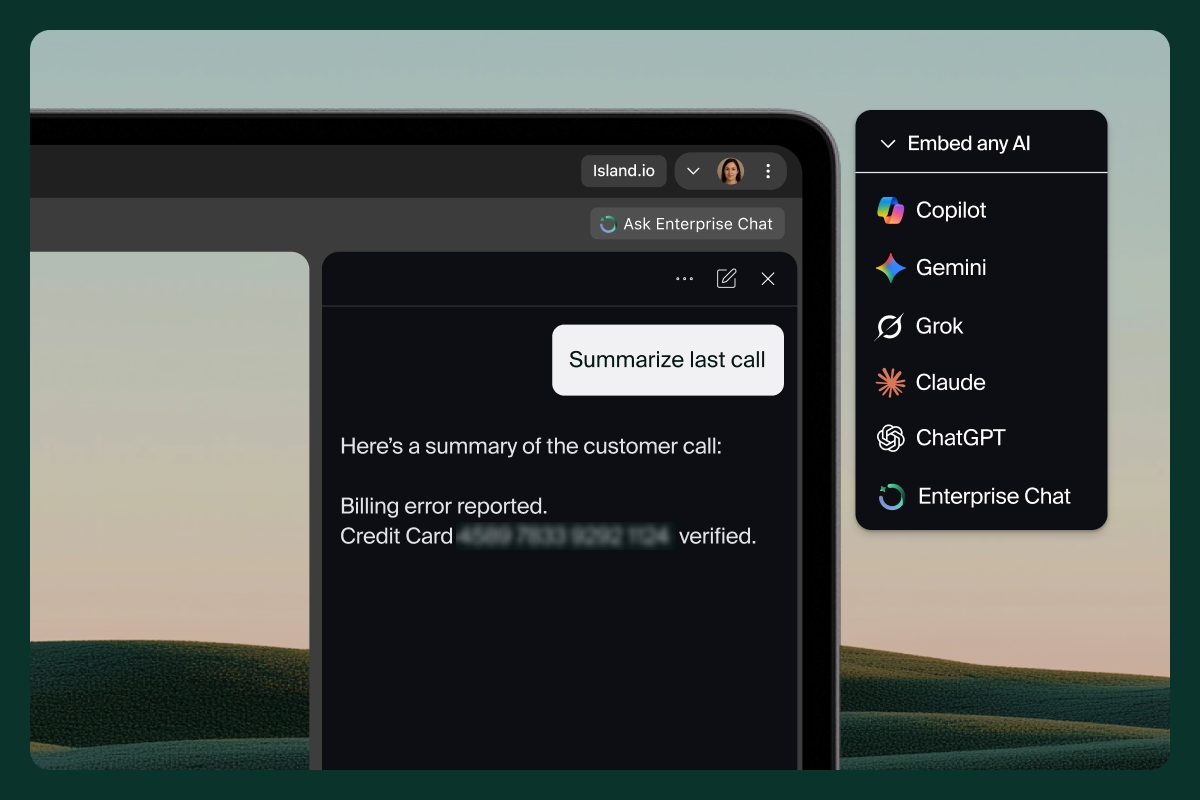
Island's Enterprise AI Browser sits at this last mile. Island Enterprise AI, specifically AI Protect, applies data redaction before content reaches AI providers and defends against prompt injection at the interaction layer. Every AI session is visible, governed, and auditable. The architecture doesn't bolt security onto AI after the fact. It builds enforcement into the place where AI interactions actually begin.
Five controls that work when layered from the browser out
You want a practical framework, not another threat briefing. These five controls work best when layered starting from the browser and extending outward to the model and network. The order is deliberate: govern data at the source first, then reinforce with deeper layers.
- Data redaction at the interaction layer. Strip or mask sensitive data before it reaches any AI model. This means PII, credentials, source code, and internal identifiers caught and redacted at the browser, not intercepted in transit. When redaction happens at the source, sensitive content never enters the AI pipeline at all.
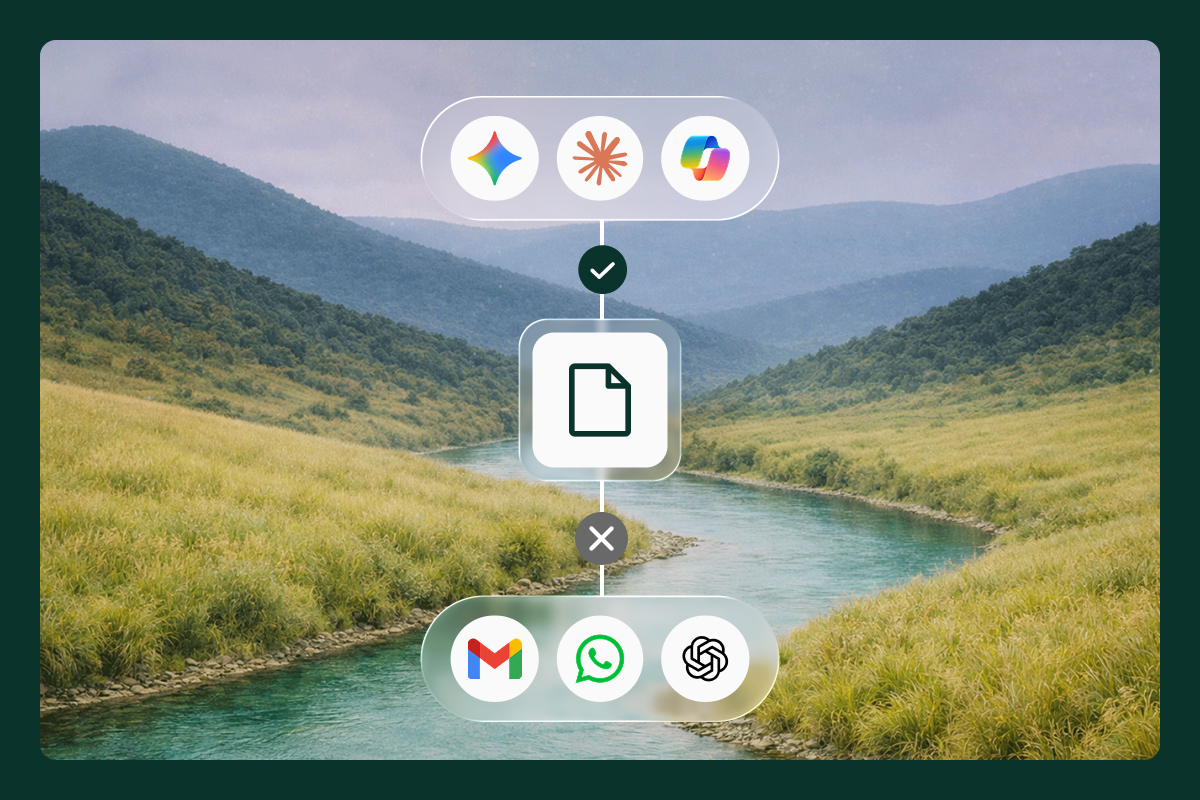
- AI tool access governance. Control which AI tools users can access, with what data categories, and under what policy conditions. The browser is the natural enforcement point for per-user, per-application policies. Sanctioned tools get governed access. Unsanctioned tools get blocked or redirected. The policy follows the user, not the network perimeter.
- Input classification and prompt analysis. Apply classifiers at the browser to detect known injection patterns, anomalous instructions, or data categories that shouldn't enter AI tools. This complements model-side input validation by catching threats before they reach the model, adding a defense layer that operates independently of the AI provider's own safeguards.
- Least-privilege scoping for agentic workflows. Limit what AI agents can access and do by governing the tools and data they reach through browser-mediated sessions. Enforce human approval gates for high-risk actions. When agents operate with only the permissions they need, a successful injection has far less room to cause damage.
- Continuous monitoring and audit. Log every AI interaction at the browser layer to build a complete audit trail of what data entered which AI tools, by whom, and when. This record is critical for compliance, incident response, and understanding how AI tools are actually used across the organization.
No single control eliminates prompt injection risk. The point of layering from the browser outward is that the earliest control catches the most. Each subsequent layer narrows what's left.
What agentic AI changes about the prompt injection threat model
You're likely deploying or evaluating AI agents that can execute multi-step workflows on their own. That shift from "answer a question" to "take an action" changes the prompt injection threat model in ways most security stacks aren't built to handle.
When an AI agent has tool access, a successful injection doesn't just produce a bad response. It can trigger data retrieval, code execution, or API calls the user never authorized. Gartner named agentic AI oversight the #1 cybersecurity trend for 2026, and the reasoning is straightforward: autonomy amplifies every vulnerability. Understanding the blast radius in AI security becomes critical when any agent action can cascade through connected systems.
Three areas illustrate how agentic AI expands the attack surface:
- Data exfiltration through tool chains. An injected prompt can instruct an agent to retrieve sensitive data and send it through legitimate tool integrations. The action looks normal to network monitoring because it uses authorized channels.
- Privilege escalation across sessions. Agents that maintain context across interactions can be manipulated to accumulate permissions incrementally, gaining access to resources they were never explicitly granted.
- Indirect injection via retrieved content. Agents that pull data from documents, emails, or web pages can ingest hidden instructions embedded in that content. This is the EchoLeak pattern applied to autonomous workflows, where the agent has no way to distinguish a legitimate instruction from a malicious one buried in a retrieved document.
The browser is the last reliable human-interaction checkpoint before an agent begins autonomous execution. Governing that moment, controlling what data and instructions enter the agent's context, is the most effective way to limit what a compromised agent can do. The NIST National Vulnerability Database shows a greater than 2,000% increase in AI-specific CVEs since 2022. The vulnerability surface is growing faster than defenses. Waiting to address agentic risks after deployment is a strategy that hasn't worked for any prior generation of enterprise software.
How to evaluate whether your AI security stack covers the last mile
You're evaluating a category that barely existed 18 months ago, and vendor claims are outpacing the frameworks designed to assess them. A few pointed questions can reveal whether your current stack has the last-mile coverage this threat requires.
Ask your team:
- Can you see what data users paste, type, or upload into AI tools before it reaches a model?
- Can you enforce per-user, per-application policies on AI tool access?
- Do you have DLP that operates on data going into AI tools, not just data coming out?
- Can you detect and block prompt injection attempts at the point of user interaction?
- Do you maintain an audit trail of every AI interaction, including the content submitted?
- For agentic workflows: can you enforce human approval gates before high-risk autonomous actions?
If most answers are "no," the AI security stack has a last-mile gap. That's not an indictment of what's been built. Model-level and network-level controls are doing real work. The gap is architectural, and it sits in the one place those tools were never designed to reach.
Three approaches exist for closing it, each with different trade-offs:
- An enterprise browser with built-in security operates at the source with full session context. Policies apply before data leaves the user's environment, and every AI interaction is visible and auditable.
- Browser extensions add a layer of visibility and control to consumer browsers, but their reach is limited by the APIs the browser vendor exposes. Extensions can be disabled by users, and their access to session content is partial.
- Network and proxy-based approaches inspect traffic between users and AI endpoints. They can enforce coarse access controls but lack application context. They see the connection, not the conversation.
The right architecture depends on your risk profile and deployment scale. What matters is asking the question most teams haven't asked yet: does your AI security stack cover the place where AI interactions actually begin?
FAQs
What is prompt injection and why is it hard to prevent?
Prompt injection manipulates AI models by embedding malicious instructions in natural-language inputs, and it's hard to prevent because the model can't reliably distinguish instructions from data. Layered defenses across the browser, model, and network are more effective than any single control.
How does an enterprise browser help prevent prompt injection?
An enterprise browser sees what users type, paste, and upload before any content reaches an AI model, allowing it to apply data redaction, input classification, and access policies at the point of interaction.
What's the difference between direct and indirect prompt injection?
Direct injection happens when a user submits malicious instructions to an AI model. Indirect injection hides malicious payloads in external content like documents, emails, or web pages that the model retrieves and processes as trusted input.
Why is agentic AI more vulnerable to prompt injection than a standard chatbot?
Agentic AI systems can take autonomous actions such as retrieving data, calling APIs, and executing code, so a successful injection can trigger unauthorized actions rather than just misleading responses.
What controls should enterprises prioritize for AI security in 2026?
Start with visibility into what data enters AI tools through browser-layer governance, then layer input validation at the model, enforce least-privilege access for AI agents, require human approval for high-risk actions, and maintain a complete audit trail.
See how browser-layer AI governance works in practice
If you're evaluating how to close the last-mile gap in your AI security stack, we'd welcome the conversation. Schedule a brief session with our team to see how browser-layer enforcement works in practice.

Island is defining the future of work for people and AI agents. Its enterprise agentic control plane helps organizations enable, govern, and audit agentic workforces alongside people. Island boosts productivity across devices, browsers, applications, networks, and data while protecting sensitive information, simplifying access, and helping enterprises scale AI safely.


.svg)
.svg)

