.svg)

Key takeaways
- Security tool consolidation reduces the vendor count, but it only reduces complexity when it also reduces the number of functions the stack has to perform.
- Chasing a lower tool count often produces a "franken-suite": fewer logos, yet the same or greater operational complexity stitched together under a single vendor.
- The most durable consolidation moves controls to the layer where work happens, so capabilities collapse into the environment instead of being re-bought as another platform.
- Best-of-breed versus platform is the wrong debate. The real question is where enforcement lives, because that determines how much complexity the architecture carries.
The consolidation math that doesn't add up
You cut vendors last year. You renewed fewer contracts, retired a couple of overlapping tools, and told the board the stack was getting simpler. Then you looked at the dashboards, the integrations, and the alert volume, and almost nothing moved. The work of running security felt exactly as heavy as before.
Most consolidation programs get measured by logos removed, not by complexity removed. Those are different things. When a program tracks how many contracts closed, it rewards subtraction on the invoice while the operational load stays right where it was. The team still tunes the same detections, still reconciles the same overlapping data, still chases the same alert fatigue across a slightly shorter list of consoles.
This isn't a failure of discipline. It's a measurement problem the whole industry shares. Appetite for the move is real: Gartner found 75% of organizations were pursuing security vendor consolidation in 2022, up from 29% in 2020, and 65% expected it to improve their risk posture. The intent is sound. The scorecard is where things quietly go wrong, because fewer tools is not the same as less work for the people who operate them.
Vendor count is the wrong metric to chase
Here's the uncomfortable part: your scorecard may be rewarding the wrong thing. Complexity doesn't track the number of tools you own. It tracks the number of functions the stack performs and the number of places you have to enforce them. Replace five tools with one platform that's harder to operate, and you haven't reduced complexity. You've concentrated it.
That's how a suite assembled by acquisition becomes a franken-suite: one vendor on the invoice, but as many consoles, data models, and policy engines underneath as the sprawl it replaced. Reducing the invoice isn't the same as reducing the work. When you look closely, consolidation tends to re-add complexity in three predictable ways:
- Migration overhead. Ripping out incumbents and re-platforming their policies is a project that can consume more staff time than the sprawl ever did, and it recurs with every acquisition the vendor bolts on.
- Backfilled feature gaps. The suite rarely covers every capability the old tools did, so teams add point products around the edges, and the tool count starts climbing again.
- One console, many engines. A single pane of glass still fronts several distinct engines underneath, each with its own tuning, telemetry, and failure modes. The dashboard consolidated. The plumbing did not.
None of this means consolidation is a bad idea. It means logo count is a vanity metric, and optimizing for it produces a stack that's cheaper to license and no easier to run.
Consolidation works when you reduce functions, not just logos
So what should you optimize for instead? Fewer things to operate, not fewer names to pay. The goal is to consolidate around the outcome you actually need (secure access, data protection, visibility) rather than around the product category you happen to be buying. Categories multiply. Outcomes don't.
The mechanism that separates real simplification from cosmetic consolidation is this: when a single control point can satisfy several requirements at once, the function disappears rather than moving. That's the difference between relocating complexity and removing it. A merged suite still performs the same list of functions in the same number of places, just under a shorter list of names. A stack that has genuinely simplified performs fewer functions, because the architecture no longer requires them as separate steps. Count functions and enforcement points, not vendors, and you'll know within a quarter whether a consolidation move actually made the team's job lighter.
Picture the everyday version. A contractor needs access to two internal apps. The real complexity isn't the vendor logo on each tool in the path. It's the number of systems standing between that person and their work: an access broker, an inspection layer, a data-loss agent, a device check, each configured and maintained on its own. Cut the count of vendors and those systems still sit in the path. Collapse several of those functions into one enforcement point and the path itself gets shorter. That's consolidation you can feel on a Monday morning, not just on a renewal statement.
Data protection tells the same story from a different angle. Think about a rule as ordinary as "don't let regulated records leave approved apps." When that control lives away from where the data is actually used, you end up maintaining a separate inspection step to catch violations, a separate logging pipeline to record them, and a separate policy console to keep the rule current. That's three things to tune, three places to break, one rule. Move the control to where the data is used and those three chores stop being separate work. The team no longer reconciles logs across systems or edits the same policy in more than one place. The rule didn't relocate to a shorter list of tools. The upkeep around it disappeared.
Why bolting a platform onto the old architecture just moves complexity
If you've inherited a stack built for a different era, none of this is your fault, and it wasn't a mistake when the choices were made. VPNs, VDI, network proxies, and point DLP solved the real problems of their time. Work flowed through the corporate network, so policy lived in the network. Putting controls in transit or in the data center was exactly the right call when that's where the traffic was.
The environment moved. Today most work happens in the browser and in SaaS, where a session never touches the old choke points in a way those controls can fully interpret. Enforcement that sits in transit can see connections, but it can't always see inside the session where the actual work, and the actual risk, now lives. So teams add more tools to recover the visibility they lost, and the sprawl quietly rebuilds itself. Bolt a consolidation platform on top of that same network-centric foundation and you've changed the label, not the location of enforcement.
It helps to think in terms of where a control can actually observe the work. Controls native to the layer where work happens can see and act inside the session. Controls added onto that layer (for example, an extension that brings security to an existing browser) are a valid complement that extends reach into places a native approach hasn't yet gone. Controls that sit outside the session entirely, in the network path, were never designed to look inside a modern browser tab, because that wasn't where policy needed to live when they were built. This is an argument about approach and placement, not about any one product. The closer enforcement sits to the work, the fewer functions the rest of the stack has to reconstruct.
Consolidate at the layer where work actually happens
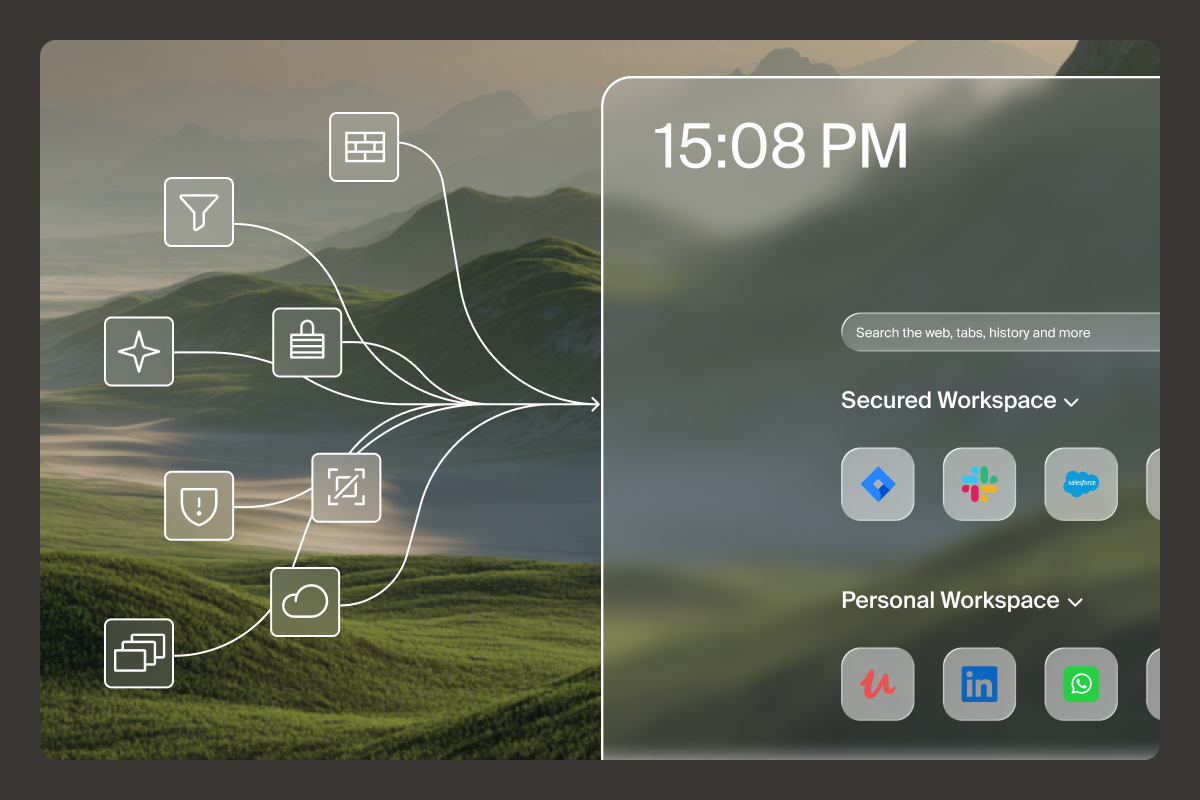
Here's the shift worth sitting with: if complexity is a function of where enforcement lives, then the most effective place to consolidate is the layer where work already occurs. When security, access, and data controls are embedded in the environment where people actually do their jobs, several point tools stop being necessary, because their function is now native to the place work happens rather than added around it.
Island is one example of this principle in practice. By embedding controls into the environment itself, a set of capabilities that used to live in separate products collapse into one place:
- Secure access to internal apps without a separate VPN client sitting in the path.
- Last-mile data protection applied where data is used, without a standalone agent to deploy and maintain.
- Conditional access tied to identity, device, and application, evaluated at the point of use rather than reconstructed downstream.
- AI governance and visibility at the exact point where employees use AI, instead of a fresh category of tools bolted on to watch it.
That last one matters more every quarter. AI tool sprawl is becoming its own consolidation problem, and the entry points multiply faster than most stacks can add controls. Governing AI where it's actually used consolidates a class of tools most organizations are only beginning to acquire, before the sprawl sets in. The architecture that makes this work is the Island Enterprise Platform, where these controls are built in, not bolted on, so IT, security, and productivity operate as one environment instead of a collection of solutions. Independent validation exists for the economics: Forrester's Total Economic Impact study found a 344% ROI over three years for enterprises adopting the approach. The point isn't the product. It's the placement: consolidate at the last mile and functions genuinely disappear rather than relocating to a new console.
How to consolidate without trading away capability
The fear underneath every consolidation decision is a reasonable one: that simplifying means giving up the depth your best specialized tools provide. But best-of-breed versus platform is a false binary. You resolve it by consolidating where a native control removes a function outright, and keeping specialized tools where depth genuinely matters. The two aren't in tension when you sequence them well.
To do that without flying blind, evaluate candidates on criteria that go beyond a feature matrix:
- Map tools to functions, then cut overlapping functions first. Inventory what each tool does, not what it's called. The fastest wins are the functions two or three tools all perform.
- Measure deployment friction and adoption, not just capability checkboxes. A control the workforce routes around is a control you don't really have, however complete its feature list looks.
- Test against your highest-friction real workflow. Feature matrices pass in the abstract and fail in production. A live workflow tells you the truth.
Sequencing matters as much as selection. Resist the urge to collapse everything in one migration. Instead, pick a single function, prove the keep-versus-collapse decision on it, and let coverage settle before you touch the next one. Phasing the work this way gives you a clean read on whether a native control truly removed a function or just hid it, because you're watching one variable at a time rather than a dozen. It also protects the workforce: if a change degrades something, you can see it and fix it while the blast radius is small. Function-by-function is slower on paper, but it rarely leaves a gap you only discover months later, after everything moved at once.
One more piece of advice runs against the usual instinct. The best proving ground isn't your hardest use case. It's your most embarrassing one: the workflow where everyone quietly knows the current tool is overkill, but no one has built the business case to change it. If consolidation clearly wins there, you've found momentum that's easy to defend. And when you talk to vendors, ask for deployment-friction and adoption data, not another feature list. The most capable control on paper still fails if people work around it, so the honest question is how smoothly it lands, not how long the datasheet runs.
Your stack got complex one tool at a time. Simplifying can start the same way
If you want to pressure-test this model against your own environment, we're happy to compare notes and walk through what reducing functions (not just logos) looks like in practice. Schedule a walkthrough at island.io/schedule-demo.
FAQs
Does consolidating security tools actually reduce complexity?
Only if it reduces the number of functions the stack performs. Cutting vendors alone often relocates complexity rather than removing it, so the operational load stays high even as the invoice shrinks.
What's the difference between reducing tools and reducing functions?
Reducing tools lowers your vendor count. Reducing functions eliminates work by letting one native control satisfy several requirements at once, which is what makes the underlying complexity go away.
Do I have to choose between a security platform and best-of-breed tools?
No. Consolidate where a native control removes a function outright, and keep specialized tools where depth genuinely matters. The two approaches coexist when you sequence them deliberately.
Where should security tool consolidation start?
Map your tools to the functions they perform, cut overlapping functions first, and test each change against your highest-friction real workflow rather than a feature checklist.
Why does adding a single-vendor platform sometimes increase complexity?
A suite assembled by acquisition can carry as many consoles and data models as the sprawl it replaced. The logo count drops while the operational load, and the complexity, stays right where it was.

Island is defining the future of work for people and AI agents. Its enterprise agentic control plane helps organizations enable, govern, and audit agentic workforces alongside people. Island boosts productivity across devices, browsers, applications, networks, and data while protecting sensitive information, simplifying access, and helping enterprises scale AI safely.


.svg)
.svg)

